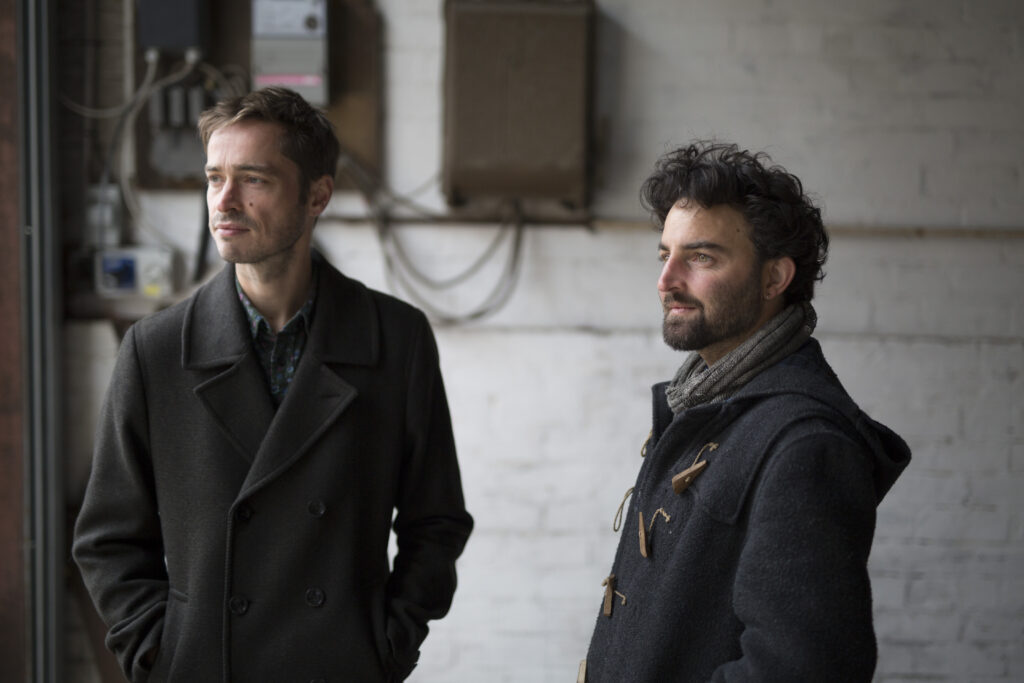
One of the many wonderful things about folk and traditional music is how expansive and inclusive it is. Songs blend with tunes blend with singers – and just as the songs reveal themselves differently in different seasons of life, so too do different combinations of musicians unlock alternative aspects of this music. Sid Goldsmith is one such musician. A multi-instrumentalist who stumbled into the folk world running sound at his local as a teenager, he now features in several different musical incarnations: with new-folk trio, Tarren, with the Tamsin Elliot Trio, with Jimmy Aldridge, with whom he’ll be headlining this year’s Traditional Music Day, and with Jimmy and Lady Maisery for the Awake Arise and Wakefire projects. This conversation took us from early days running sound in pubs, to possibly the most wonderful instrument-acquisition story you’ll ever hear!
“To be a great folk singer, you have to be a great storyteller, as Jimmy Aldridge and Sid Goldsmith are clearly aware. The duo are both fine singers and multi-instrumentalists.”
The GUARDIAN
So let’s start off with the kind of obvious connection, Sid. How has being from East Anglia informed your musical career and your journey?
I guess I discovered folk music when I was in East Anglia by the Milkmaid Folk Club turning up at my local boozer, [The Railway, in Wymondham]. A couple called Terry and Jane bought the pub and set up the folk club in the back room of the restaurant.
I’d sort of gone from grunge music, grunge and rock, and worked backwards through electric blues to acoustic blues, and I was just on the cusp of thinking, okay, maybe folk music is okay. I was playing guitar through this huge PA amplifier at the time, and because I had that, I got the job of doing sound for the folk club.
I think I was like 18, maybe 19, and I did sound for Martin Carthy, Peggy Seeger, Vin Garbutt, Tommy Emmanuel, John Renborn, James and Nancy Kerr – all these people came through, and it was just this incredible awakening exposure.
Any particular moments that stood out? That’s quite the education you had there!
Vin Garbutt arrived with this shock of crazy hair and his completely outlandish character. I’d never met anyone like him, and I remember just being in tears with both his comedy and his tenderness, and talking about all these political issues that I’d not really engaged with, but was starting to think about at the time, and everyone was sitting there singing this all out of them in this room that I’d really only ever associated with getting pissed as a teenager and listening to rock bands.
It just really went in, what this kind of music and performance can do to a group of people. It was incredible, seeing and experiencing how we can all share this thing in the room together. So I’ve sort of been chasing that ever since, really.
Is there something about folk music that makes that experience different to other genres?
I think there are a few different ways, actually.
Firstly, in the song tradition at least, it’s often actively encouraged for people to to join their voice in, and in doing that, it changes the dynamic. You’re not just part of an audience; you’re part of the performance. Then there’s the informality of the performance – performers are always very keen to interact with the audiences. There’s a back and forth with the audience of energy and conversation that you don’t really get elsewhere.
With some of the people that I saw in that folk club, there was a lot more talk in the music, and that might have been a bit over the top, but you also often left feeling like you got to know a person and their story during the night.
For me, music has always been a tool for connection. So I’m always looking for songs that I know can create a moment where there’s an exchange of energy between me and the audience, and they’re the tools rather than the end goal, I guess.
But of course the whole canon of songs is fascinating in itself for the historical content that’s in there.That’s maybe another way that it’s different is that you’ve got all of this music that is a shared heritage as well? So I think on some subconscious level, even people that aren’t already converts to folk music do kind of sense that there’s something more than just that this person’s written a song. These things have grown over time and been altered and become part of our story.
I think the first time I saw you play, you were playing a cittern, which isn’t a particularly common instrument to see or hear. What’s your journey with musical instruments been like? I’m assuming you didn’t start off there? The grunge and post-punk scene weren’t renowned for citterns, after all….
Well, when I started it was just guitar really. I’d been playing electric guitar for quite a long time, and then I got an acoustic guitar to play acoustic blues. So I was doing all the Robert Johnson 12 bar stuff. My first girlfriend played folk music, and her dad was a banjo player, and he actually used to run the Sunday sessions at the Railway. We used to have these afternoons where we’d just absolutely raise the roof off the building with our voices, have a Sunday lunch, and then get back to it and raise the roof again.
But the evolution to the cittern was much later. I met a group of people when I moved to Bristol that were playing mostly Irish traditional tunes, and I ended up picking up the double bass to play in that, and I was really enjoying backing the tunes. Having come from a song tradition, learning how to rhythmically back tunes was really fun. And then after a while of doing that, I felt like I was missing out by not playing the melodies. I got hold of the English concertina first, and that was my first tune instrument. I’ve probably been playing that for about ten years at this point.
Lockdown was when I got hold of the cittern, and that’s kind of become my main thing to a degree. At the moment I’ve been concentrating on the concertina again for a particular project, but each of these instruments enables you to straddle both worlds, so you can play the tunes, but you can also back the tunes, so you can jump between those roles and it’s always lovely to come back to.
What drew you to that instrument?
I wanted the cittern specifically because it has quite a wide range, so I can still play all of the guitar chord repertoire as well as the tunes. Supposedly, it was the most popular instrument in England in the mid 1800s. There’s the story that every barber shop would have had one on the wall, and people would have played tunes to each other while they waited for their shave or haircut. It’s fallen out of favour in that form, but it has been brought back as a larger instrument, especially in Scandinavian countries. It did have a bit of a revival here in the 70s and 80s and it’s become really popular for Scandinavian fiddle tunes.
I’m sort of on a one-man-mission to bring it back to the English tradition, but I’m also finding it a really lovely tool for writing on, and making lots of solo arrangements. It’s great for Tarren [Sid’s trio with Alex and Danny] because we all have this ability with our instruments to jump between backing or leading, which means we can kind of swap those roles between us all the time. So it really suits that band.
Why do you think it fell out of favour, and what do you think it tells us about folk and traditional music 200 years ago?
Mostly I think it just needed developing. At that time it was really popular, it was a shorter scale, and it was generally played with the fingers, so it was quite a gentle instrument for parlour and performance. Now it’s much more commonly played with the plectrum, and it’s taken instrumentalists to pick those developments up, or help luthiers develop the instrument into something that really fits into the more modern way of playing tunes.
Musicians and luthiers have this joint role of making the instruments work within whatever style they’re playing in, so I think it’s a journey of finding what fits, and I’m still on this journey with my cittern. My own is built in the Scandinavian style, so it has these slacker strings that are very different to how an Irish bouzouki player would play. You can get these sort of languid, loose ornaments in there that really suit Scandinavian music. But I’m on a constant journey of changing strings to sort of figure out where the line is that really fits with English and Celtic music.
I don’t think that luthiers get quite the credit they deserve in the development of musical styles. There’s a festival that we were supposed to go to in France, that was sadly cancelled, which began as a luthier’s festival, and it’s now a 25,000 person strong festival. But the luthiers are still a huge part of it, and it’s where people go to ask the questions that they need to ask to get what they need from their instruments to develop their music further.
Do you remember a particular tune or song, maybe from the days of The Railway way back, that really piqued your interest?
Probably the most obvious one for me is the Chemical Workers’ song, which Jimmy and I perform together. We sing it pretty much every gig, and that was one of the light bulb moments in The Railway when Vin Garbutt sang it. It’s such a heavy subject matter, and while everyone acknowledged this, they were also having a great time listening and singing it all out. And I think that that was a huge moment for me to realise what’s possible with this music. There are another two that I always come back to that have accompanied me through my whole life that I just find myself singing in the quiet moments are The Joy of Living by Ewan McCall, and Dick Gaughan’s version of Robbie Burns’ Westlin Winds. I feel like they’re running alongside my life, and I often sort of reference back to them to see how I’ve changed.
That’s a really interesting way of putting it. So how have they? Are there any ways you can pick out that they have changed or grown with you?
Themes of nature are ones that I notice. My relationship with nature is always deepening, and whenever I’m listening to that song, the references to certain animals and landscapes are very evocative to me, and I think make me realise how much I need that side of myself – the nature-loving, exploring part of me. There’s this beautiful kind of structure in The Joy of Living, which is one of the last songs that Ewan wrote before he died, and it’s saying farewell to nature and the hills that he can’t access anymore because of his age, and then his children, his love, and then the last verses are kind of summing up within his death of like what he wants to happen. He wants to be returned to nature after his death, and there’s the clarity of those four chapters. We’re always moving through those four stages, so I think every time I return to the song, I feel like I’m in a different stage.
Makes you realise the depth and complexity of songs when they can reach you over the various decades of your life, doesn’t it?
Absolutely, it contains multitudes.
Back to you and Jimmy. How did that partnership emerge, Sid? How did you guys meet and start?
Well, we grew up very close to each other, but we didn’t meet in Norfolk. We actually met in Bristol. There was a group of Jimmy’s friends that all moved down from Leeds together and were playing in the pubs, just in sessions. And I just bumped into them on a St Patrick’s Night session. I was playing Bodhran at the time, and we ended up gravitating to the same pubs to play on the same nights. And Jimmy and I would end up sitting nearer each other so that we could play on each other’s songs. It happened very organically.
Then there was actually a band New Shoots competition where you had to arrange three songs. We entered that with three songs, and we got through to the next round, and we thought, “Well that was fun, but now we’ve got to arrange another three songs”. And then got through the next round, and again: “Well that was fun, but now we’ve got to arrange another three songs”, and then we got through to the final. We didn’t win – we were runners up to Effra, who were a great band – but we then had these contest videos and a little repertoire, and we just started doing gigs locally and really enjoying it. It always just felt really easy. We both had this backlog of songs that we didn’t have a project for, and that we’d picked up along the way.
The first album pretty much came about after asking which songs we knew, and we just arranged them together and went for it. It was very simple, but it has always felt very easy with Jimmy: the harmony singing just worked.
Did you focus on music from East Anglia?
Very early on we talked about making a project about the music of our home county and just learning all of the Norfolk songs from the big singers like Harry Cox and Walter Pardon, and we pursued that a bit throughout our albums.
What’s your favourite one?
Oh blimey, I love Walter Pardon singing, and I just find it so tender and personal. The one that we always enjoyed singing was Let the Wind Blow High or Low, which is a lost love song. He lost love very early and never found it again and I think you can really hear that in his singing. Yeah, that’s the one that we always come back to, but then there’s so many others, like Lofty Tall Ship. That’s a great one.
So, you’re part of several groups and musical pairings – you and Jimmy, obviously, with Tarren, with Tamsin Elliott as part of her trio, and the Wakefire album was released recently. What can you tell us about that?
Okay, so Wakefire is the second show with Jimmy Aldridge, myself, and Lady Maisery, (Hannah James, Rowan Rheingans and Hazel Askew). Jimmy and I supported Lady Maisery many years ago on a few gigs on a tour, and we got up on stage and sang with them on the last night and had a ball and so we decided to make this Christmas show, Awake Arise, which has now been going on for years. I think we’ve done it seven or eight times now, and that will be out in December again. We’ll be touring with that.
While we were doing that show we wondered what it would look like to do a summer version of it. And so we’ve been kind of working away on that for the last four years. We had some help from the FolkEast Festival from John and Becky [Marshall-Potter] who supported the creation of it, which really helped. And this year we were finally able to go out with a show that we didn’t have to change from where we left off last year. The show was locked, and we had the album with us this year for the first time. So that was really nice to have it as a kind of complete thing that we can go and just perform with confidence for people.
We’re really looking forward to seeing you both at Traditional Music Day – does it feel like a bit of a homecoming?!
Of course! But it’s doubly exciting because I’m going to be moving back to Suffolk in February, and just really excited to get embedded in the music of that area again, and just really, you know, I think because I left when I was 21 or 22 I’ve felt a bit of a loss of ownership of that material, and I think if I’m there and in the landscape, I’ll feel a bit more justified in really, really hunting through and finding the gems.
So much potential!
The other thing, as we’re talking projects, is that I had a discovery a couple of weeks ago that my big concertina, Big Bobby Honker, is going to be 100 years old in January. So I’m now with very little time to spare trying to make him an album in the next month…
Big Bobby Honker? What’s his story?
I love this story. I started playing the English concertina rather than the Anglo, because I saw a video of a lady called Juliette Daum playing this English bass concertina in a church, and I wanted to make that sound. I scoured the Wheatstone Company ledgers and their serial numbers to find these instruments, and it turned out they had only ever made two of them, and no one knew where the other one was. Juliet wasn’t going to sell hers, and so for the last sort of, well, for about 10 years, I asked in every music shop I went in if they’d got a bass English concertina, and the common response was: “What’s that?” Then, in Philadelphia, when I was on tour with a theatre show, I asked in a shop, and the guy said, “Yeah, I sold it last week”. My heart absolutely sank, and I walked round the block and came back and convinced the guy in the shop to put me in contact with the person who he’d sold it to, and I convinced him via his wife – who thought he had enough instruments already – that he should sell it to me, and he did. So I had a theatre show in Princeton in New Jersey in the evening, and I drove up for six hours into the Catskill Mountains, not knowing what condition it was in or anything, and met this guy in a cafe and brought it home, and then brought it home to England, which is just the most ridiculous coincidence. So now he’s back, and it’s his birthday in January.
That’s amazing. And he’s literally one of two?
Yeah, he’s the other one. He could have gone in a skip or been broken up at any point in that time, you know. It’s bonkers. There are other ones that are similar with more or less buttons, but this is the other one that’s the twin of Juliet’s instrument, and no one knew if it even still existed.
So how are you going to celebrate his birthday? What tunes are worthy of a 100-year-old concertina?
Ha! I’d love to make him an album, and I think it’s going to be a mix. There’ll be some of my tunes, and there will be a couple of Irish, a couple of English, and possibly a couple of Scandi tunes, just because that kind of gives a flavour of what I do on it. But then also, I spend a lot of time just playing kind of low droney ambient things on it, so I’m hoping to do something that kind of shows what noises it can make, and that might be quite out there! We’ll have to see what time allows.
Do you know anything about why he and his twin sister – for some reason, it’s a sister! – were made? Why were so few made? Was it an experimental thing?
Yeah. Well, it’s interesting because when they were being made in large numbers, say when Bobby was made, there were a lot of concertina bands around, so you would have been playing a small ranged instrument that fits into a bigger group. So you would have had ones that have just Big Bobby’s low range or just his high range.
Very few were made that were actually like solo instruments that could do the whole thing. I’m surprised there weren’t more but there is a trade off in extra weight and size that comes with the extra range. I guess it was more of a social instrument, more of an ensemble instrument when they were being made in large numbers.
What do you know about the instrument? Do you have any idea where it was made?
So the company was called Wheatstone. Hang on, I can tell you this because I’ve got a document all about him. At the point he was made, the company was in Charing Cross. Charles Wheatstone was one of our most famous inventors at the time. He invented the Wheatstone bridge that enabled a lot of electronics to work, and had a hand in the telegraph, I think. But this, as far as I know, is the only English patented instrument, and he invented it. It’s supposedly the national instrument of England, but there are relatively few people that play them.
I’m not sure I was even aware we had a national instrument!
Indeed! That’s a can of worms that I’ve been wanting to open: regional instruments. Around here, we obviously have a strong history of Dulcimer players. In fact, where I grew up in Wicklewood was only a few miles from Hingham and Barford where some of our best known players came from. Hammer Dulcimer players, like Billy Bennington, supposedly played in the pubs every lunchtime, and I think I don’t know what truth there is in it, but someone told me once that there was a different style for every village or every town in the country. Doing a study on the dulcimers of England would be a really fascinating deep dive. Maybe maybe I’ll have time in 20 years for that, but we’ll see.
There’s a lot of work done by the Howson family among others. There’s some good stuff online about them.
Certainly at EATMT, there’s quite a repository of information. It’s strange to think about the life and things that were going on in these pubs at lunchtime, and every day somebody was going down to the pub to play a tune.
Yeah, I mean we’re doing our best, you know. But maybe it’s time to bring back lunchtime tunes?!
___
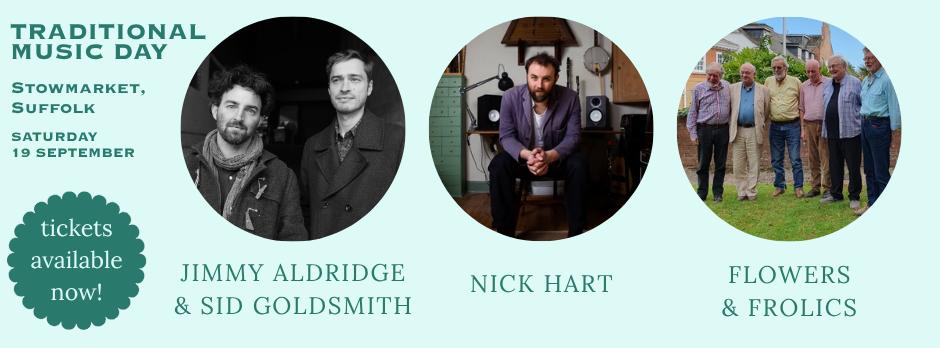
Sid will be appearing as part of the Jimmy Aldridge & Sid Goldsmith duo at our 2026 Traditional Music Day on Saturday 19th September. Tickets are avaiilable now – for the whole day + evening concert, or for the evening concert on its own.