Veteran VT152CD
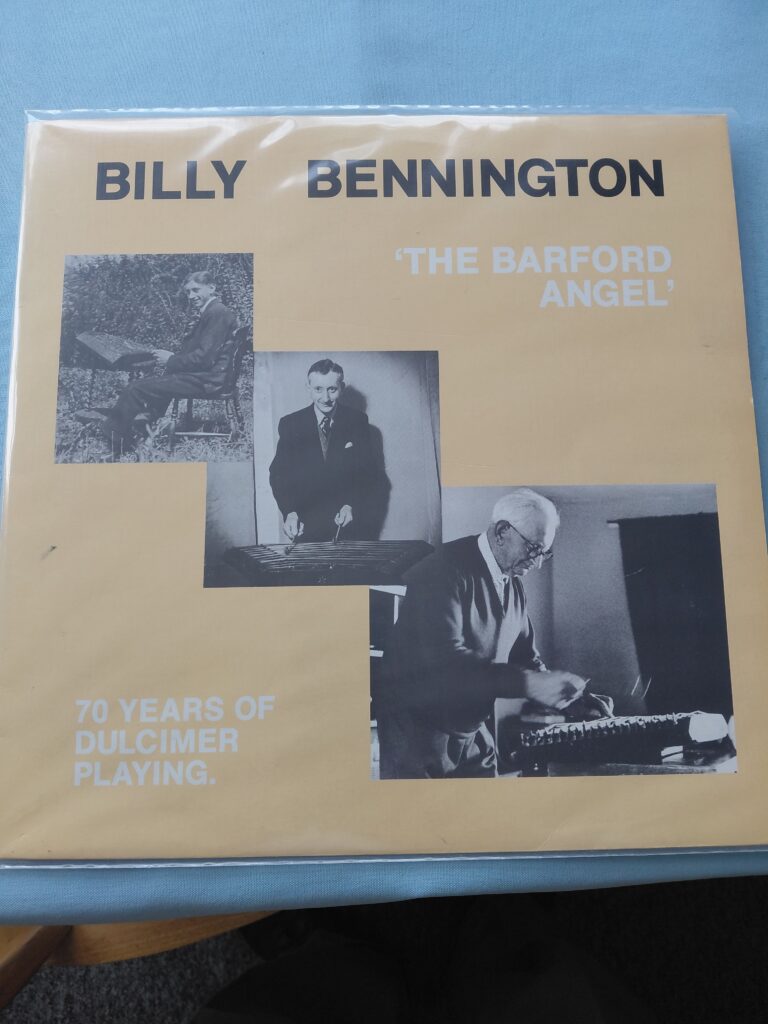
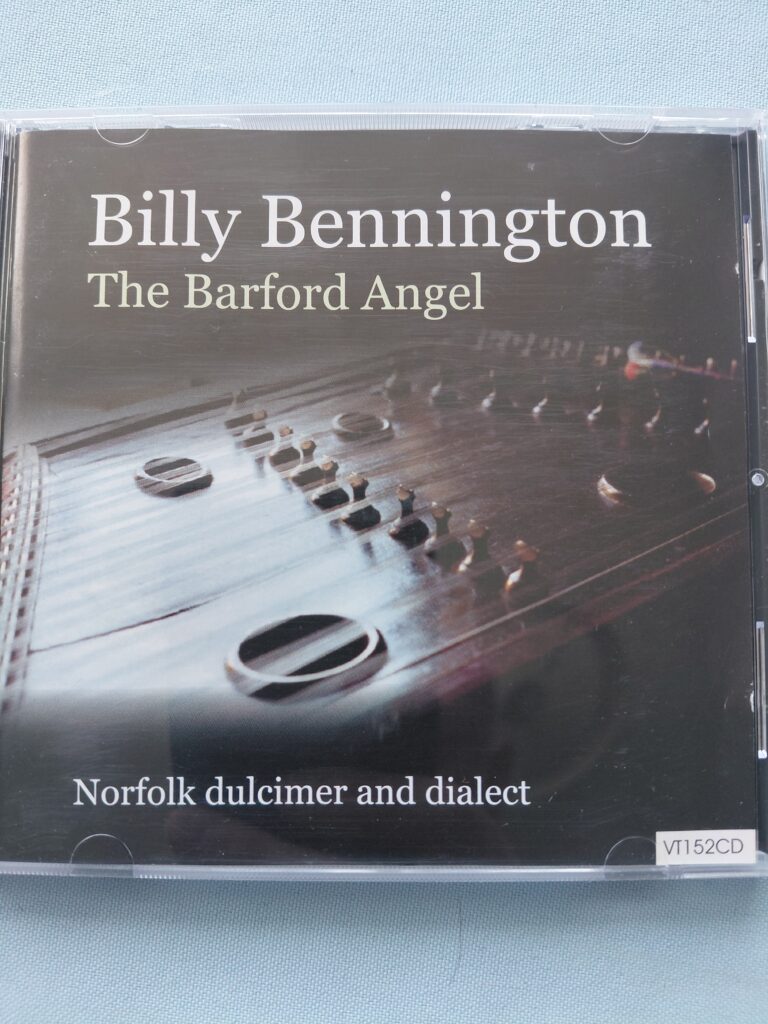
In 1973, Topic Records put out an LP of instrumental music from this region – English Country Music from East Anglia (1) – which proved to be highly influential for the burgeoning scene of musicians and enthusiasts dedicated to promoting the idea that England had a vibrant tradition of music-making, which could be celebrated in just the same way as it was in Scotland and Ireland. The LP comprised music from four performers, one of whom was Billy Bennington, dulcimer player from Barford. I have reviewed this album previously (2) and don’t propose to revisit that ground here. Suffice to say that the LP certainly showed that East Anglia was a place where, in the 1970s, a few traditional performers could still be found. In 1987, a full LP of Billy Bennington’s music – The Barford Angel – was released on the tiny East Anglian Life label (3), further demonstrating Billy’s virtuosity on the instrument. In 2005 Veteran reissued the LP on compact disc, adding the tracks from the Topic LP too, to create a vibrant musical portrait of this dulcimer virtuoso.
Billy Bennington was born in Barford in 1900, an area of several ‘dulcimore’ players, a tradition which seems to have emanated out of Norwich, which was also noteworthy for makers of the instrument. He took lessons from local musician and band leader Billy Cooper after 1912 – whose son, also Billy Cooper, was also a prominent player, (4) and in the years after the First World War Billy teamed up with Billy Cooper junior and fiddler Walter Baldwin (5) to play in pubs all over Norfolk. From then on Billy fulfilled the role of local musician, whilst working as a gardener, developing an ornate but precise style of playing. These recordings were made towards the end of his life – he died in October 1986, a year after the bulk of the recordings were made – but his talents seem to have been in no way diminished by his age.
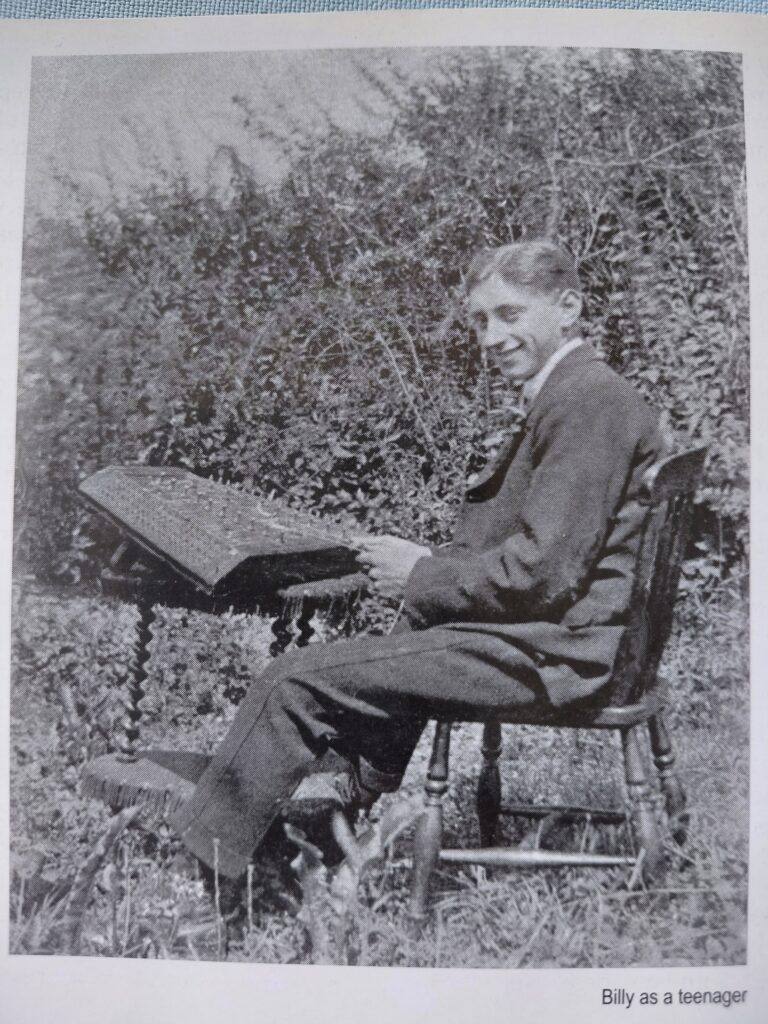
What we have here is over an hour of Billy’s repertoire: the social dances – hornpipes, polkas, schottisches and waltzes – marches and a couple of popular song tunes from his younger years. Hornpipes are well represented: a slightly unusual, rolling version of the ubiquitous Flowers of Edinburgh, (mistitled Yarmouth Hornpipe on the Topic LP), a sprightly medley of the local perennial favourites Yarmouth Hornpipe and Sheringham Breakdown, as well as the equally well-known Sailor’s Hornpipe (containing a snippet of Flowers of Edinburgh along the way), all at a moderate, assured pace. Schottisches are also well represented, illustrating how commonplace this couple dance was in these rural communities: Herbert Sadd’s Schottische, a rather florid and complex version of the tune more commonly known as Mountain Belle Schottische, and which came from the highly-regarded local player of that name, followed by an untitled Schottische and yet another unnamed, which track then nicely changes tempo into a Step Dance.
Polkas are equally well represented, with the wonderful Gay Ladies Polka and also two others which have been taken up by musicians locally, and played as a set – Pony Trot Polka and On the Green, the latter with its improvised section. Here are the originals in all their glory. Likewise a slow and stately version of the somewhat hackneyed Redwing, starting on the second strain of the tune, and none the worse for that. Also the song Going to the Derby, making an effective polka, and which Katie’s Quartet reworked as ‘BB’s’ (6) It’s easy to see the extent to which Billy Bennington was such an influence on younger performers, and the worth of these recordings in that respect.
The solitary jig, Rose Cottage, was named by Billy for his cottage and he comments that it was used for the Norfolk Long Dance (one of many, often untitled, tunes that local musicians had for the purpose). Billy once again gives an unhurried, assured performance. Waltzes are evident in the form of two distinct tunes called Dulcie Bell. The first is the ‘usual’ tune of this name, also played by Billy Cooper (junior) and probably written by his father, ‘Old Cooper’. (7) It certainly lives up to its name, with its Edwardian elegance and charm. Much the same could be said of the other, Dulcie Bell 2, which appeared on the Topic LP as ‘Dulcie Belle’ and for which Billy didn’t have a name. There are also two marches – a favourite type of tune – the Sousa-composed On Parade and The Gunner’s March, used, as Billy describes, for the Military Two-Step.
An unusual item is the tour de force performance of the American string band favourite The Chicken Reel. Where Billy got it from is unknown, but here is proof that the cross-Atlantic exchange of tunes was not a one-way flow in the early Twentieth Century (as exemplified also by the popularity of such tunes as Redwing and Whistling Rufus). There is also the dulcimer party-piece The Bells of St Mary’s, and the rest of the running time comprises popular songs of the earlier Twentieth Century, When Johnny Comes to Town, Lovely Lucerne, Obidiah, I Like to Say Good Morning and the sublime My Beloved Cornelia, with its effective mandolin mimicry.
In all, here we have a wonderful musical portrait of an extraordinary rural musician, a man who operated within the loose borders of tradition, but whose virtuosity took this music to a high level indeed. The CD is subtitled ‘Norfolk dulcimer and dialect’, and what we also get are several spoken passages as introductions to tunes, with wonderful – and sometimes hilarious – anecdotes about Billy’s life and experiences as a musician, all adding to the richness of the listening experience. This is, possibly unsurprisingly, the only full album dedicated to an East Anglian dulcimer player. (8) For that reason alone it is essential for anyone’s music collection, but it is much more than just a historical document: it is a vibrant aural portrait of a wonderful musician.
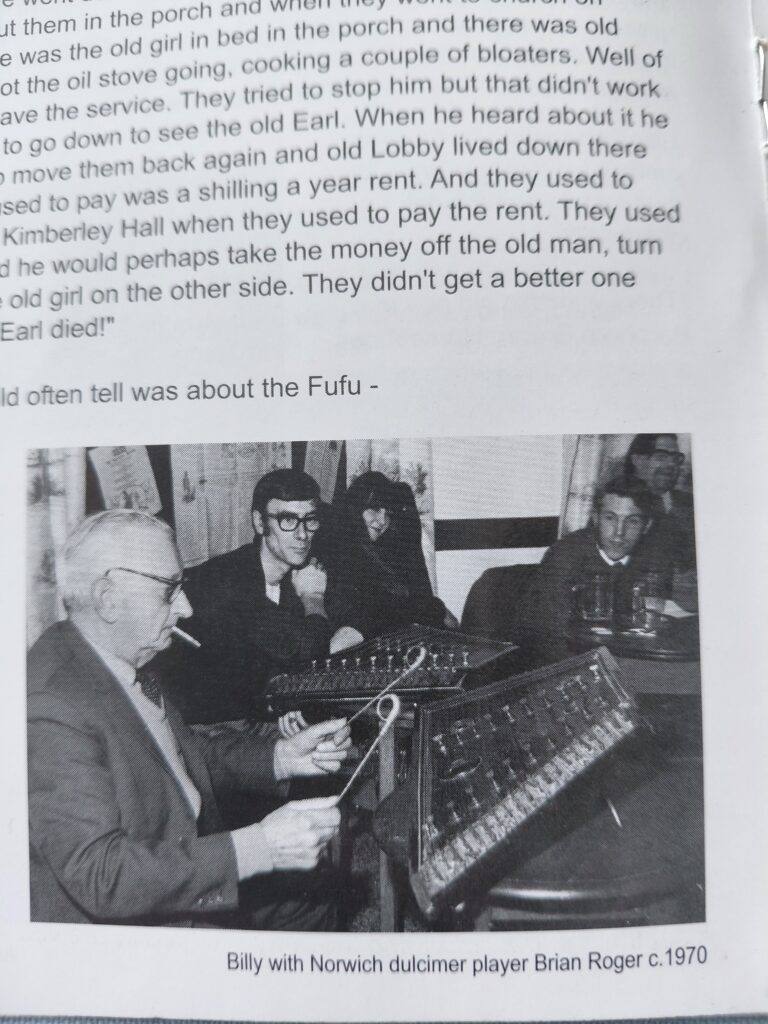
The sound quality is excellent and the CD booklet contains much information and several photographs, as is usual with Veteran releases. There really isn’t anything lacking; it’s a highly recommended album, available at the time of writing as both CD and download from Veteran.
Chris Holderness May 2026
Notes:
1. English Country Music from East Anglia Topic 12TS229, 1973
2. Reviewed in the January 2026 newsletter
3. Billy Bennington The Barford Angel East Anglian Life EAL-1, 1987
4. Billy Cooper (junior) can be heard on English Country Music Topic TSCD607, 2000, Heel and Toe: Veteran VT150CD, 2005, and ‘I Thought I Was the Only One!’ Dulcimer Playing in East Anglia Veteran VTDC12CD, 2015. The LP version of the first was reviewed in the newsletter for December 2025, the second was reviewed recently in another newsletter; a review from 2015 of the latter can be found at mustrad.mainlynorfolk.info
5. Not to be confused with Shipdham fiddler Walter Bulwer, as sometimes happens due to the similarity of the name. Walter Baldwin was a blacksmith in Hingham who was regarded as a fine fiddler. He was never recorded. His image can be seen in the photo of the ‘Hingham Minstrels’: see Chris Holderness: The Devil’s Box in the East: Traditional Fiddle Playing in Norfolk and Suffolk, 2024, at eatmt.org.uk
6. Recorded on Katie’s Quartet Old Hat Music OH3CD, 1996
7. Billy Cooper’s version of Dulcie Bell can be heard on TSCD607 and VT150CD, as above 8. More players, and more material by Billy Bennington, can be heard on VTDC12CD, as above.