Review
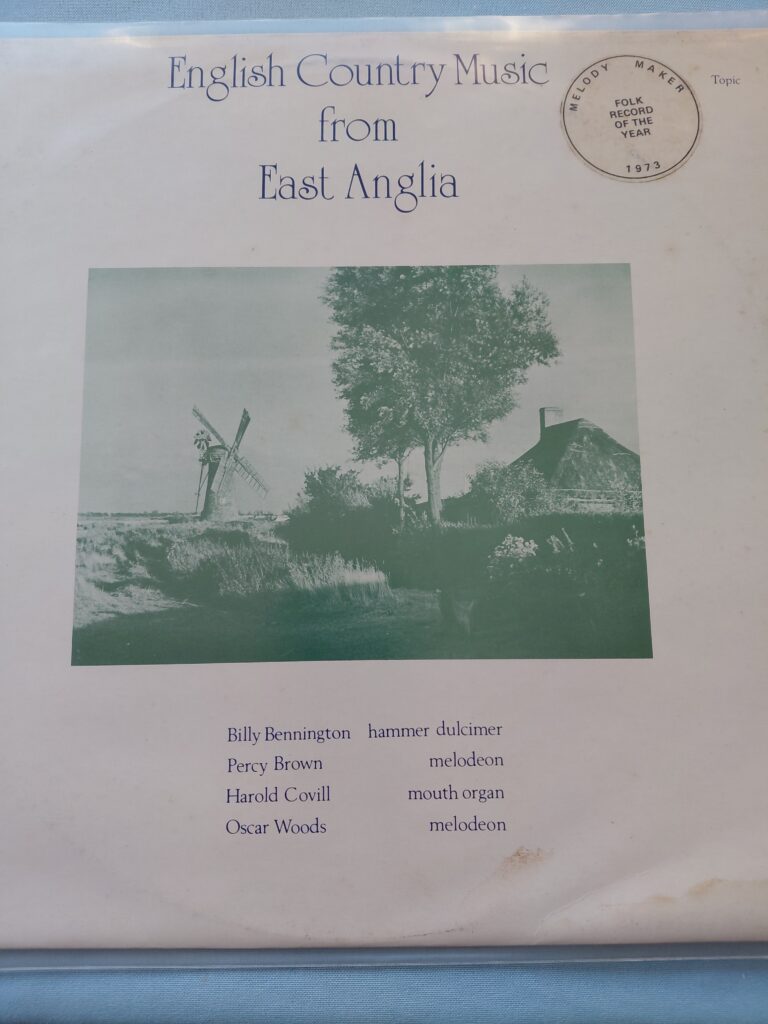
English Country Music from East Anglia
Topic 12TS229 (1973)
Following on from my recent appraisal of the influential album Record No 1 / English Country Music, (1) it is now perhaps time to revisit a Topic Records release from 1973 which served as something of a companion piece, as far as influence on revival of English country dance music was concerned – the rather similarly-titled English Country Music from East Anglia. Indeed, as Katie Howson mentioned in the previous article, the two are popularly referred to in that circle as “The Black Album” and “The White Album” respectively – referencing the predominant colour of each album sleeve – suggesting a certain pairing in people’s minds.
Both records featured a selection of music from various local musicians, although there is no crossover at all between them in that respect. Whereas the Record No 1 / English Country Music release featured ensemble performances of a rollicking country dance band, the English Country Music from East Anglia seems a much more austere affair. What we have here are solo performances from four East Anglian musicians, prominent in their communities, all recorded by Topic Records’ Tony Engle in 1972 and 1973. The four are melodeon players Oscar Woods and Percy Brown, mouth organ player Harold Covill, and dulcimer player Billy Bennington. That the record was influential around the time of release is made plain by the fact that it was “Melody Maker Folk Record of the Year 1973”, as a sticker on my copy proudly proclaims.
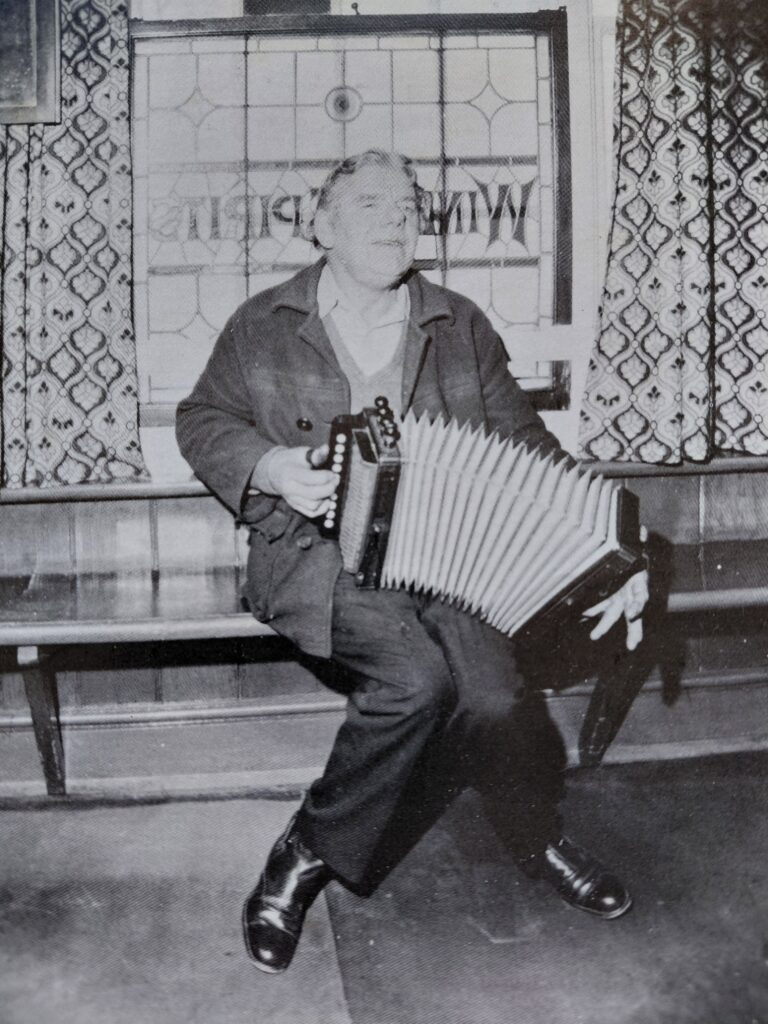
The record opens with Oscar Woods from Benhall Green in Suffolk, with a sprightly untitled Jig, played on one-row melodeon (2), and closes with Norfolk melodeon player Percy Brown – from Aylsham – rattling out the Heel and Toe Polka, this time with two-row melodeon. There is quite a contrast in their styles, that goes beyond merely the instrument used, which underlines the variety to be found in this music across the area, and certainly demonstrating that there isn’t an obvious and identifiable “East Anglian” style of playing (although there are certainly similarities in traits) (3). In between, we have a broad selection of robust tunes, of which the sleeve notes comment: “The music on this record is still being played in East Anglia, although nowhere near as much as it was, and is typical of the repertoire. It is functional music – largely used for dancing, although tunes for singing are present in large numbers – and is not played very often for listening (as is more the case with the Irish instrumental tradition). This doesn’t mean that the musicians regard it as unimportant, but the emphasis is more on basic tune and rhythm than melodic and harmonic variation.” (4)
Oscar Woods is featured on seven tracks, the aforementioned jig, two untitled polkas, the ubiquitous Oh, Joe the Boat is Going Over, two ‘step dance tunes’, one untitled and the other a version of The Sailor’s Hornpipe, and a waltz, the seemingly misnamed ‘Italian’ Waltz – there seems to be no evidence of an Italian origin. The booklet notes add: “Close by (to Oscar’s home) lived an old farm worker, ‘Tiger’ Smith, and it was he who provided the inspiration for Oscar to play the melodeon…He would sit beside him and listen to him play. Eventually Oscar’s father came home with an old melodeon and this was where he started. He bought ‘Tiger’ Smith’s melodeon and concentrated on those tunes that ‘Tiger’ played…When he was older and had an old car, he and ‘Tiger’ would play around the local pubs. There were a number of other melodeon players about at this time and Oscar learned from them – in particular the Seaman family of Darsham.” It is beyond my expertise to analyse Oscar’s melodeon style, but suffice to say that here we have solid examples of tunes played with verve, simple perhaps in style, but perfectly suited to accompany a step dance or when someone decided upon a waltz or polka, all in the key of C. Listening to these tracks instantly puts me in mind of events in Suffolk village halls, where the tunes – particularly the polkas – still have common currency, which in itself is testament to Oscar Woods’ influence and also perhaps that of the record itself.
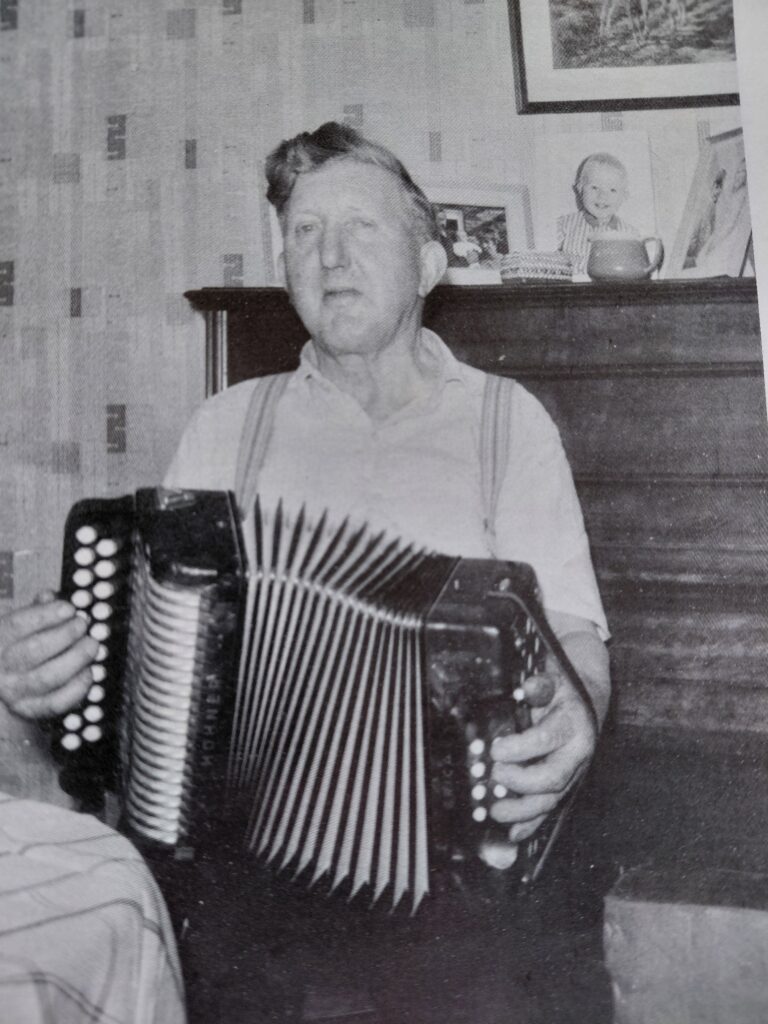
A completely different sound is given by Percy Brown and his two-row Hohner Erica melodeon. With a very full and rich sound and driving rhythm, here we have six tracks of his playing. Elsewhere, Percy has been recorded playing lengthy medleys of tunes, particularly hornpipes, where he changes from one tune to another in rapid succession, barely finishing one before changing to another. (5) Here however we mainly have him performing single tunes. Once again, there is a very good selection of typical pub tunes: several polkas – Old Joe the Boat is Going Over again (with slightly different title), followed by an untitled one (which is known as King’s Polka) and also the Heel and Toe Polka. There is also the Waltz for the Veleta, which the sleeve notes maintain “is not the usual Veleta tune.” I don’t know what the usual Veleta tune might be, but in my experience, it is exactly this tune and version which is played today, although not necessarily to accompany the actual dance. Once again, this would underline the influence of both Percy Brown and the record, on musicians, since its release. There is also a four-part Barn Dance Tune and a couple of tunes for step dancing: the hard driving Yarmouth Breakdown and the single-part Sheringham Breakdown. Of the latter, the sleeve notes mention that, “The second half of the tune Percy doesn’t know. He learned it from ‘two concertina people’.” Be that as it may, this one-part tune was also played in similar fashion by Albert Hewitt of Southrepps. (6) The tune as played is a simplified version of the first strain of the Four Hand Reel. The booklet notes comment that “Percy has been playing the melodeon ‘ever since he can remember’; before he was five his mother ‘showed him the keys’ and he taught himself from then on…He started to play publicly at his parents’ house in Felmingham, which had a club-room for dancing. After leaving school he played regularly for weddings. He has played a lot for dancing in local pubs and for the Cromer fishermen’s step dancing.” (7) The tunes given on the album certainly are a good sample of what would have been required for such occasions.
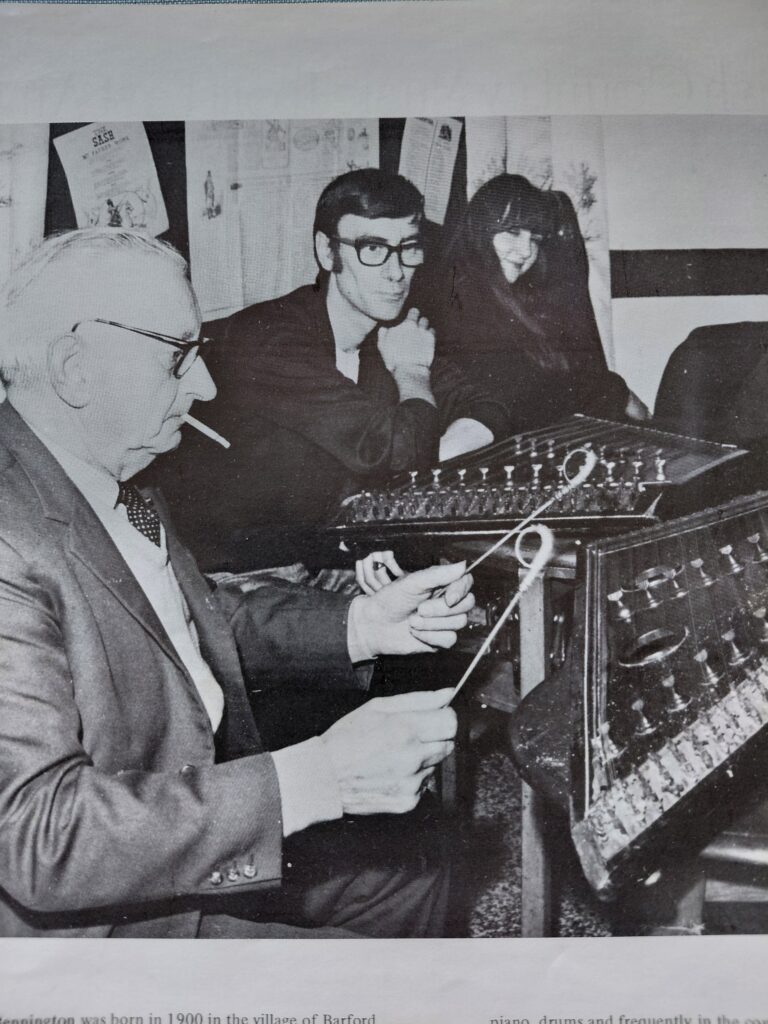
Billy Bennington of Barford in Norfolk, who learned his dulcimer playing from another local player, Billy Cooper, is showcased on eight tracks. Of all these players, he is the one who strays away from the aforementioned sleevenote comment that “the emphasis is more on basic tune and rhythm than melodic and harmonic variation. Whilst certainly very rhythmic, Billy’s playing exhibits all the inventiveness of a true virtuoso. Very often he gives a very ‘notey’, even ‘flowery’, version of a tune, with a complex series of notes and variations. Here we have polkas such as the stately Gay Ladies Polka and a refreshingly slow and mellow version of the hackneyed chestnut Red Wing (where he also unusually starts with the second strain of the tune); also On the Green, which Billy seems to have picked up from a brass band, as it was apparently popular in the repertoire of such village bands. Billy seems to have delighted in the playing of marches, and several have been recorded by him. Here we have On Parade, as a very good example. There is also the beautiful waltz Dulcie Belle, which “comes from the father of Billy Cooper” but which, confusingly, is not the same tune of that name recorded by Billy Cooper. (8) Billy Bennington has in fact been recorded playing both. (9) The selection is rounded off, true to form, with three tunes for step dancing. There is the common Jack’s the Lad (Sailor’s Hornpipe) and one which Billy apparently called Yarmouth Hornpipe (by which name it is given on the LP), but which is really Flowers of Edinburgh. Less commonly, there is a Slow Step Dance Tune, the dance for which the sleeve notes maintain “is sometimes called The Irish Jig”. Billy Bennington is yet another good example of a local player who learned his craft from others in the locality and then honed his skill to become a prominent musician; as the booklet notes have it, “In Billy’s own words he was ‘just crazed on the dulcimer’ and he would cycle the seven miles to Hingham every night to get Billy Cooper to teach him. It was from Billy Cooper that he learned his finger-picking style and a lot of his tunes come from him, although many were popular locally, and some form the core of most country musicians’ repertoires.”
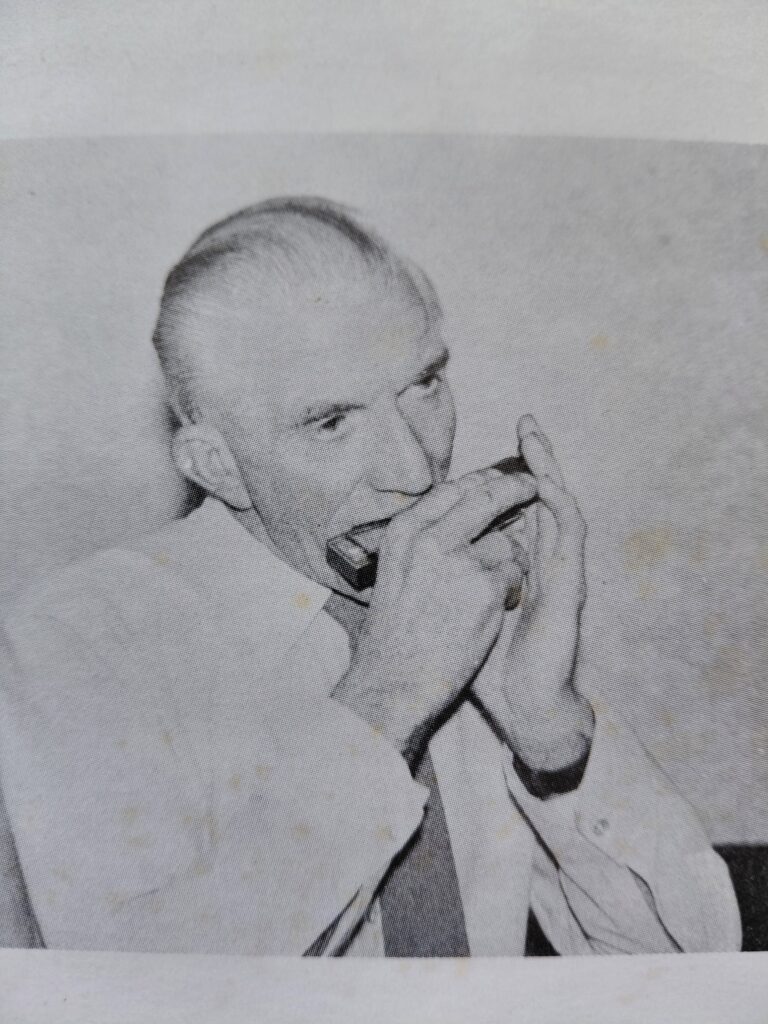
Finally, there are two tunes on the mouth organ from Harold Covill of March in Cambridgeshire. He had previously been recorded as a singer by Peter Kennedy (10) and the booklet notes state: “His father was a fine mouth organ player and he would often pinch his mouth organ and take it to school. When he got home he would be expected to play a tune. Shortly after this, his father bought him his own instrument and he has never been without one since.” He played for local dances and also “has a small band of youngsters whom he is teaching.” Here he gives us a standard version of The Oyster Girl and, less commonly perhaps, The Nutting Girl (although this song tune – as The Oyster Girl is – does certainly see service as a country dance and morris tune. (11) We have, again, straightforward, rhythmic playing, ideal to accompany social dancing.
So, English Country Music from East Anglia gives a good selection of the repertoires of four local musicians, all very different from each other in style. There are some similarities in repertoire. The sleeve notes comment that “the most common tunes found amongst country musicians in East Anglia are step dances, polkas and waltzes – probably because a musician would be called upon to play these during the evening in a pub.” We get a generous helping of all of these, as well as a few jigs for social dances such as the Long Dance. (12) The album was undoubtedly very influential and is an essential addition to the collection of anyone interested in local musical traditions and country dance. It unfortunately has not been reissued, but is available as a download from Topic Records. It is also fairly easy to find. In addition, most tracks have been reissued across several compilations – see Appendix below – and Oscar Woods, Percy Brown and Billy Bennington have had a great deal of their music released elsewhere. In all, this is an essential East Anglian album, one of the classics from Topic Records’ catalogue of the time.
Chris Holderness January 2026
Notes
- See: C Holderness: English Country Music: Sixty Years of the Legendary Record;
EATMT newsletter, December 2025 - Published in the EATMT tune book Before the Night Was Out (2007) as Tiger Smith’s
Jig. Several other tunes from the LP have been published here. - See: C Holderness: The Devil’s Box in the East: Traditional Fiddle Playing in Norfolk and
Suffolk; EATMT newsletter, autumn 2024, for a discussion of this in relation to fiddle
players - Sleeve notes to the LP – 12TS229. I have also quoted from the small booklet, which
gives information about the performers - Examples are included on the 2 CD set: The Pigeon on the Gate: Melodeon Players
from East Anglia VTDC11CD (2008) - See: C Holderness: Southrepps: Singing and Step Dancing in a North Norfolk Village
Musical Traditions MT221 (2009) - For more information about Percy Brown, step dancing in north Norfolk and Cromer in
particular, see the Musical Traditions articles by C Holderness: Percy Brown: Aylsham
Melodeon Player MT211 (2007), Dick Hewitt: A True Norfolk Man MT245 (2010) and The
Dancing Davies: Step Dancing Fishermen of Cromer MT291 (2014) - See: C Holderness: Billy Cooper: The Hingham Dulcimer Player Remembered By His
Family MT208 (2007). Billy Cooper’s music can be heard on English Country Music
Topic TSCD607 and I Thought I Was the Only One! Dulcimer Playing in East Anglia
Veteran VTDC12CD - Both are included on Billy Bennington: The Barford Angel Veteran VT152CD
- Harold Covill’s songs can be heard on A Soldier’s Life For Me Topic 12T196 (William
Taylor) and Songs of Animals and Other Marvels 12T198 (The Happy Family) - Vaughan Williams collected The Low-Backed Car from fiddler Stephen Poll at Tilney St
Lawrence in 1905, which is basically the same tune - The Long Dance was a longways set dance, very common in Norfolk. Ann Mary
Bullimore, landlady of Morston Anchor, gave a description to Peter Kennedy in 1952:
see: C Holderness: Herbert Smith: Fiddling Blacksmith of Blakeney MT179 (2006). Many
Norfolk musicians had a tune for the Long Dance, mostly unnamed and nearly all in 6/8
time.
Appendix
Although the English Country Music from East Anglia is unavailable in any form other than a download, a great many of the tunes have been made available elsewhere on compact disc:
All of the Billy Bennington material is available on Billy Bennington: The Barford Angel
Veteran VT152CD
Topic TSCD659: Rig-a-Jig-Jig: Dance Music of the South of England contains Yarmouth
Breakdown, The Veleta and The Heel and Toe Polka from Percy Brown and both untitled polkas and the ‘Italian’ Waltz from Oscar Woods.
Topic TSCD664: Troubles They Are But Few contains Old Joe the Boat is Going Over / Untitled Polka from Percy Brown
Other tracks from these musicians (but not from the LP) are scattered across several
compilations, but there is a significant amount on both The Pigeon on the Gate and I Thought I Was The Only One, as above