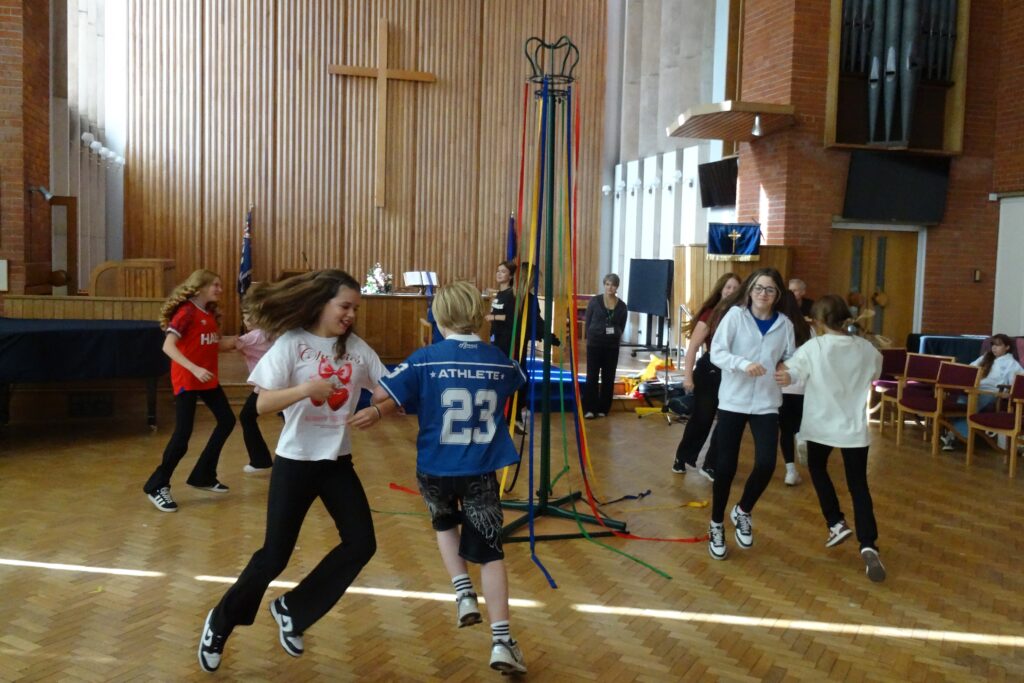
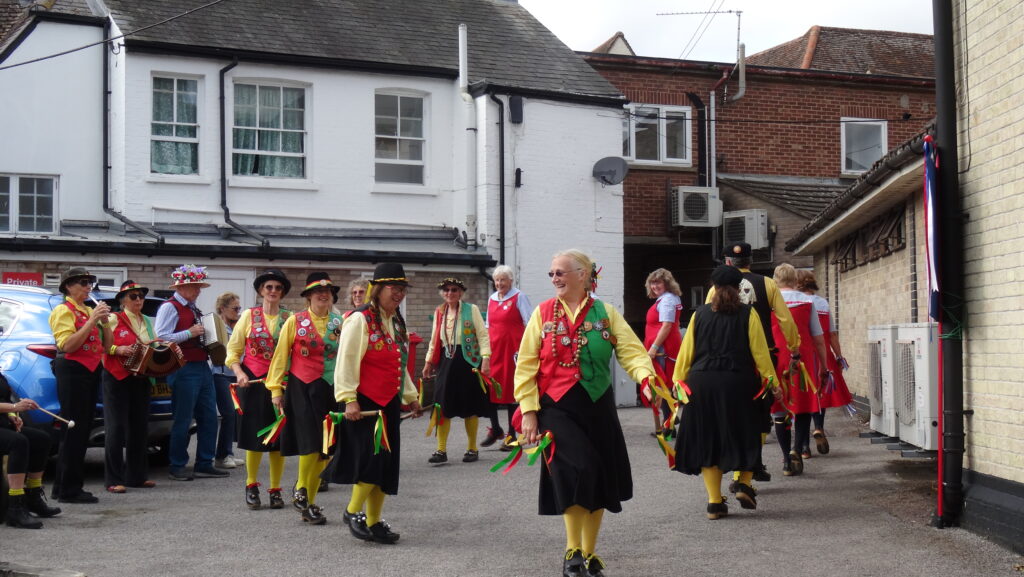
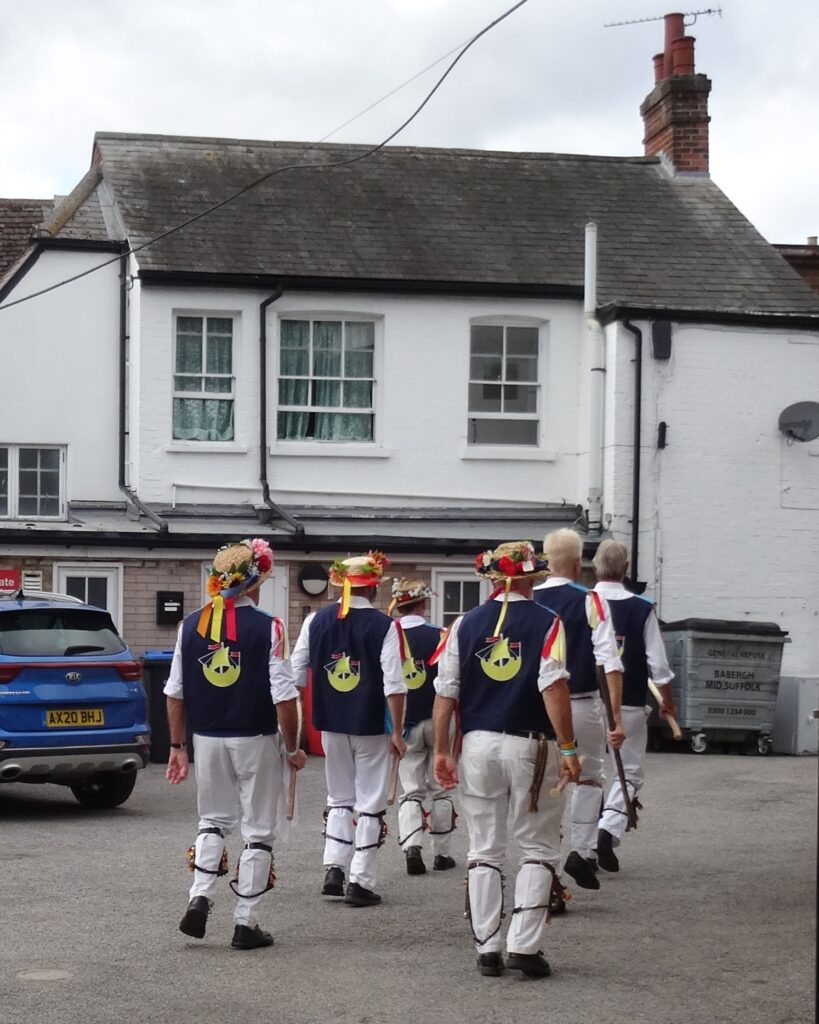
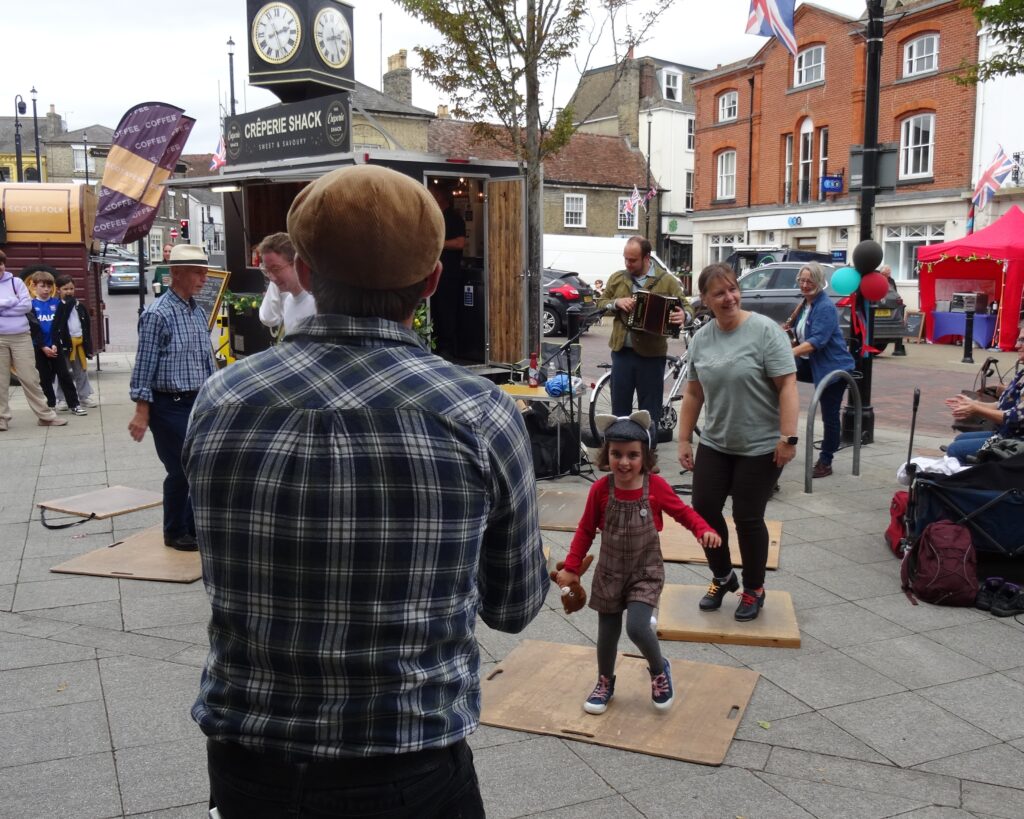
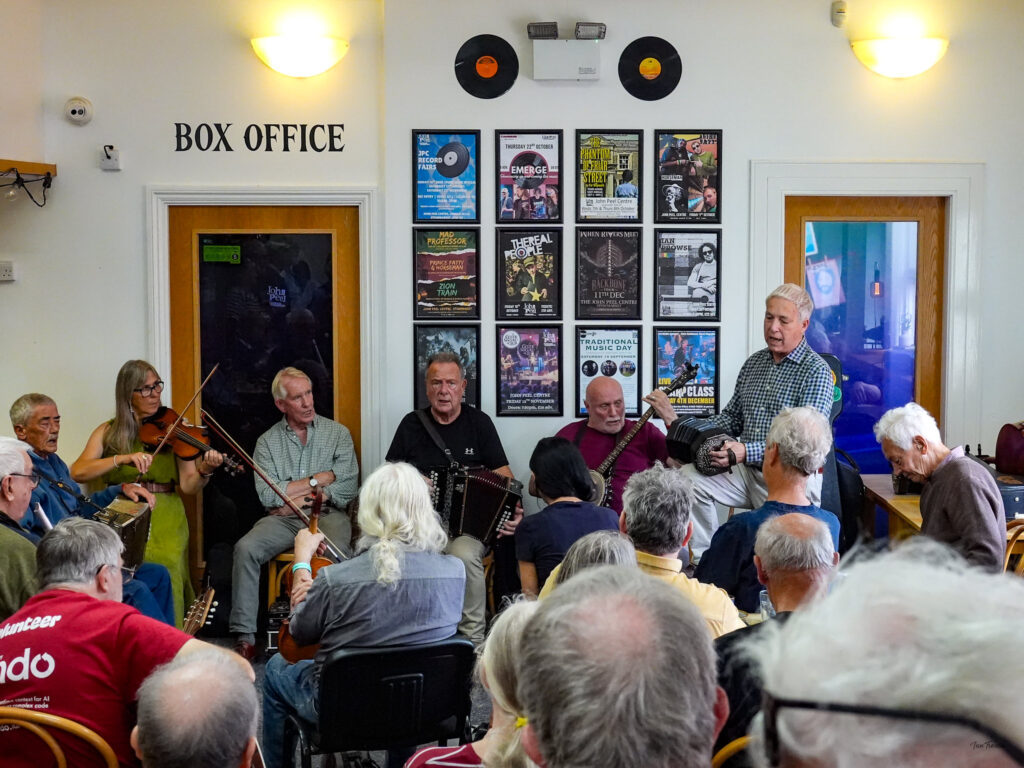
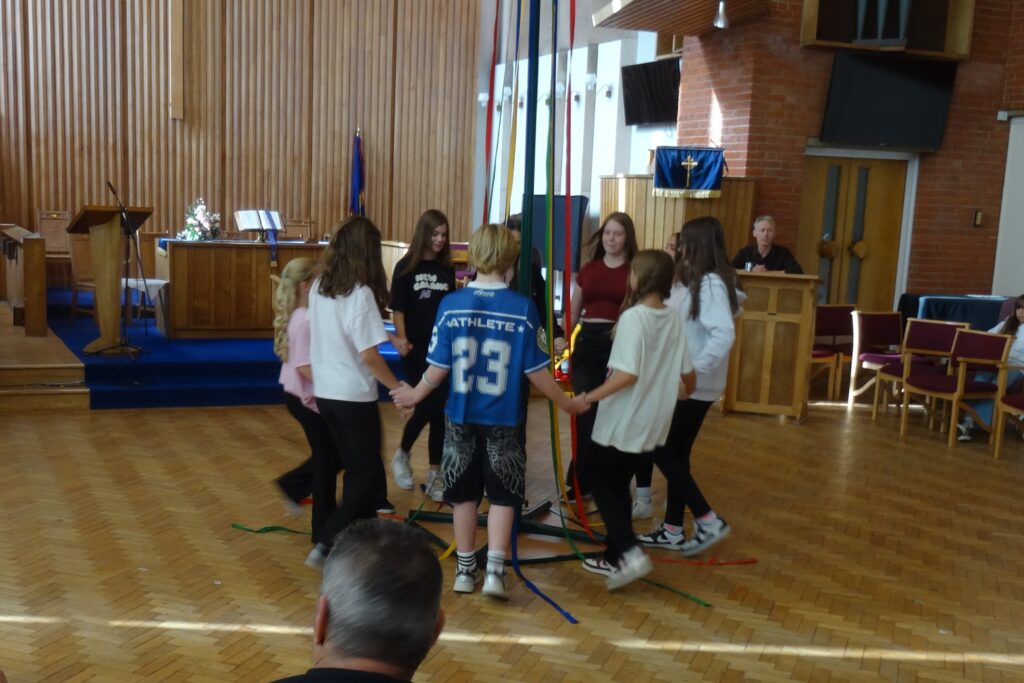
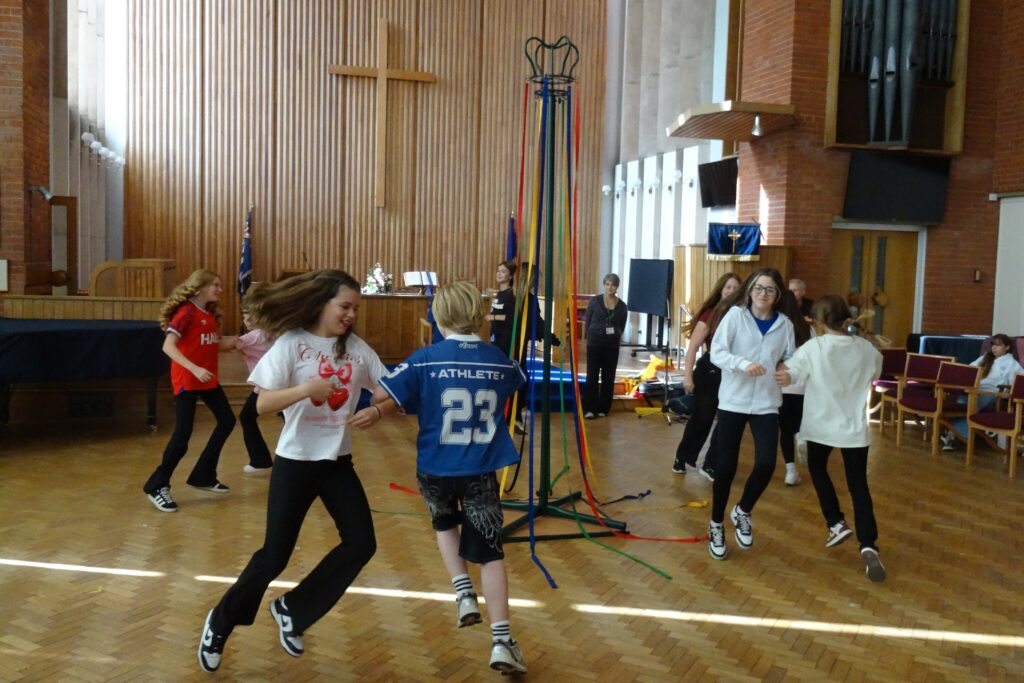
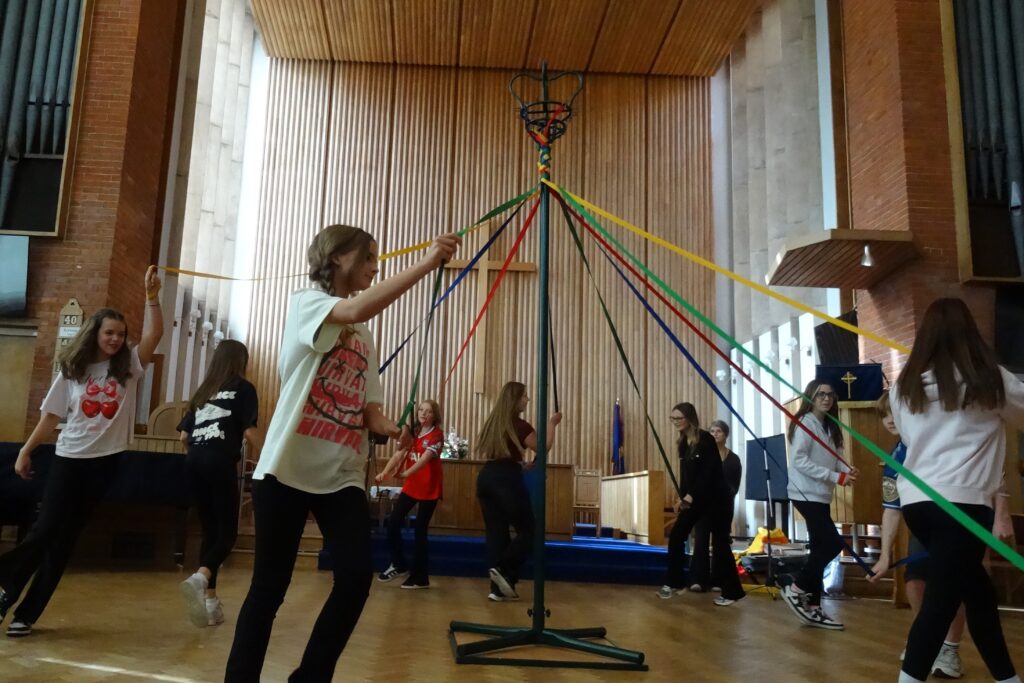
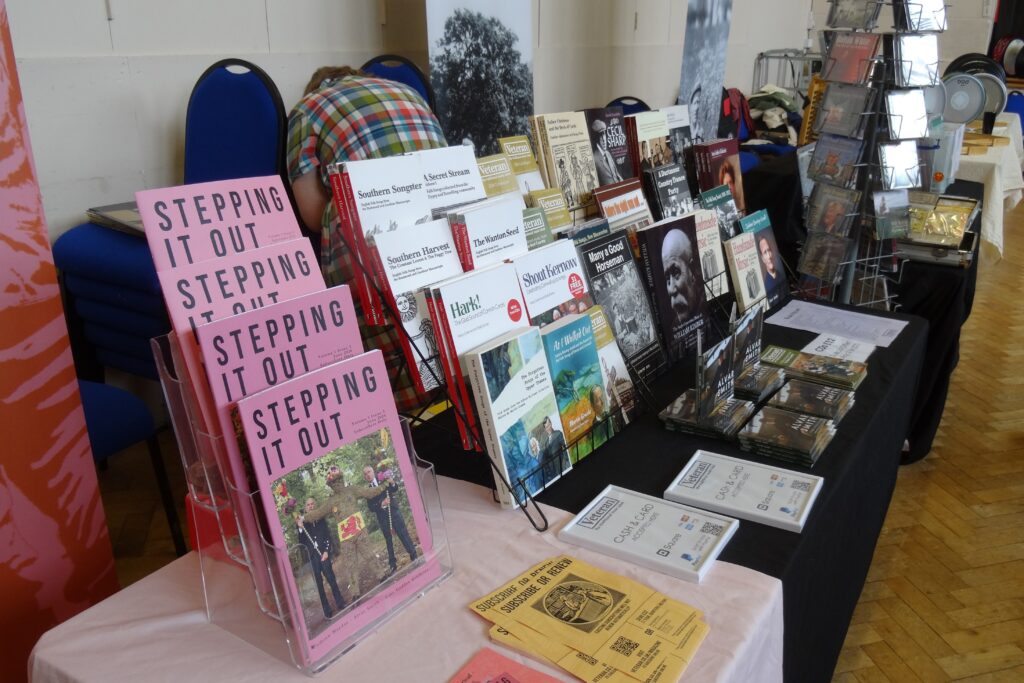
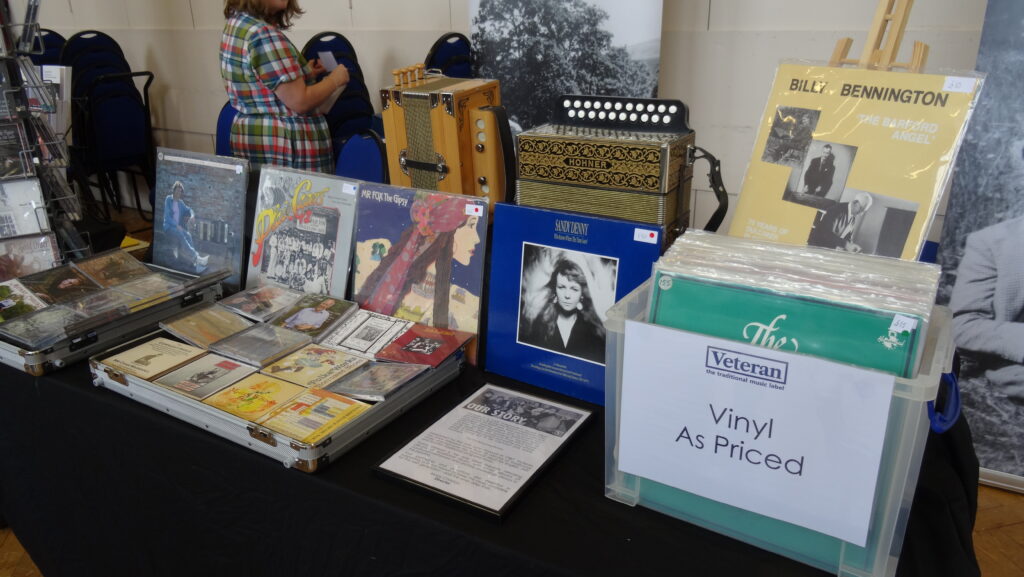
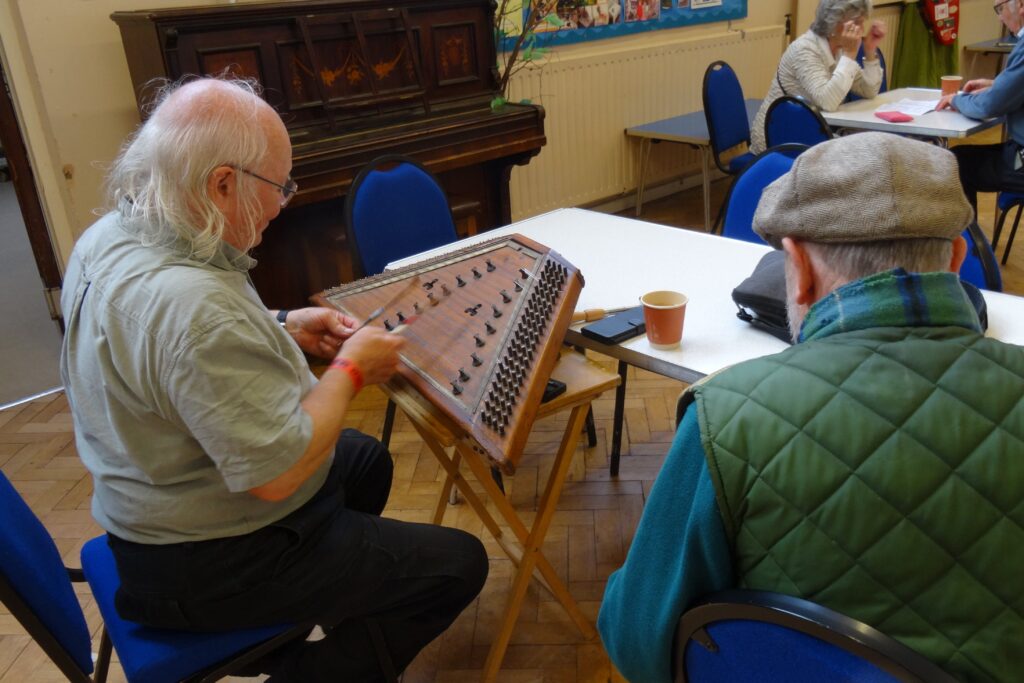
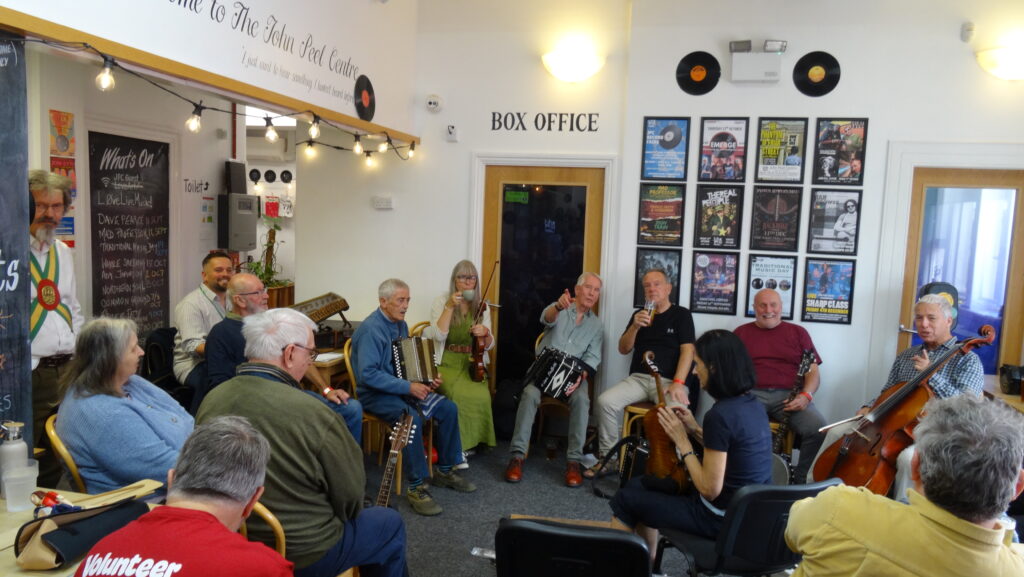
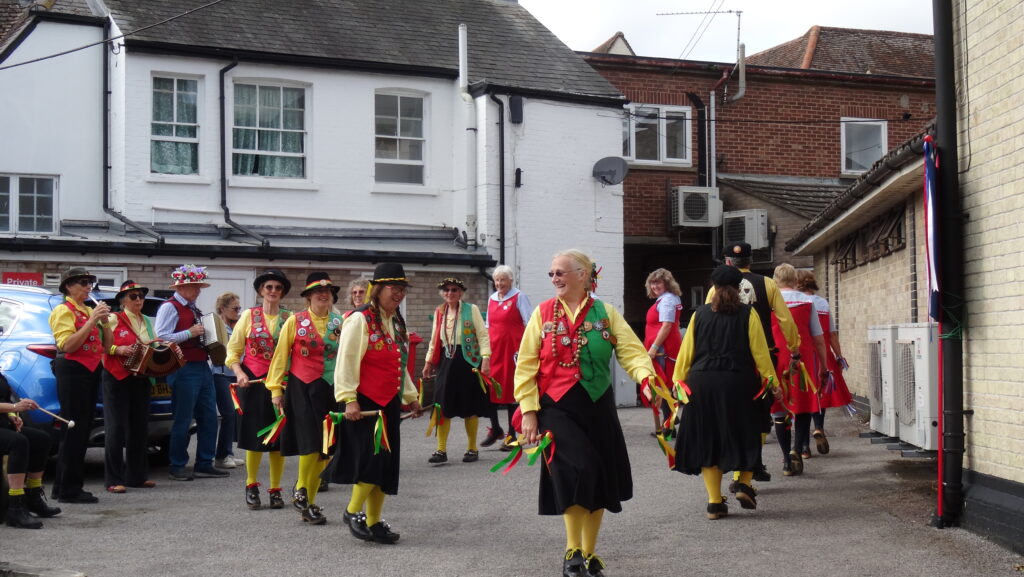
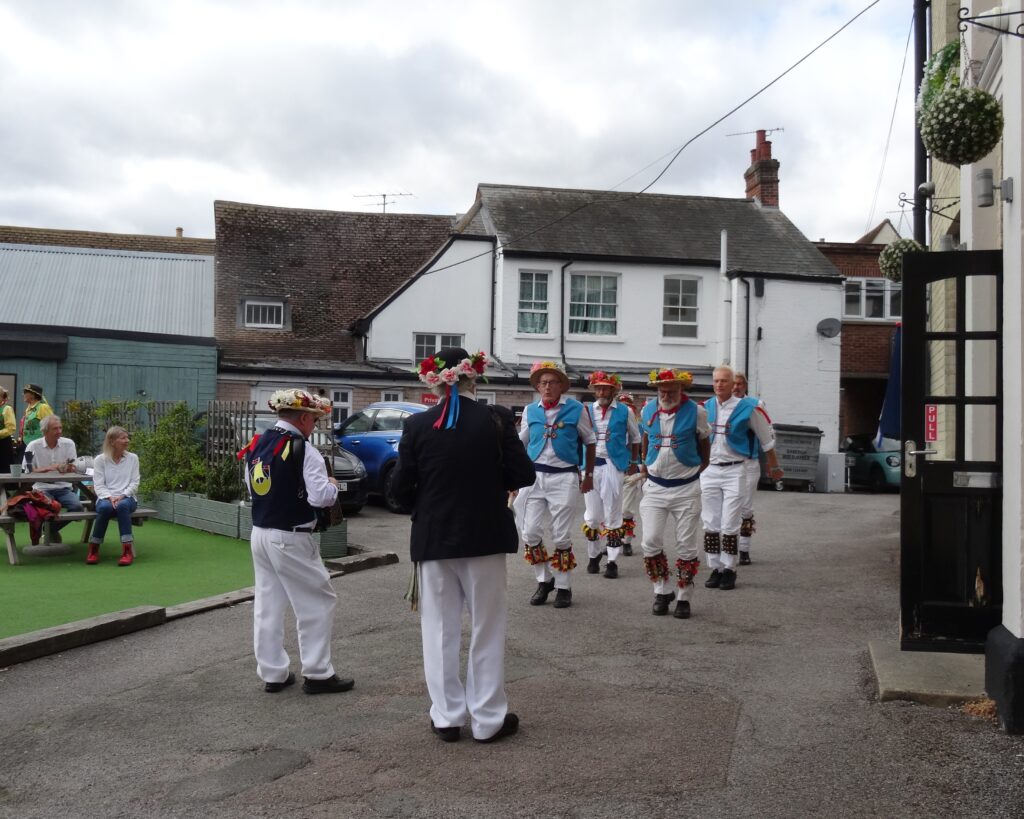
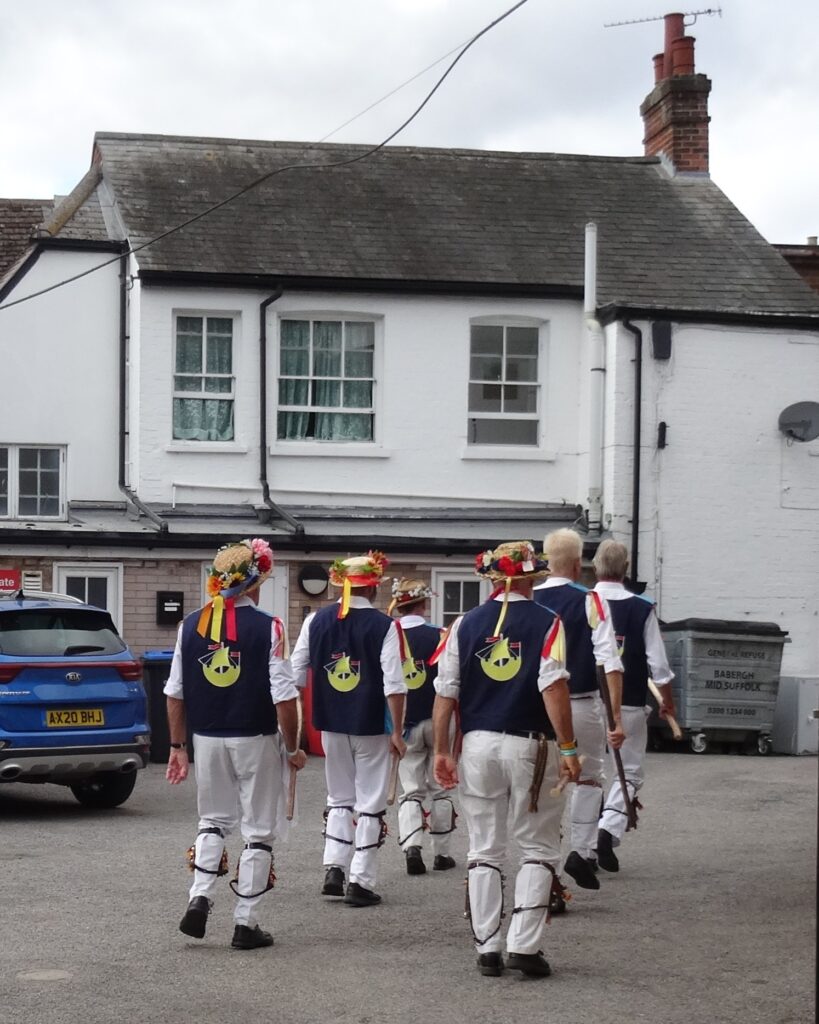
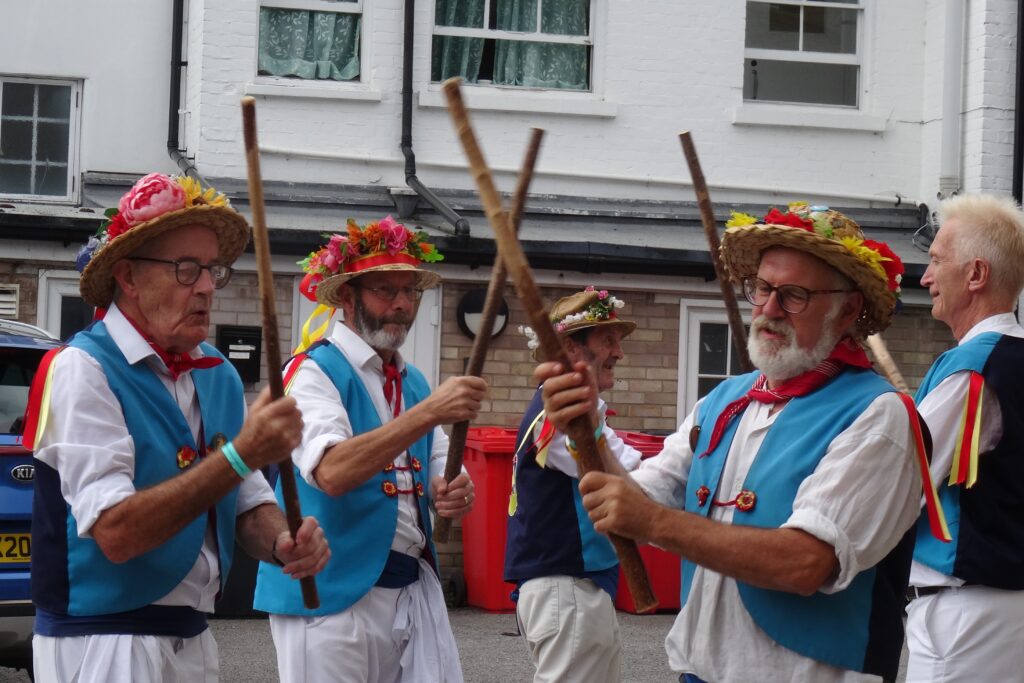
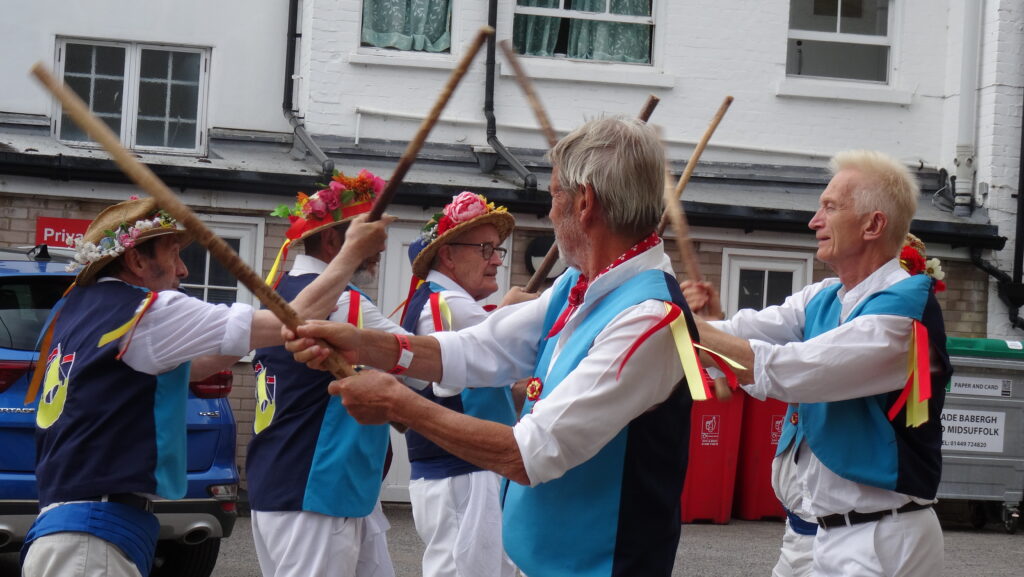
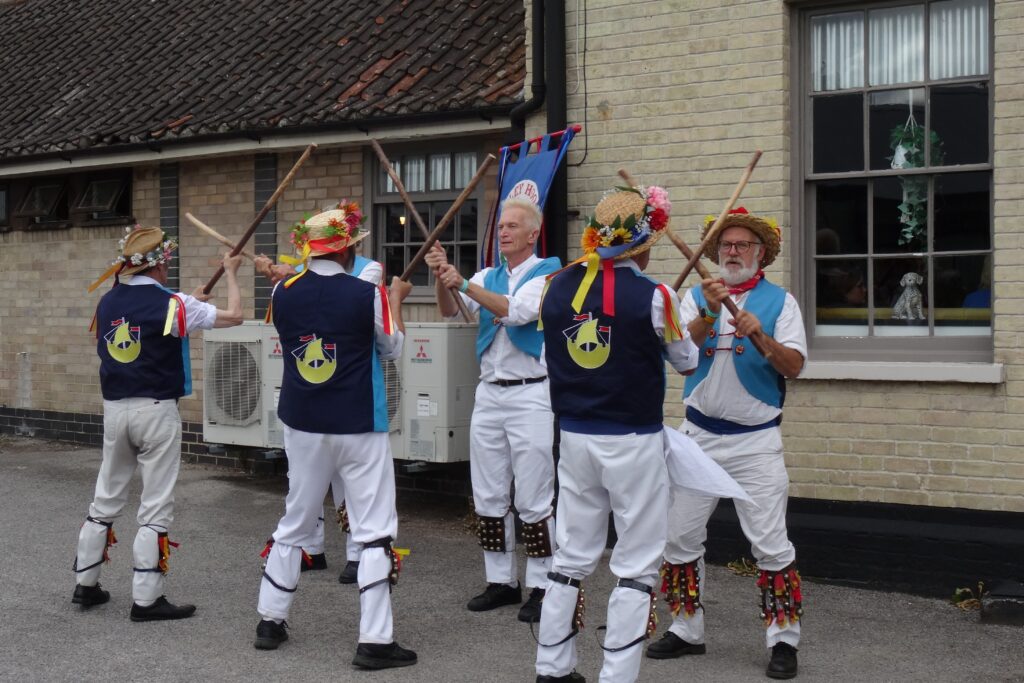
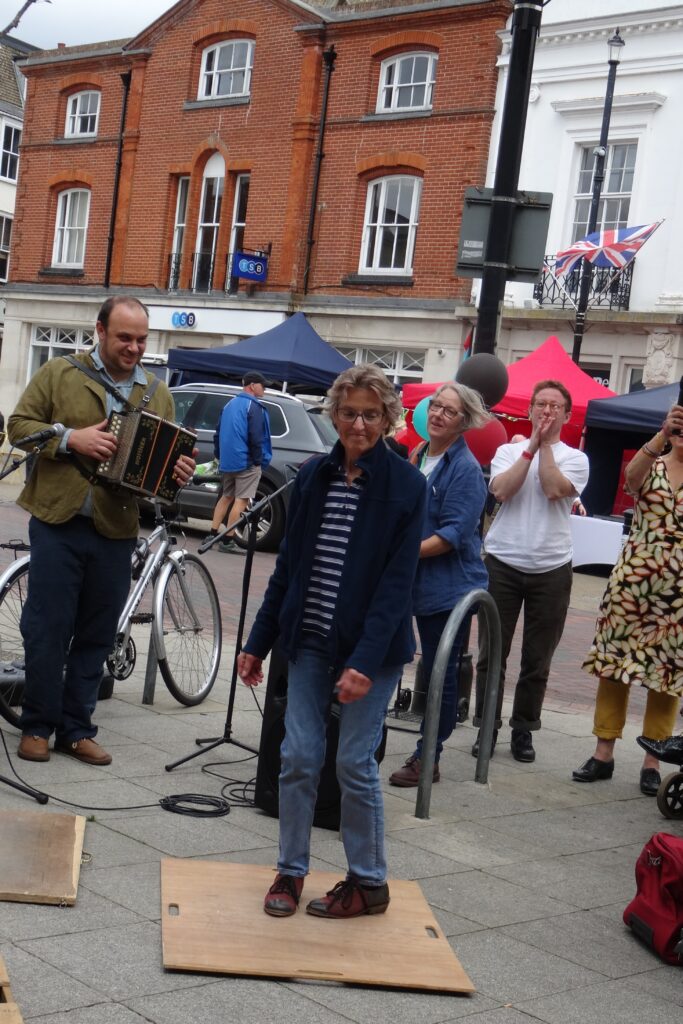
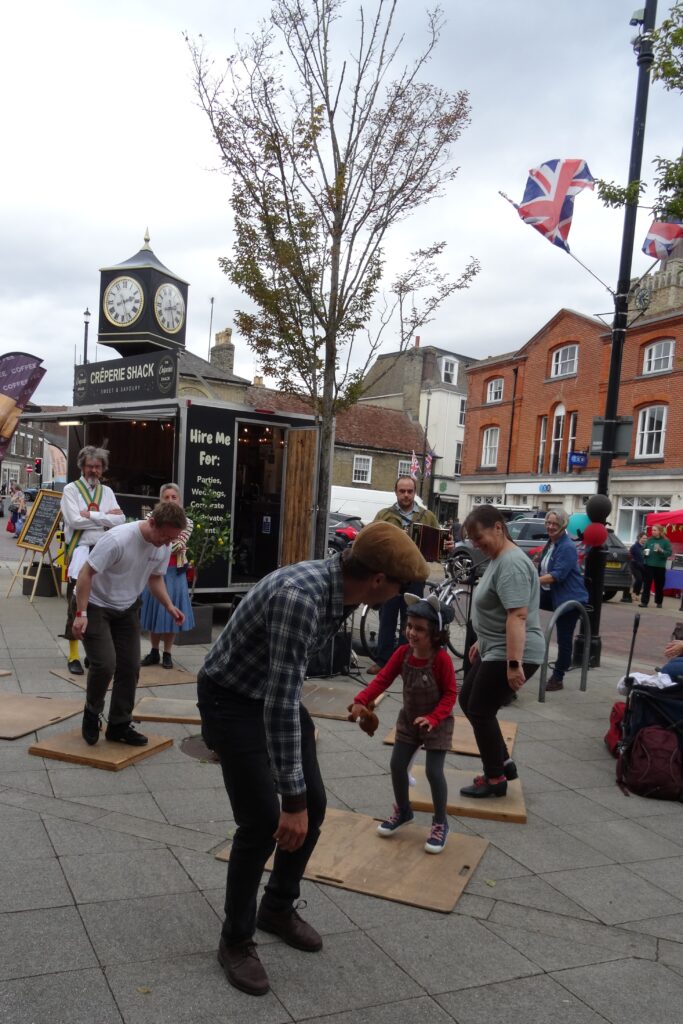
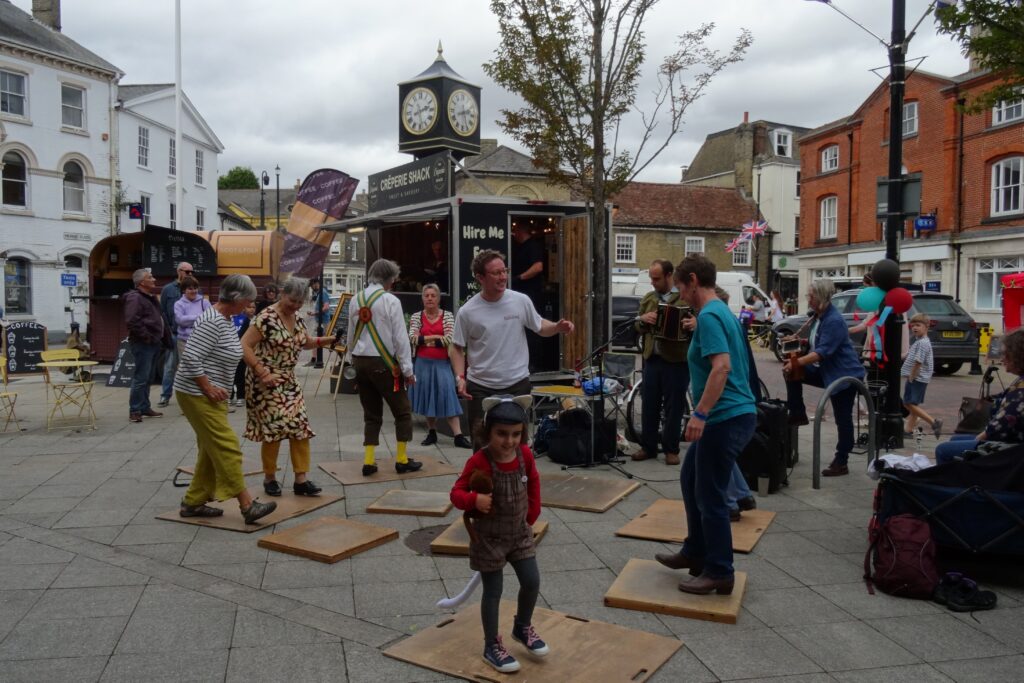
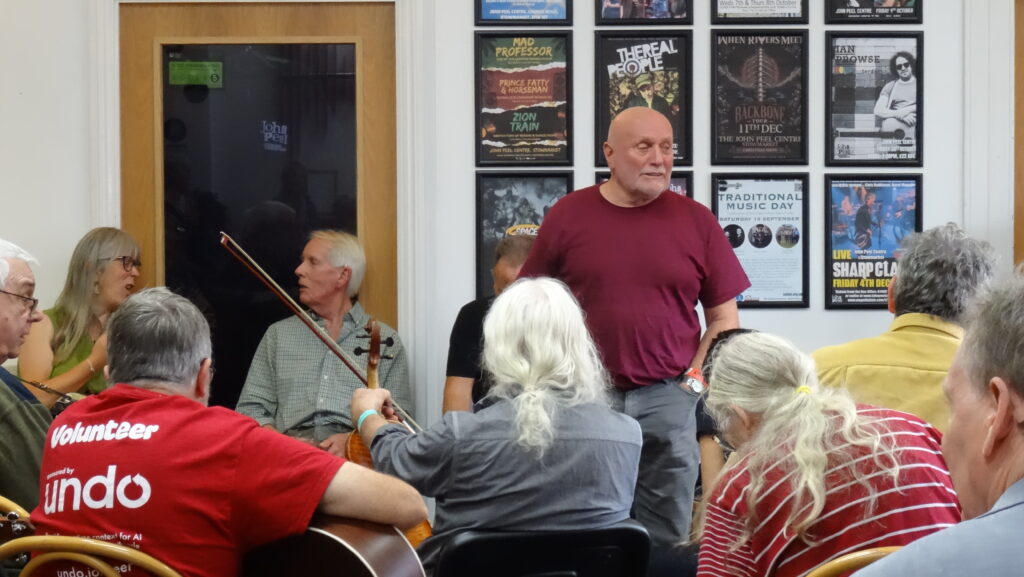
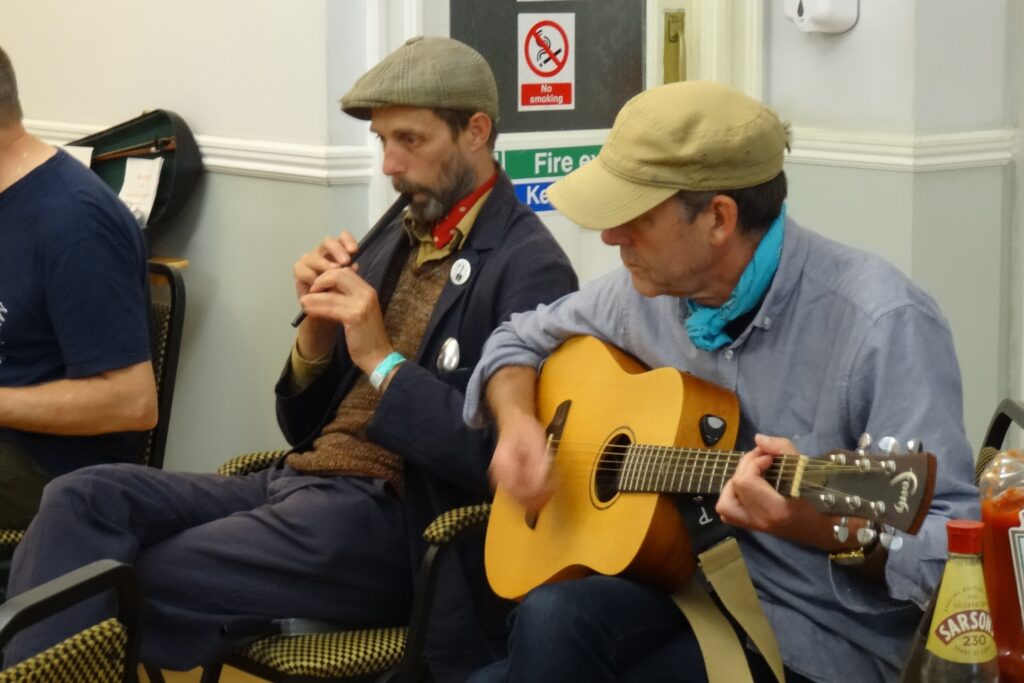
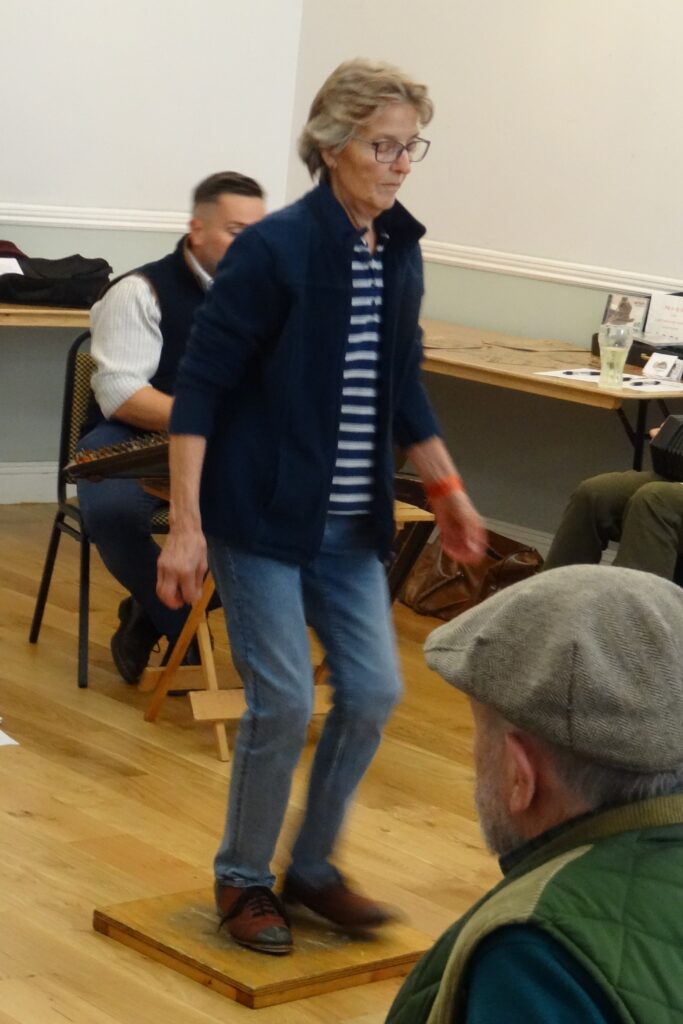
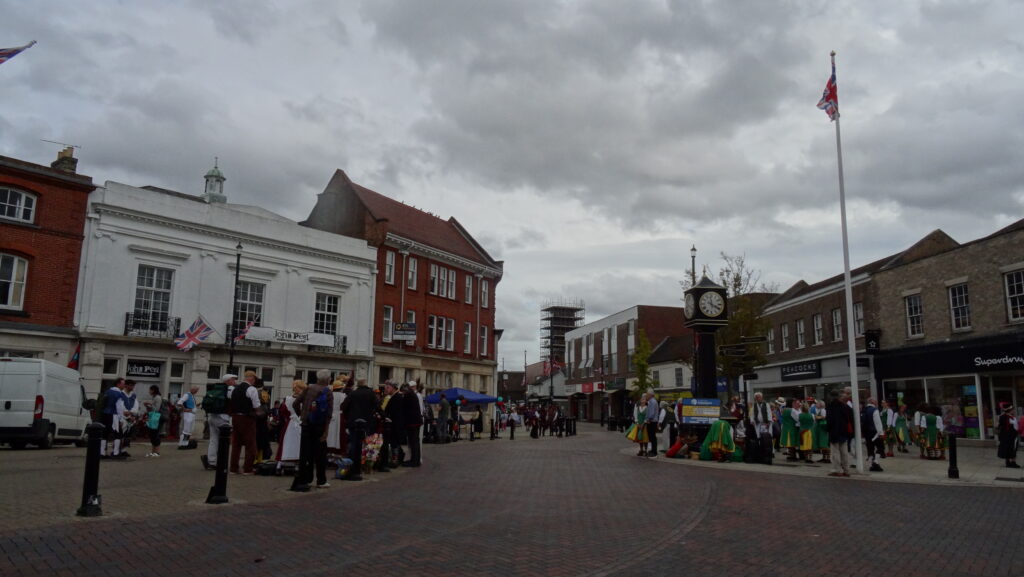
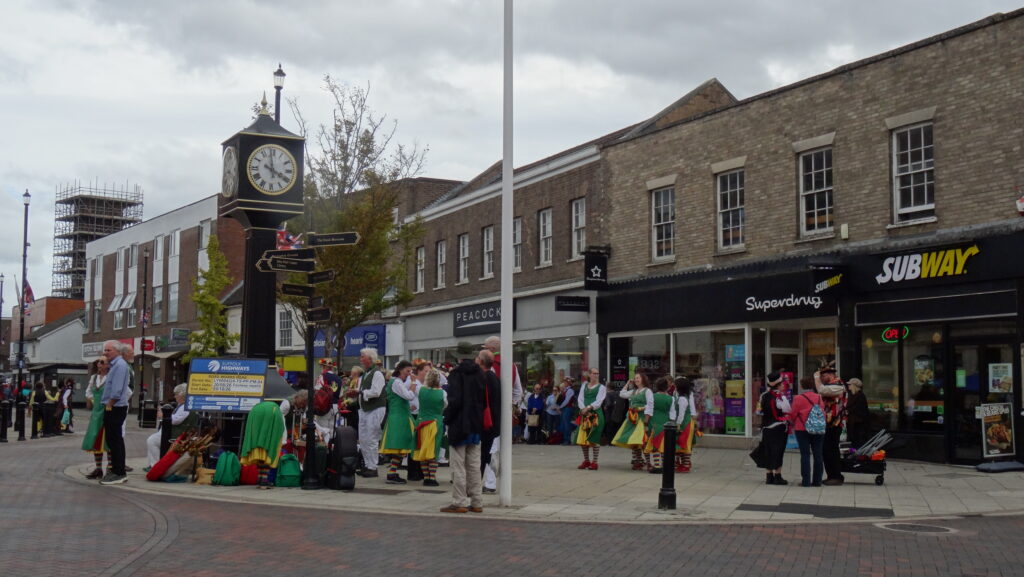
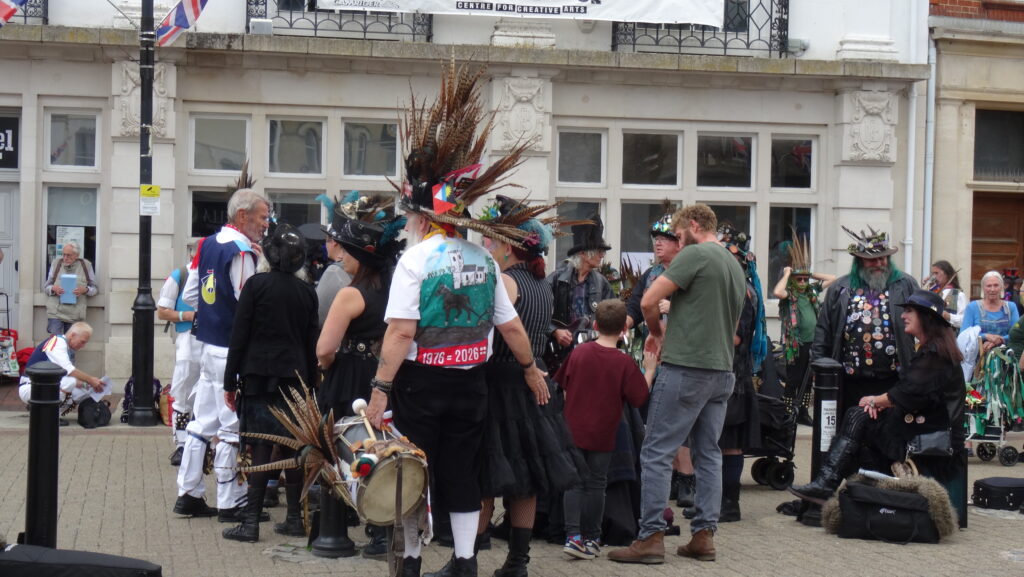
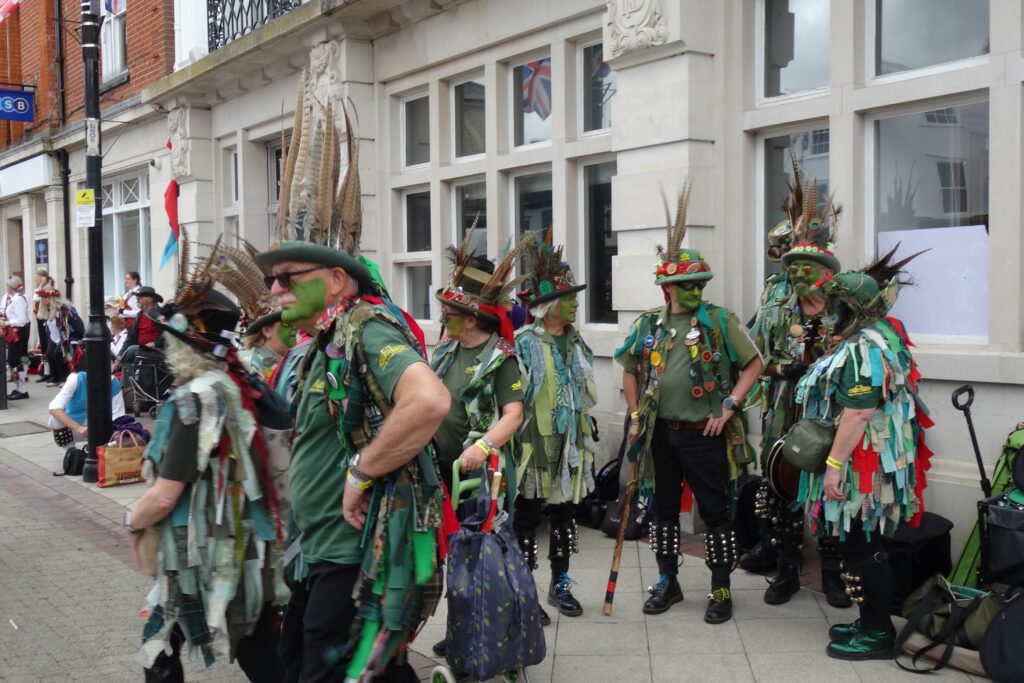
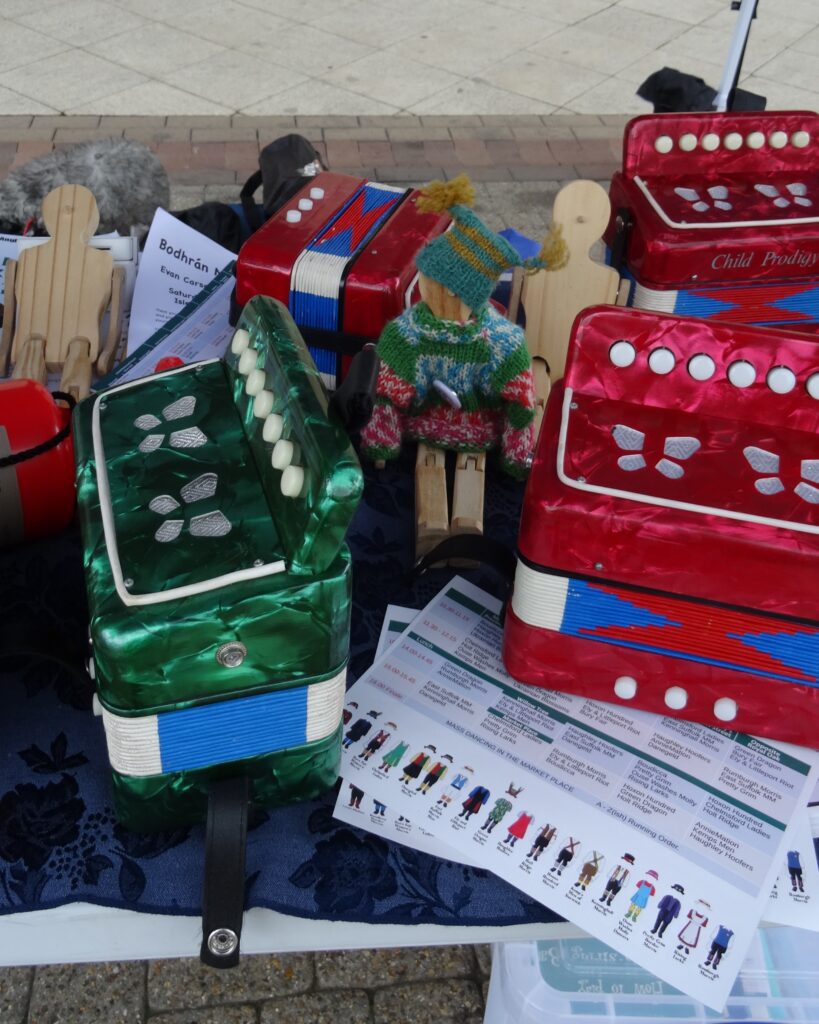
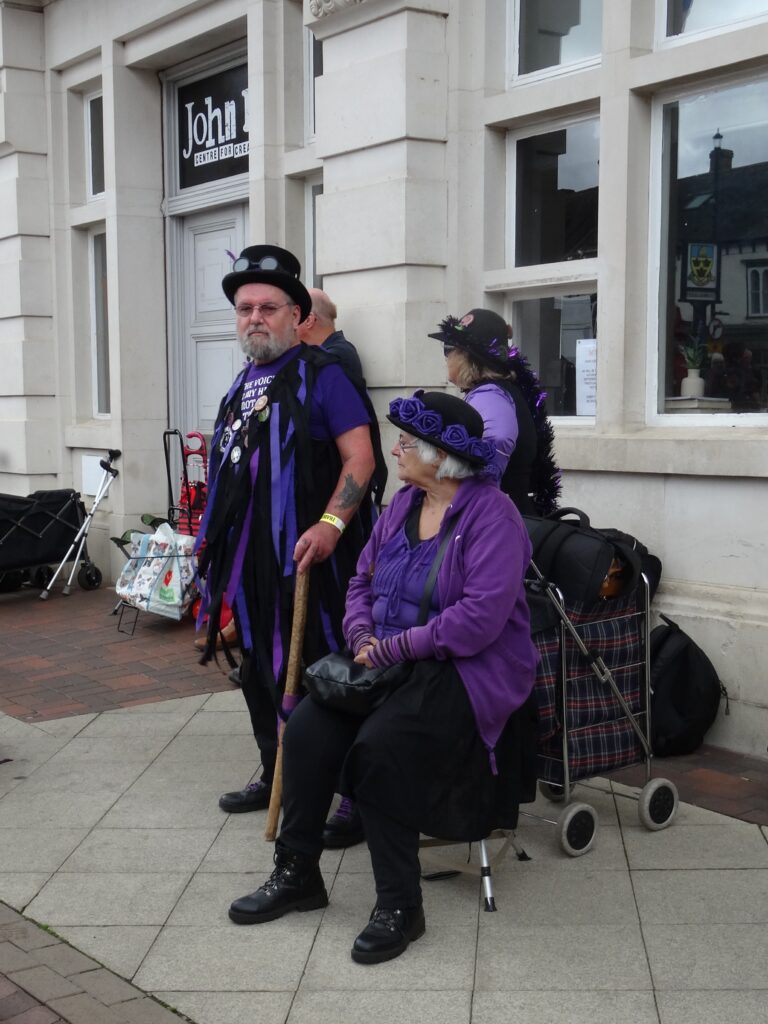
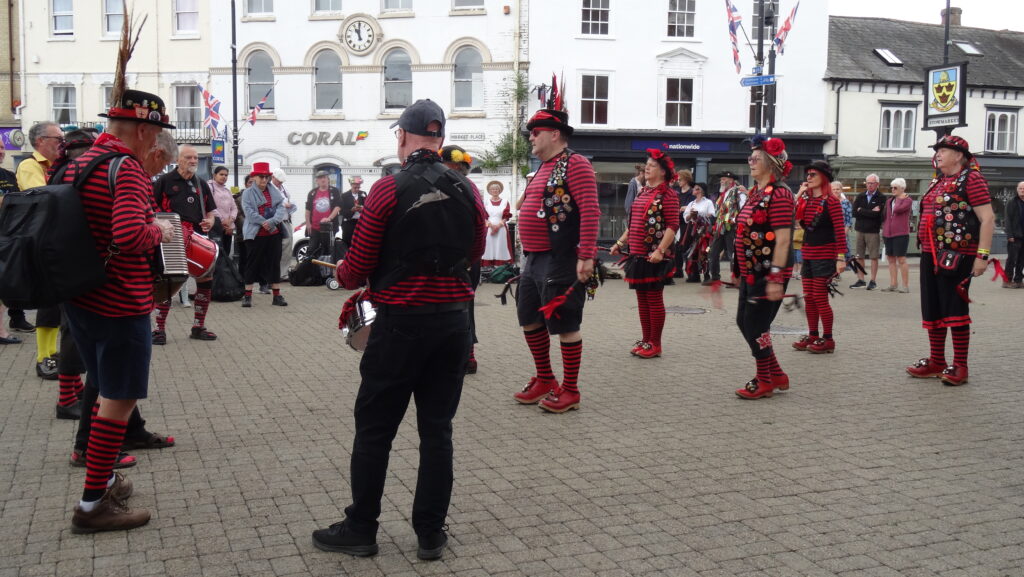
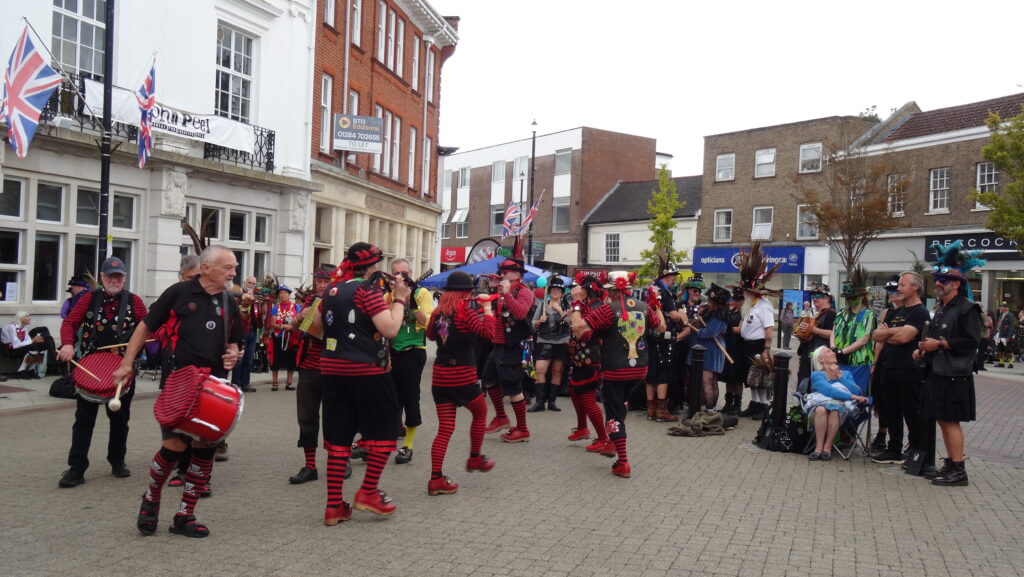
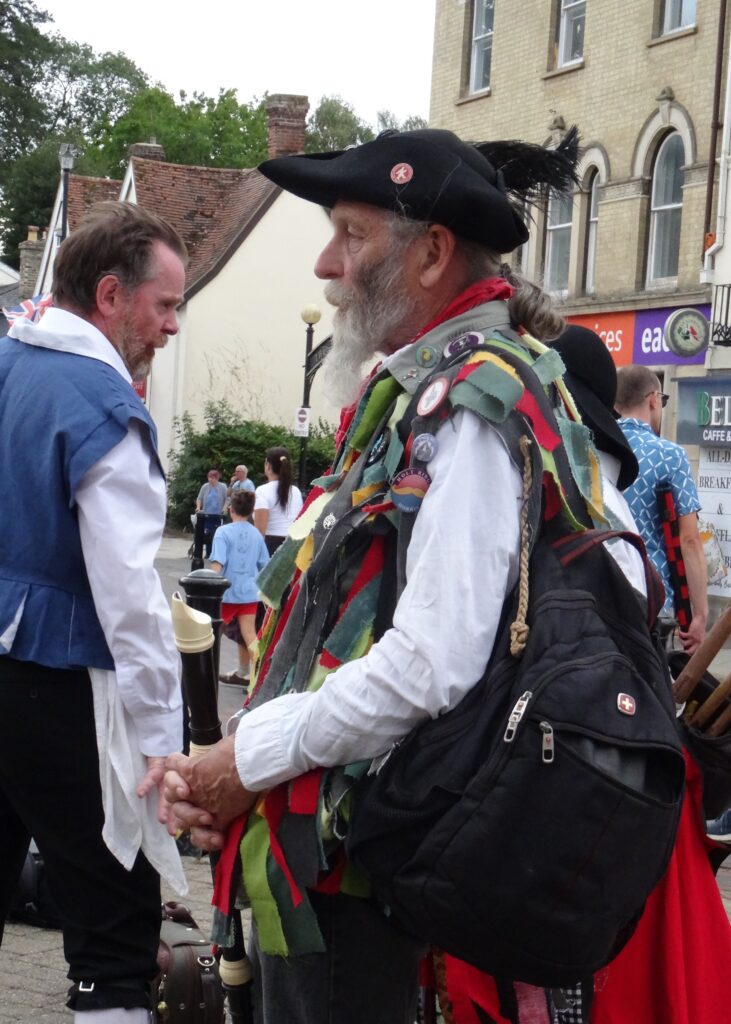
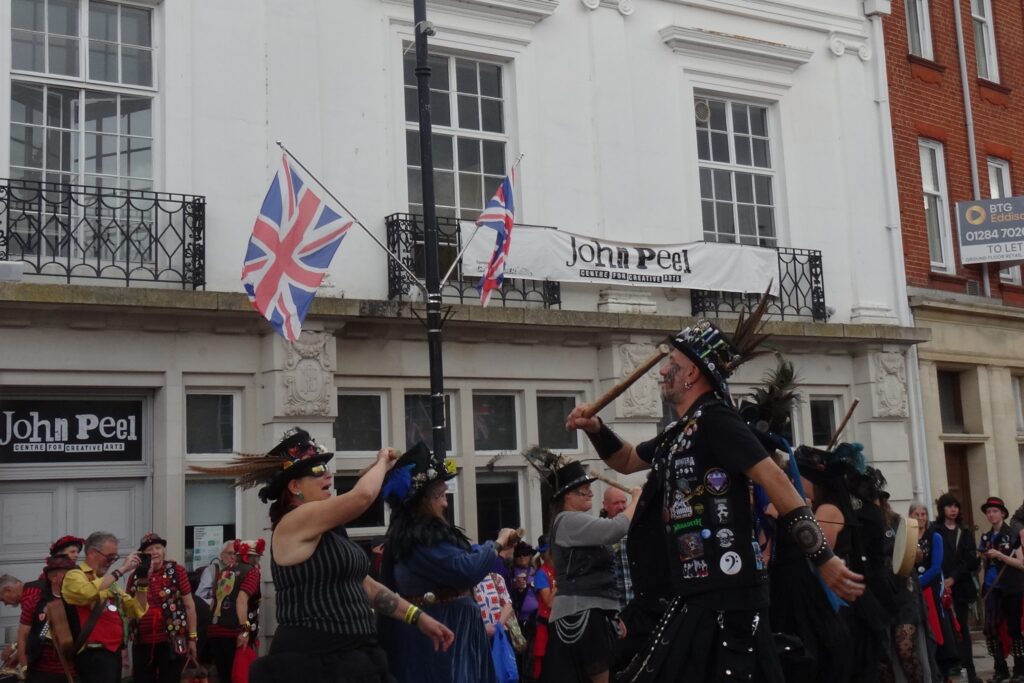
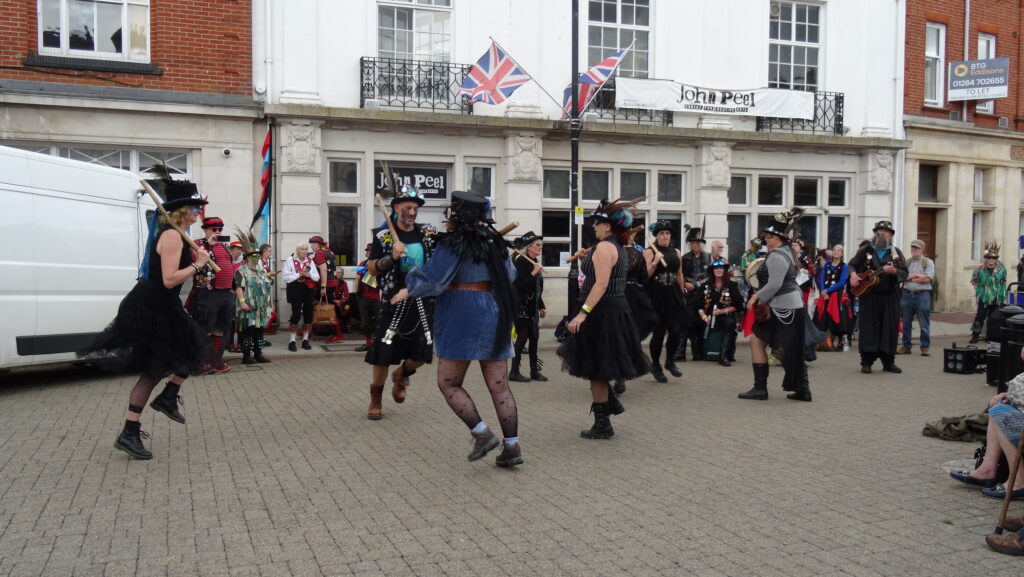
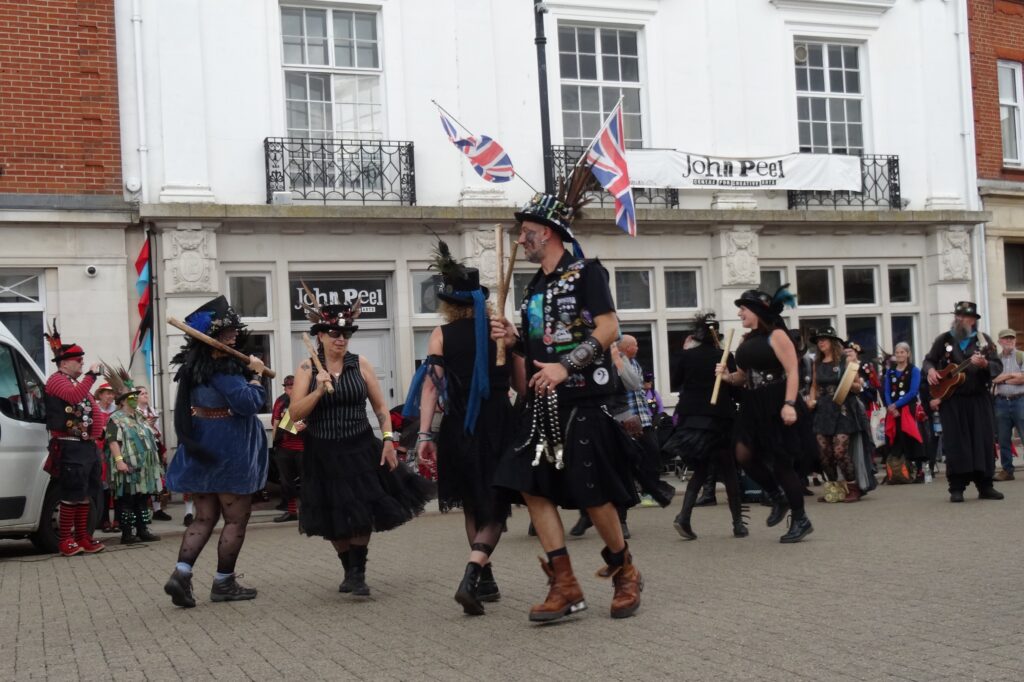
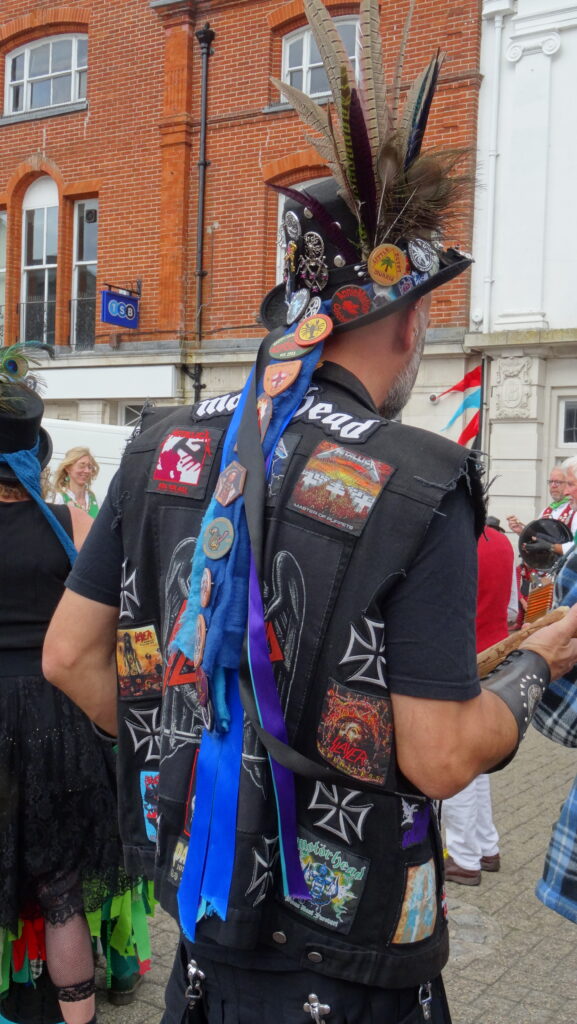
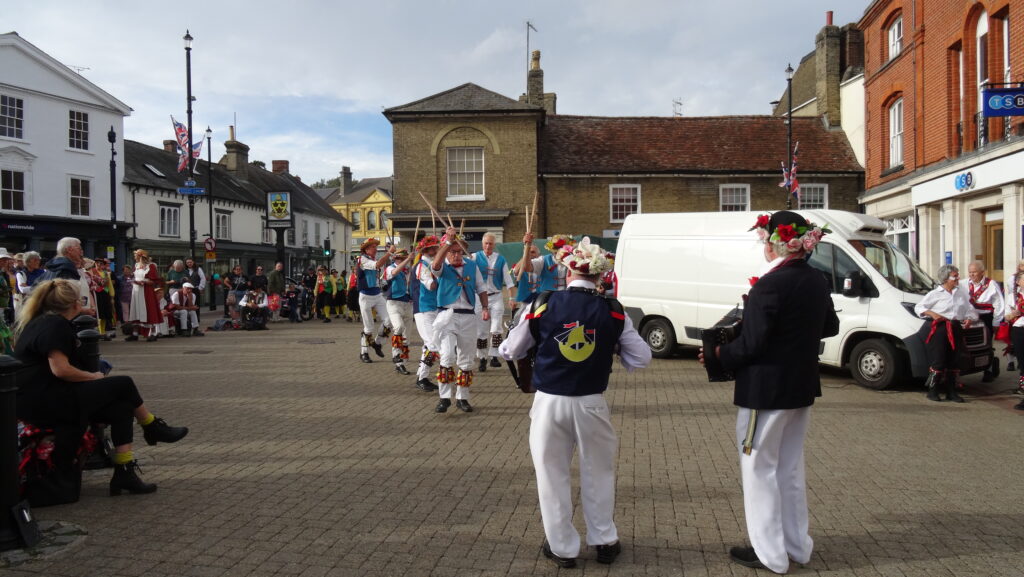
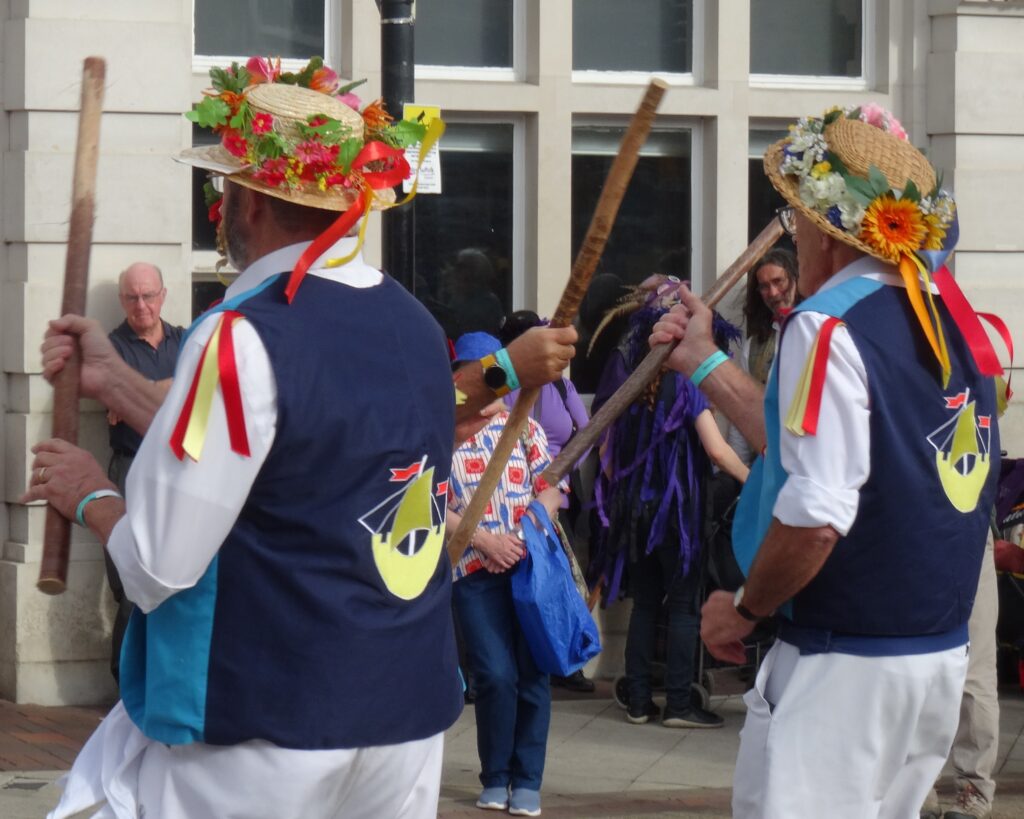
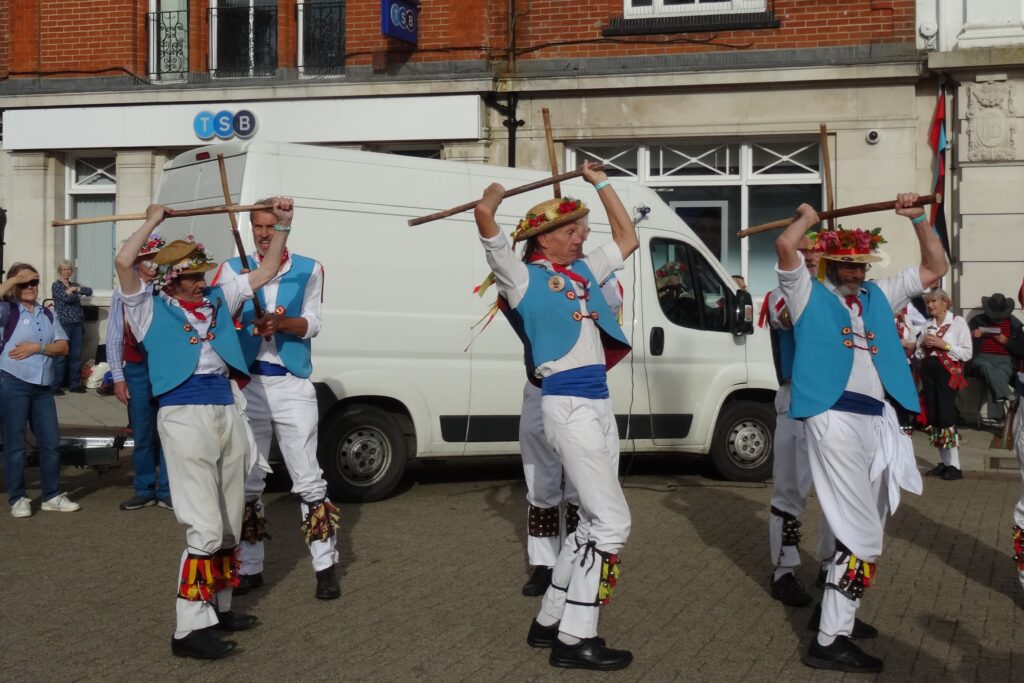
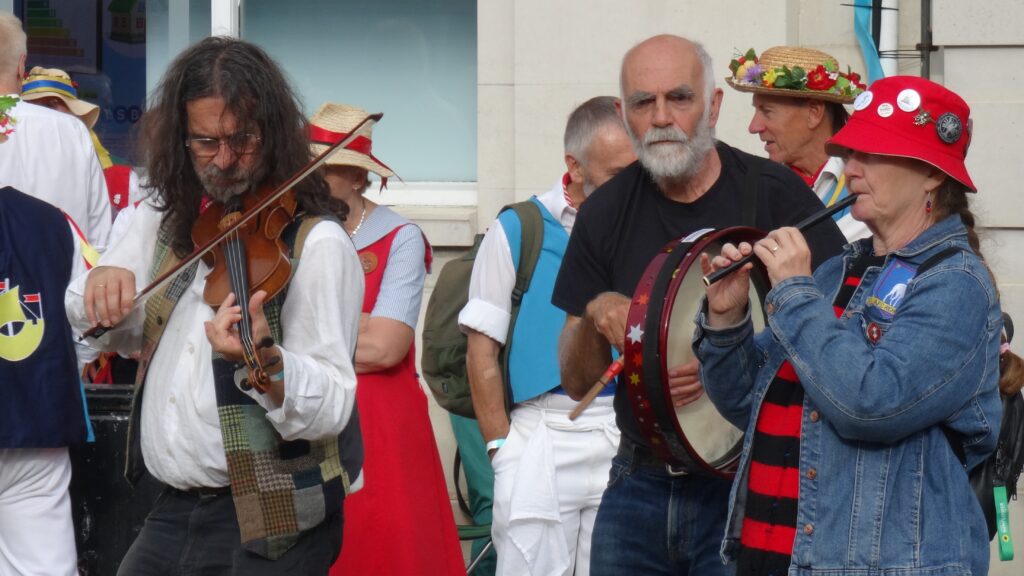
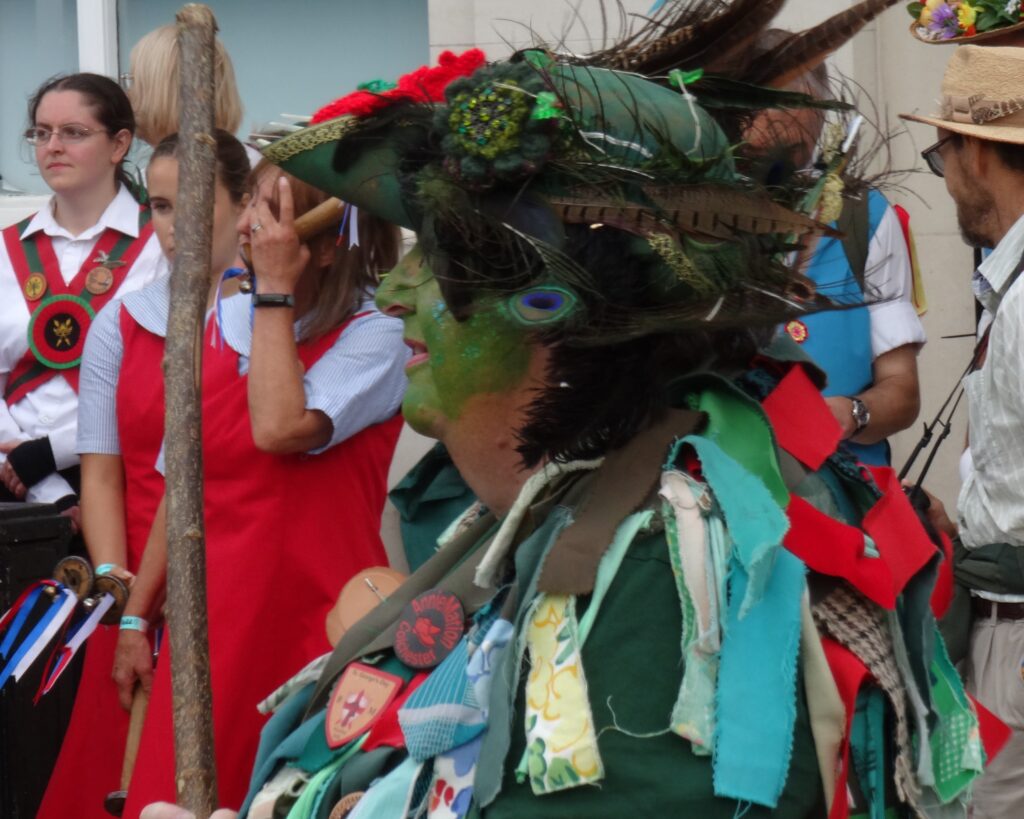
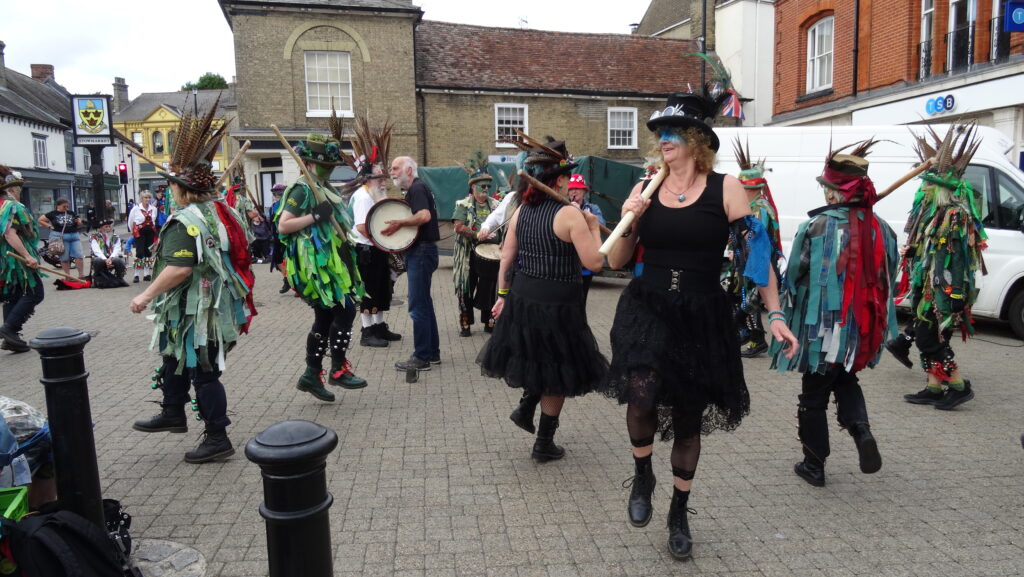
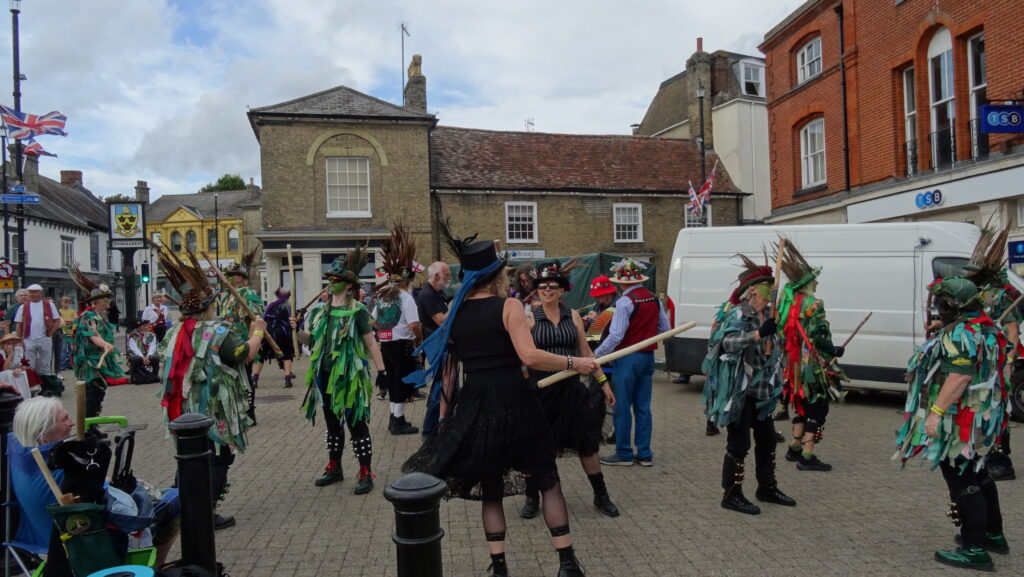
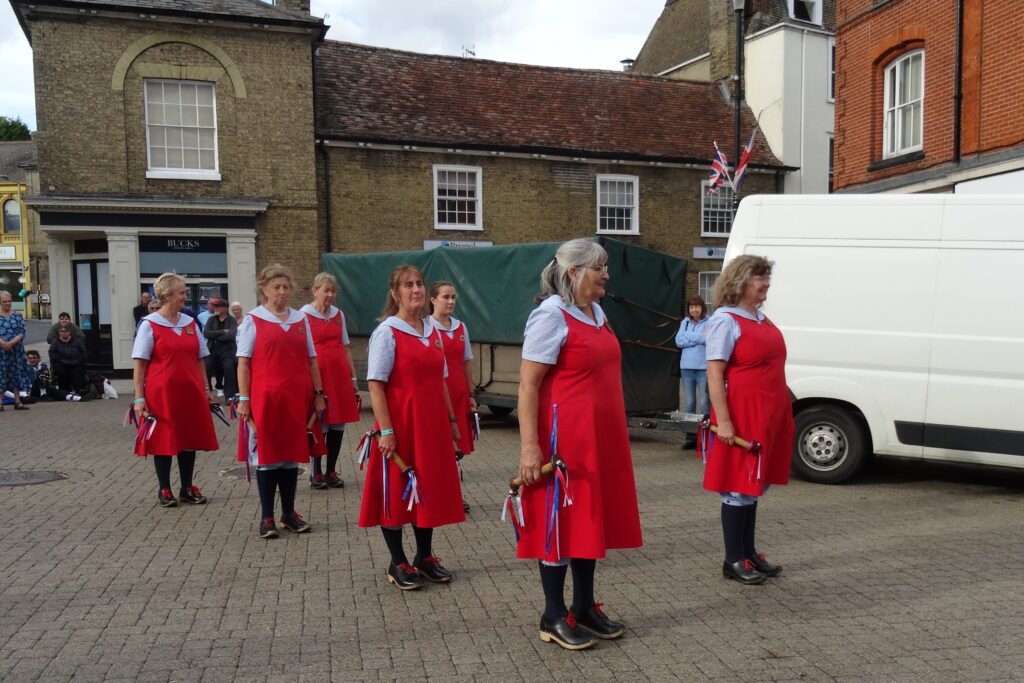
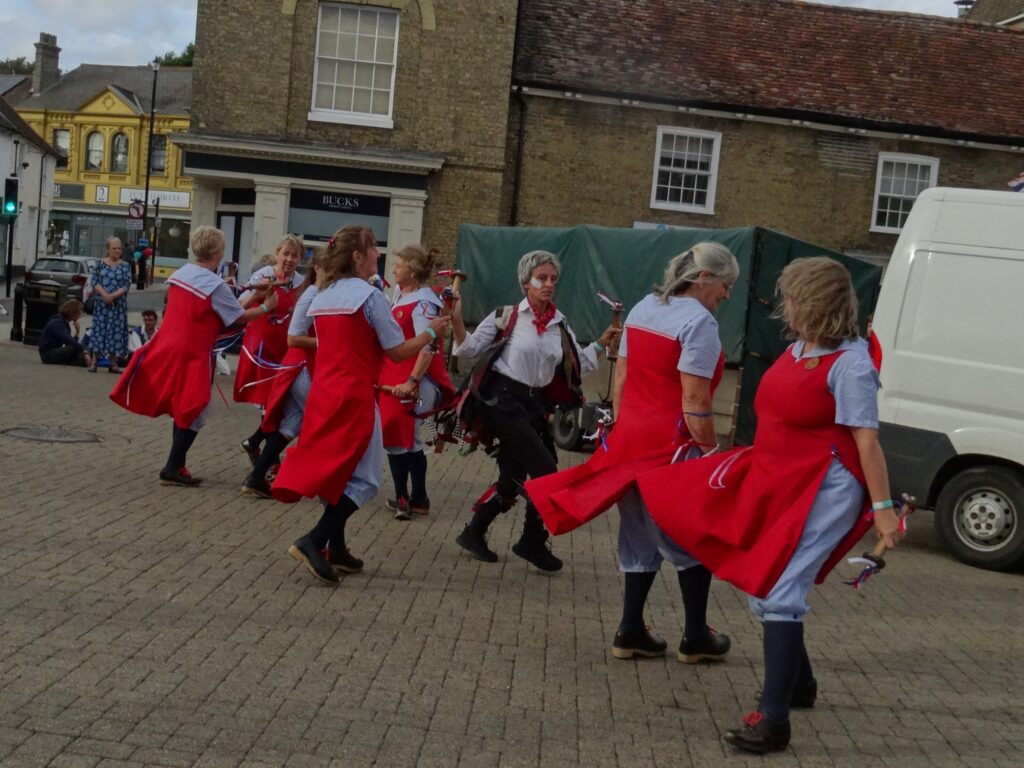
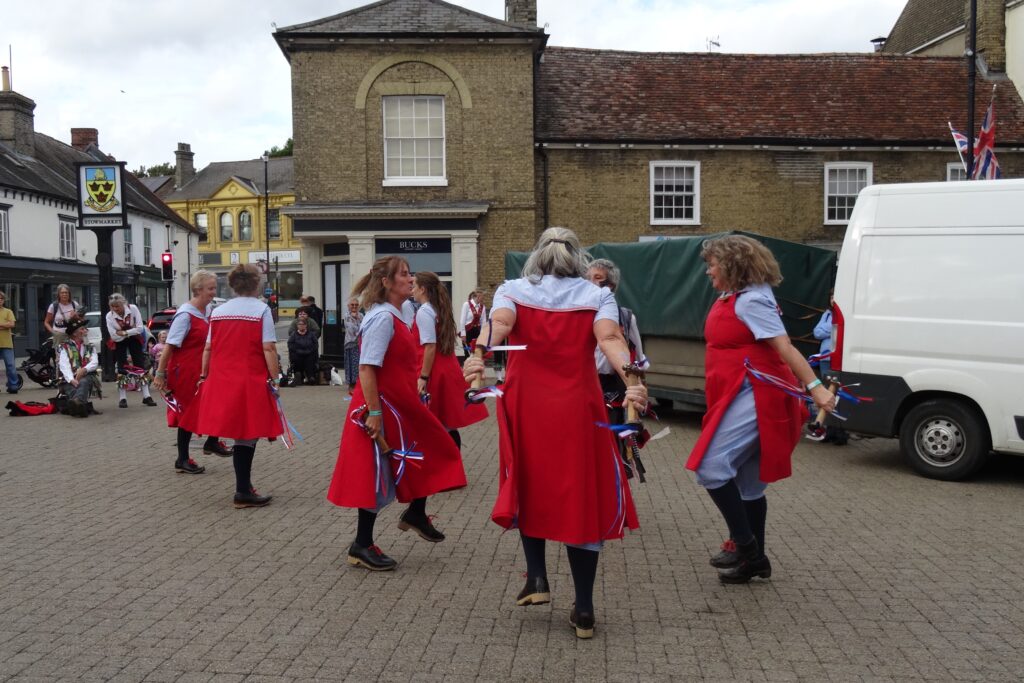
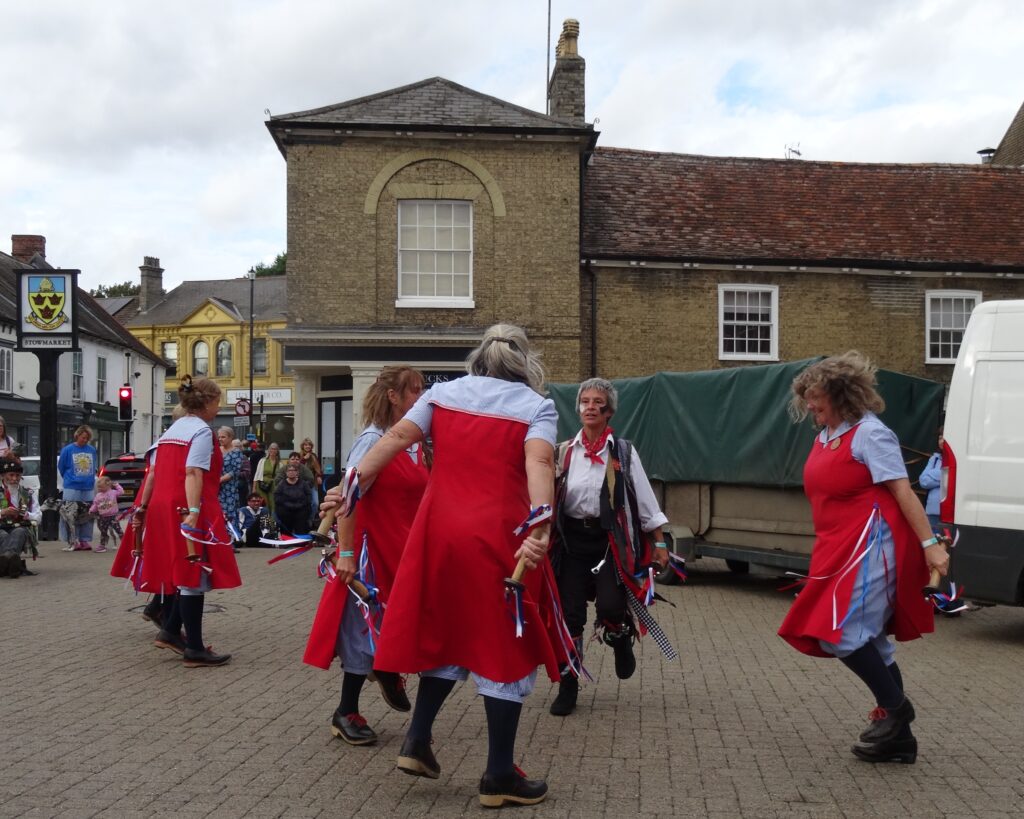
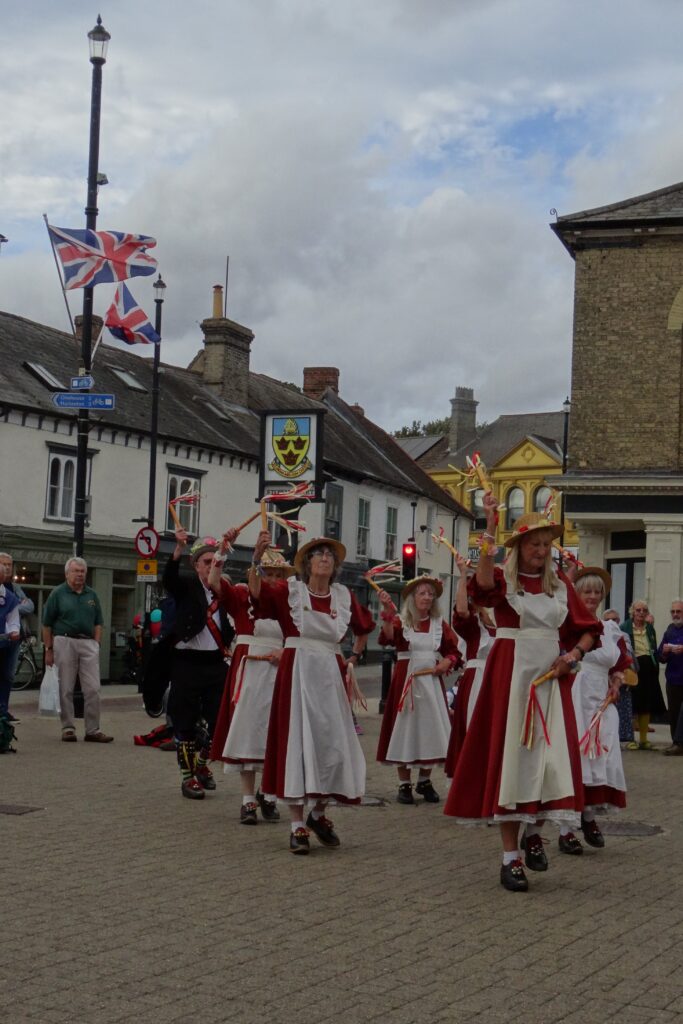
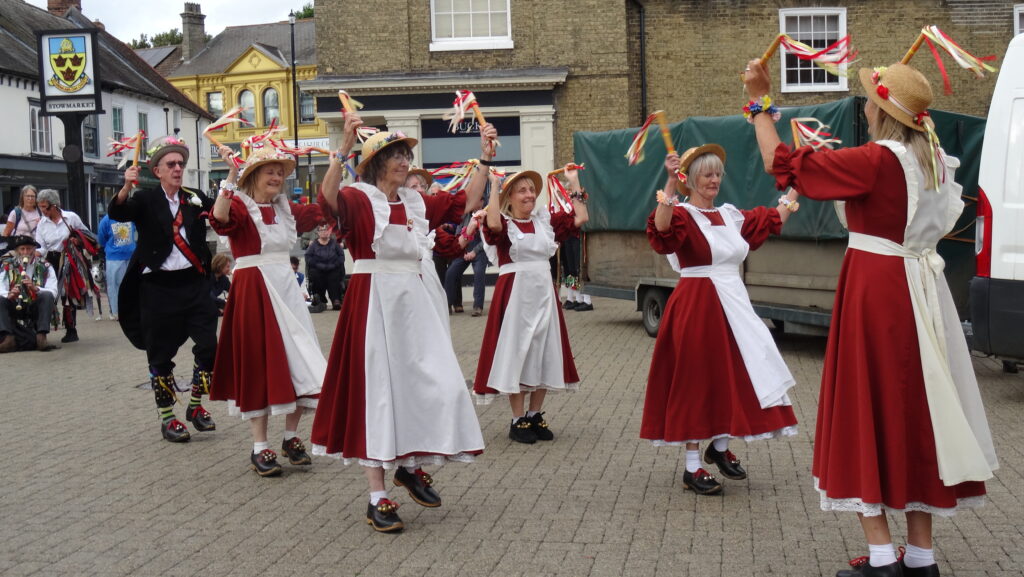
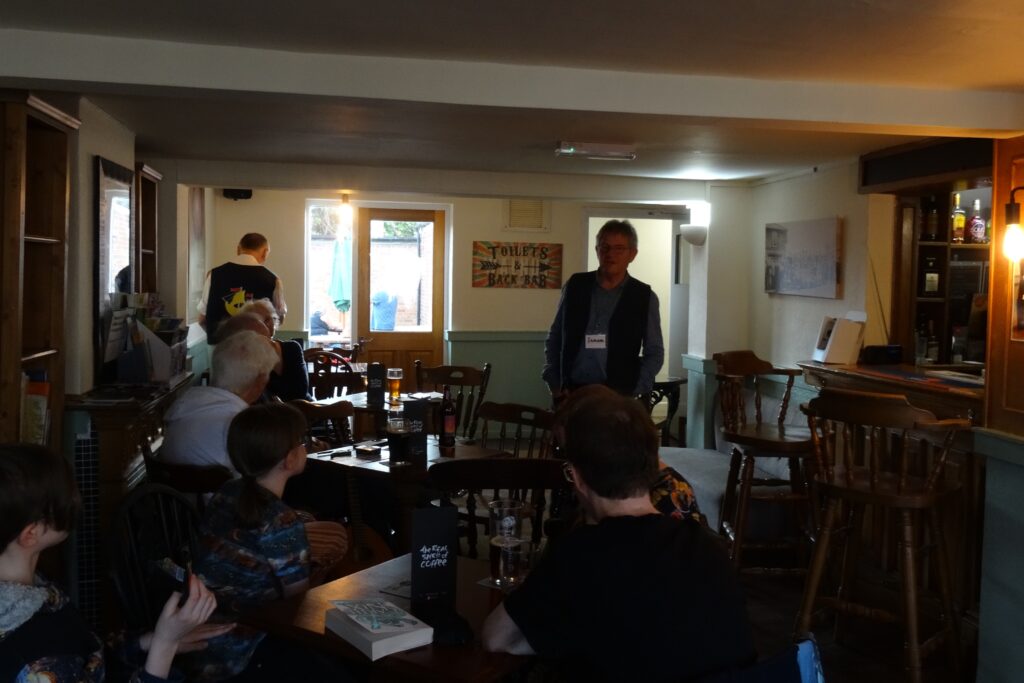
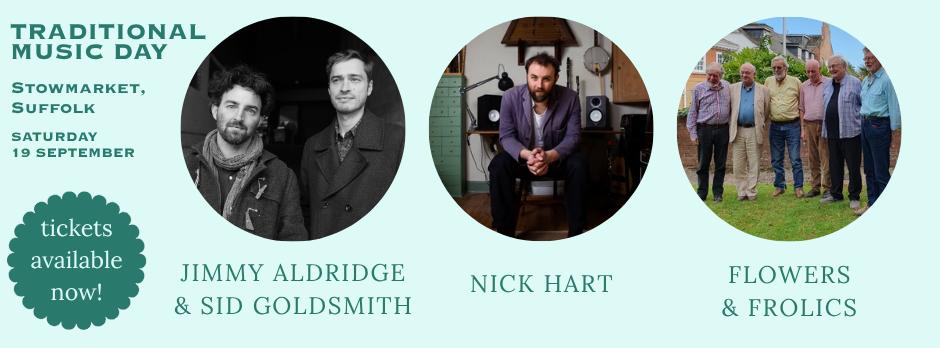
On September 19, 2026 Stowmarket came alive with traditional music, dance and song. Of course you can’t bottle the atmosphere, or capture it on the screen, but here’s a taste of the wonderful day we enjoyed.
Photos by Gayle Wade & Ian Trouse – thank you for these. It’s brilliant to have a lasting snapshot of the day!
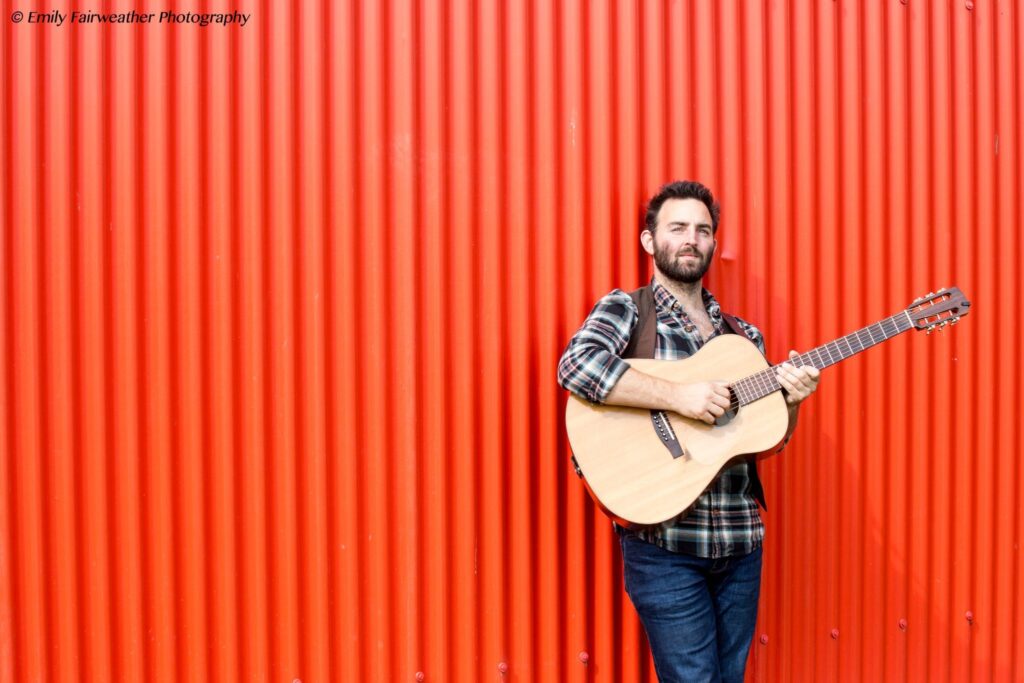
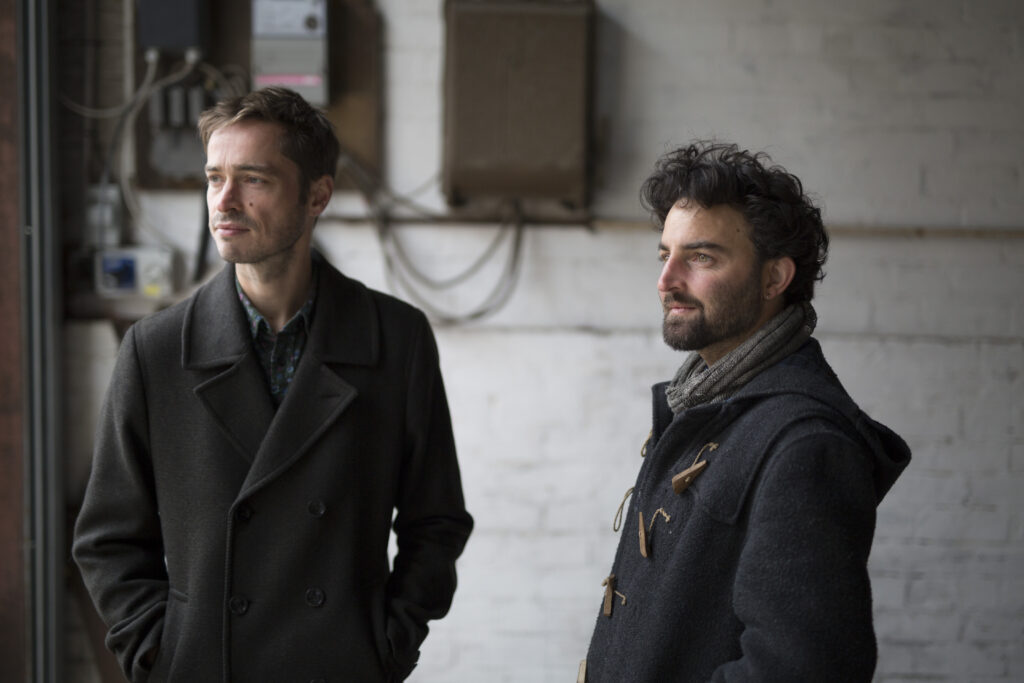
One of the many wonderful things about folk and traditional music is how expansive and inclusive it is. Songs blend with tunes blend with singers – and just as the songs reveal themselves differently in different seasons of life, so too do different combinations of musicians unlock alternative aspects of this music. Sid Goldsmith is one such musician. A multi-instrumentalist who stumbled into the folk world running sound at his local as a teenager, he now features in several different musical incarnations: with new-folk trio, Tarren, with the Tamsin Elliot Trio, with Jimmy Aldridge, with whom he’ll be headlining this year’s Traditional Music Day, and with Jimmy and Lady Maisery for the Awake Arise and Wakefire projects. This conversation took us from early days running sound in pubs, to possibly the most wonderful instrument-acquisition story you’ll ever hear!
“To be a great folk singer, you have to be a great storyteller, as Jimmy Aldridge and Sid Goldsmith are clearly aware. The duo are both fine singers and multi-instrumentalists.”
The GUARDIAN
So let’s start off with the kind of obvious connection, Sid. How has being from East Anglia informed your musical career and your journey?
I guess I discovered folk music when I was in East Anglia by the Milkmaid Folk Club turning up at my local boozer, [The Railway, in Wymondham]. A couple called Terry and Jane bought the pub and set up the folk club in the back room of the restaurant.
I’d sort of gone from grunge music, grunge and rock, and worked backwards through electric blues to acoustic blues, and I was just on the cusp of thinking, okay, maybe folk music is okay. I was playing guitar through this huge PA amplifier at the time, and because I had that, I got the job of doing sound for the folk club.
I think I was like 18, maybe 19, and I did sound for Martin Carthy, Peggy Seeger, Vin Garbutt, Tommy Emmanuel, John Renborn, James and Nancy Kerr – all these people came through, and it was just this incredible awakening exposure.
Any particular moments that stood out? That’s quite the education you had there!
Vin Garbutt arrived with this shock of crazy hair and his completely outlandish character. I’d never met anyone like him, and I remember just being in tears with both his comedy and his tenderness, and talking about all these political issues that I’d not really engaged with, but was starting to think about at the time, and everyone was sitting there singing this all out of them in this room that I’d really only ever associated with getting pissed as a teenager and listening to rock bands.
It just really went in, what this kind of music and performance can do to a group of people. It was incredible, seeing and experiencing how we can all share this thing in the room together. So I’ve sort of been chasing that ever since, really.
Is there something about folk music that makes that experience different to other genres?
I think there are a few different ways, actually.
Firstly, in the song tradition at least, it’s often actively encouraged for people to to join their voice in, and in doing that, it changes the dynamic. You’re not just part of an audience; you’re part of the performance. Then there’s the informality of the performance – performers are always very keen to interact with the audiences. There’s a back and forth with the audience of energy and conversation that you don’t really get elsewhere.
With some of the people that I saw in that folk club, there was a lot more talk in the music, and that might have been a bit over the top, but you also often left feeling like you got to know a person and their story during the night.
For me, music has always been a tool for connection. So I’m always looking for songs that I know can create a moment where there’s an exchange of energy between me and the audience, and they’re the tools rather than the end goal, I guess.
But of course the whole canon of songs is fascinating in itself for the historical content that’s in there.That’s maybe another way that it’s different is that you’ve got all of this music that is a shared heritage as well? So I think on some subconscious level, even people that aren’t already converts to folk music do kind of sense that there’s something more than just that this person’s written a song.These things have grown over time and been altered and become part of our story.
I think the first time I saw you play, you were playing a cittern, which isn’t a particularly common instrument to see or hear. What’s your journey with musical instruments been like? I’m assuming you didn’t start off there? The grunge and post-punk scene weren’t renowned for citterns, after all….
Well, when I started it was just guitar really. I’d been playing electric guitar for quite a long time, and then I got an acoustic guitar to play acoustic blues. So I was doing all the Robert Johnson 12 bar stuff. My first girlfriend played folk music, and her dad was a banjo player, and he actually used to run the Sunday sessions at the Railway. We used to have these afternoons where we’d just absolutely raise the roof off the building with our voices, have a Sunday lunch, and then get back to it and raise the roof again.
But the evolution to the cittern was much later. I met a group of people when I moved to Bristol that were playing mostly Irish traditional tunes, and I ended up picking up the double bass to play in that, and I was really enjoying backing the tunes. Having come from a song tradition, learning how to rhythmically back tunes was really fun. And then after a while of doing that, I felt like I was missing out by not playing the melodies. I got hold of the English concertina first, and that was my first tune instrument. I’ve probably been playing that for about ten years at this point.
Lockdown was when I got hold of the cittern, and that’s kind of become my main thing to a degree. At the moment I’ve been concentrating on the concertina again for a particular project, but each of these instruments enables you to straddle both worlds, so you can play the tunes, but you can also back the tunes, so you can jump between those roles and it’s always lovely to come back to.
What drew you to that instrument?
I wanted the cittern specifically because it has quite a wide range, so I can still play all of the guitar chord repertoire as well as the tunes. Supposedly, it was the most popular instrument in England in the mid 1800s. There’s the story that every barber shop would have had one on the wall, and people would have played tunes to each other while they waited for their shave or haircut. It’s fallen out of favour in that form, but it has been brought back as a larger instrument, especially in Scandinavian countries. It did have a bit of a revival here in the 70s and 80sand it’s become really popular for Scandinavian fiddle tunes.
I’m sort of on a one-man-mission to bring it back to the English tradition, but I’m also finding it a really lovely tool for writing on, and making lots of solo arrangements. It’s great for Tarren [Sid’s trio with Alex and Danny] because we all have this ability with our instruments to jump between backing or leading, which means we can kind of swap those roles between us all the time. So it really suits that band.
Why do you think it fell out of favour, and what do you think it tells us about folk and traditional music 200 years ago?
Mostly I think it just needed developing. At that time it was really popular, it was a shorter scale, and it was generally played with the fingers, so it was quite a gentle instrument for parlour and performance. Now it’s much more commonly played with the plectrum, and it’s taken instrumentalists to pick those developments up, or help luthiers develop the instrument into something that really fits into the more modern way of playing tunes.
Musicians and luthiers have this joint role of making the instruments work within whatever style they’re playing in, so I think it’s a journey of finding what fits, and I’m still on this journey with my cittern. My own is built in the Scandinavian style, so it has these slacker strings that are very different to how an Irish bouzouki player would play. You can get these sort of languid, loose ornaments in there that really suit Scandinavian music. But I’m on a constant journey of changing strings to sort of figure out where the line is that really fits with English and Celtic music.
I don’t think that luthiers get quite the credit they deserve in the development of musical styles. There’s a festival that we were supposed to go to in France, that was sadly cancelled, which began as a luthier’s festival, and it’s now a 25,000 person strong festival. But the luthiers are still a huge part of it, and it’s where people go to ask the questions that they need to ask to get what they need from their instruments to develop their music further.
Do you remember a particular tune or song, maybe from the days of The Railway way back, that really piqued your interest?
Probably the most obvious one for me is the Chemical Workers’ song, which Jimmy and I perform together. We sing it pretty much every gig, and that was one of the light bulb moments in The Railway when Vin Garbutt sang it. It’s such a heavy subject matter, and while everyone acknowledged this, they were also having a great time listening and singing it all out. And I think that that was a huge moment for me to realise what’s possible with this music. There are another two that I always come back to that have accompanied me through my whole life that I just find myself singing in the quiet moments are The Joy of Living by Ewan McCall, and Dick Gaughan’s version of Robbie Burns’ Westlin Winds. I feel like they’re running alongside my life, and I often sort of reference back to them to see how I’ve changed.
That’s a really interesting way of putting it. So how have they? Are there any ways you can pick out that they have changed or grown with you?
Themes of nature are ones that I notice. My relationship with nature is always deepening, and whenever I’m listening to that song, the references to certain animals and landscapes are very evocative to me, and I think make me realise how much I need that side of myself – the nature-loving, exploring part of me. There’s this beautiful kind of structure in The Joy of Living, which is one of the last songs that Ewan wrote before he died, and it’s saying farewell to nature and the hills that he can’t access anymore because of his age, and then his children, his love, and then the last verses are kind of summing up within his death of like what he wants to happen. He wants to be returned to nature after his death, and there’s the clarity of those four chapters. We’re always moving through those four stages, so I think every time I return to the song, I feel like I’m in a different stage.
Makes you realise the depth and complexity of songs when they can reach you over the various decades of your life, doesn’t it?
Absolutely, it contains multitudes.
Back to you and Jimmy. How did that partnership emerge, Sid? How did you guys meet and start?
Well, we grew up very close to each other, but we didn’t meet in Norfolk. We actually met in Bristol. There was a group of Jimmy’s friends that all moved down from Leeds together and were playing in the pubs, just in sessions. And I just bumped into them on a St Patrick’s Night session. I was playing Bodhran at the time, and we ended up gravitating to the same pubs to play on the same nights. And Jimmy and I would end up sitting nearer each other so that we could play on each other’s songs. It happened very organically.
Then there was actually a band New Shoots competition where you had to arrange three songs. We entered that with three songs, and we got through to the next round, and we thought, “Well that was fun, but now we’ve got to arrange another three songs”. And then got through the next round, and again: “Well that was fun, but now we’ve got to arrange another three songs”, and then we got through to the final. We didn’t win – we were runners up to Effra, who were a great band – but we then had these contest videos and a little repertoire, and we just started doing gigs locally and really enjoying it. It always just felt really easy. We both had this backlog of songs that we didn’t have a project for, and that we’d picked up along the way.
The first album pretty much came about after asking which songs we knew, and we just arranged them together and went for it. It was very simple, but it has always felt very easy with Jimmy: the harmony singing just worked.
Did you focus on music from East Anglia?
Very early on we talked about making a project about the music of our home county and just learning all of the Norfolk songs from the big singers like Harry Cox and Walter Pardon, and we pursued that a bit throughout our albums.
What’s your favourite one?
Oh blimey, I love Walter Pardon singing, and I just find it so tender and personal. The one that we always enjoyed singing was Let the Wind Blow High or Low, which is a lost love song. He lost love very early and never found it again and I think you can really hear that in his singing. Yeah, that’s the one that we always come back to, but then there’s so many others, like Lofty Tall Ship. That’s a great one.
So, you’re part of several groups and musical pairings – you and Jimmy, obviously, with Tarren, with Tamsin Elliott as part of her trio, and the Wakefire album was released recently. What can you tell us about that?
Okay, so Wakefire is the second show with Jimmy Aldridge, myself, and Lady Maisery, (Hannah James, Rowan Rheingans and Hazel Askew). Jimmy and I supported Lady Maisery many years ago on a few gigs on a tour, and we got up on stage and sang with them on the last night and had a ball and so we decided to make this Christmas show, Awake Arise, which has now been going on for years. I think we’ve done it seven or eight times now, and that will be out in December again. We’ll be touring with that.
While we were doing that show we wondered what it would look like to do a summer version of it. And so we’ve been kind of working away on that for the last four years. We had some help from the FolkEast Festival from John and Becky [Marshall-Potter] who supported the creation of it, which really helped. And this year we were finally able to go out with a show that we didn’t have to change from where we left off last year. The show was locked, and we had the album with us this year for the first time. So that was really nice to have it as a kind of complete thing that we can go and just perform with confidence for people.
We’re really looking forward to seeing you both at Traditional Music Day – does it feel like a bit of a homecoming?!
Of course! But it’s doubly exciting because I’m going to be moving back to Suffolk in February, and just really excited to get embedded in the music of that area again, and just really, you know, I think because I left when I was 21 or 22 I’ve felt a bit of a loss of ownership of that material, and I think if I’m there and in the landscape, I’ll feel a bit more justified in really, really hunting through and finding the gems.
So much potential!
The other thing, as we’re talking projects, is that I had a discovery a couple of weeks ago that my big concertina, Big Bobby Honker, is going to be 100 years old in January. So I’m now with very little time to spare trying to make him an album in the next month…
Big Bobby Honker? What’s his story?
I love this story. I started playing the English concertina rather than the Anglo, because I saw a video of a lady called Juliette Daum playing this English bass concertina in a church, and I wanted to make that sound. I scoured the Wheatstone Company ledgers and their serial numbers to find these instruments, and it turned out they had only ever made two of them, and no one knew where the other one was. Juliet wasn’t going to sell hers, and so for the last sort of, well, for about 10 years, I asked in every music shop I went in if they’d got a bass English concertina, and the common response was: “What’s that?” Then, in Philadelphia, when I was on tour with a theatre show, I asked in a shop, and the guy said, “Yeah, I sold it last week”. My heart absolutely sank, and I walked round the block and came back and convinced the guy in the shop to put me in contact with the person who he’d sold it to, and I convinced him via his wife – who thought he had enough instruments already – that he should sell it to me, and he did. So I had a theatre show in Princeton in New Jersey in the evening, and I drove up for six hours into the Catskill Mountains, not knowing what condition it was in or anything, and met this guy in a cafe and brought it home, and then brought it home to England, which is just the most ridiculous coincidence. So now he’s back, and it’s his birthday in January.
That’s amazing. And he’s literally one of two?
Yeah, he’s the other one. He could have gone in a skip or been broken up at any point in that time, you know. It’s bonkers. There are other ones that are similar with more or less buttons, but this is the other one that’s the twin of Juliet’s instrument, and no one knew if it even still existed.
So how are you going to celebrate his birthday? What tunes are worthy of a 100-year-old concertina?
Ha! I’d love to make him an album, and I think it’s going to be a mix. There’ll be some of my tunes, and there will be a couple of Irish, a couple of English, and possibly a couple of Scandi tunes, just because that kind of gives a flavour of what I do on it. But then also, I spend a lot of time just playing kind of low droney ambient things on it, so I’m hoping to do something that kind of shows what noises it can make, and that might be quite out there! We’ll have to see what time allows.
Do you know anything about why he and his twin sister – for some reason, it’s a sister! – were made? Why were so few made? Was it an experimental thing?
Yeah. Well, it’s interesting because when they were being made in large numbers, say when Bobby was made, there were a lot of concertina bands around, so you would have been playing a small ranged instrument that fits into a bigger group. So you would have had ones that have just Big Bobby’s low range or just his high range.
Very few were made that were actually like solo instruments that could do the whole thing. I’m surprised there weren’t more but there is a trade off in extra weight and size that comes with the extra range. I guess it was more of a social instrument, more of an ensemble instrument when they were being made in large numbers.
What do you know about the instrument? Do you have any idea where it was made?
So the company was called Wheatstone. Hang on, I can tell you this because I’ve got a document all about him. At the point he was made, the company was in Charing Cross. Charles Wheatstone was one of our most famous inventors at the time. He invented the Wheatstone bridge that enabled a lot of electronics to work, and had a hand in the telegraph, I think. But this, as far as I know, is the only English patented instrument, and he invented it. It’s supposedly the national instrument of England, but there are relatively few people that play them.
I’m not sure I was even aware we had a national instrument!
Indeed! That’s a can of worms that I’ve been wanting to open: regional instruments. Around here, we obviously have a strong history of Dulcimer players. In fact, where I grew up in Wicklewood was only a few miles from Hingham and Barford where some of our best known players came from. Hammer Dulcimer players, like Billy Bennington, supposedly played in the pubs every lunchtime, and I think I don’t know what truth there is in it, but someone told me once that there was a different style for every village or every town in the country. Doing a study on the dulcimers of England would be a really fascinating deep dive. Maybe maybe I’ll have time in 20 years for that, but we’ll see.
There’s a lot of work done by the Howson family among others. There’s some good stuff online about them.
Certainly at EATMT, there’s quite a repository of information. It’s strange to think about the life and things that were going on in these pubs at lunchtime, and every day somebody was going down to the pub to play a tune.
Yeah, I mean we’re doing our best, you know. But maybe it’s time to bring back lunchtime tunes?!
___
Sid will be appearing as part of the Jimmy Aldridge & Sid Goldsmith duoat our 2026 Traditional Music Day on Saturday 19th September. Tickets are avaiilable now – for the whole day + evening concert, or for the evening concert on its own.
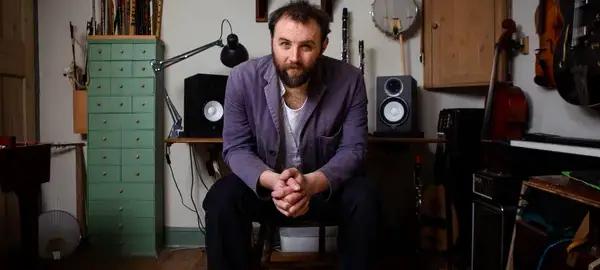
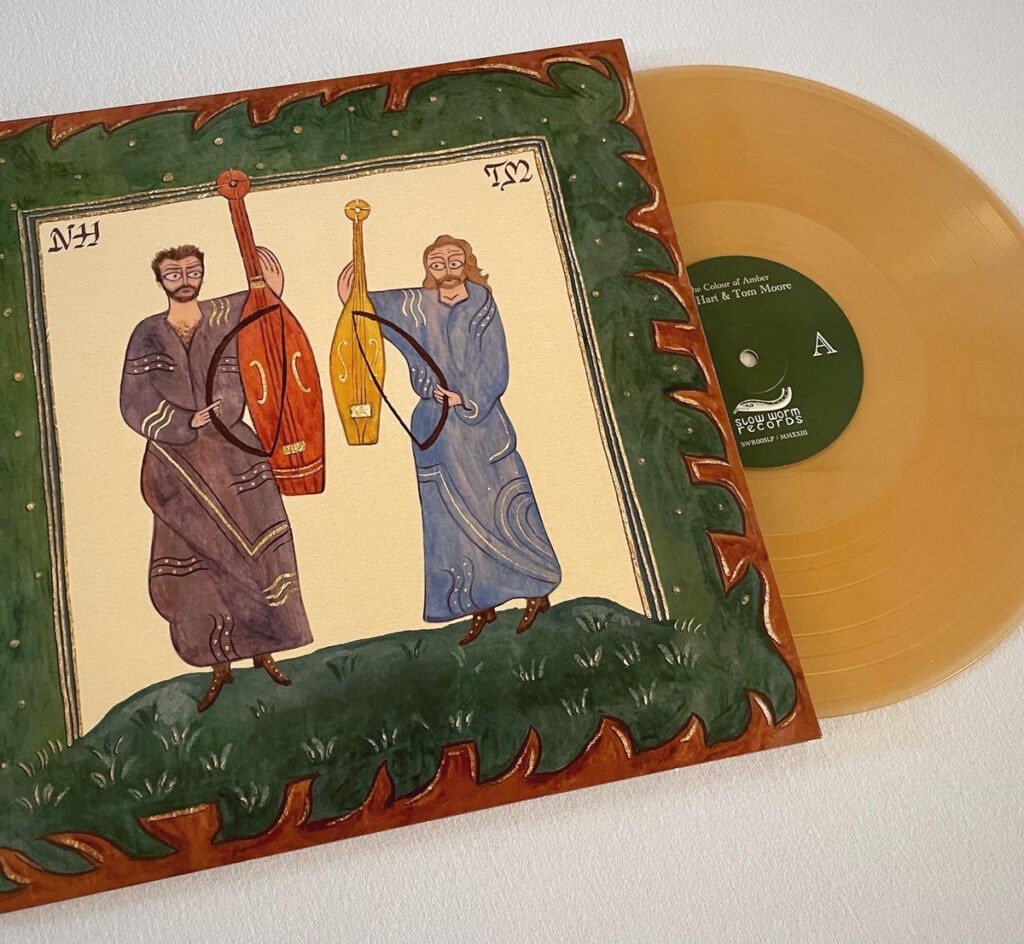
Nick Hart is a truly special musician. Endlessly fascinated by the traditional song of England, but particularly of the East Anglian region where he grew up, his performances combine deeply moving vocals with the kind of virtuosity that reassures us folkies that traditional music’s future is secure. His most recent album – The Colour of Amber (2024) – which he released with regular collaborator, Tom Moore, blends his unique vocals and the haunting sounds of the viola da gamba with Moore’s fiddle, and his most recent project – The Nursery Rhymes Project – is just about to come to fruition.
“Probably the finest interpreter of traditional English folk songs this generation has produced”
-tradfolk.co
He is one of our featured artists at the 2026 Traditional Music Day in Stowmarket and tickets for the evening show (featuring Nick, Jimmy Aldridge & Sid Goldsmith, and Bryony Griffith & Alice Jones) are available now.
We caught up with Nick recently for a freewheeling chat about traditional music in which we touched upon the endless appeal of songs without authors, Hereward the Wake, the importance of local curiosity and much more.
Let’s start with a big question, Nick. What is traditional music – and why does it matter?
I grew up playing folk music, and I grew up in a house where what people listened to, and what they performed and what they participated in, was generally referred to as folk music. And that’s the terminology that people used; it’s certainly the terminology that I used, but the definition – and the goal posts – have widened over time.
When I was at university, bands like Mumford and Sons were also being described as folk, so actually for a while, I was using ‘traditional music’ to refer to the kind of music I played. I used it to define things that are older and pinned to a particular place. There’s a distinction between music that’s held in common, which belongs to all of us – and stuff which is the personal intellectual property of a songwriter.
As for why it matters, well, I think we all have to find and define our own relationship to it. I think it’s important because we’re living in an age where, I think more than ever before, we are encouraged to lean into the individual and when music is discussed, often it’s from the perspective of a musician. I’m not sure that that’s good for us. I think participating in things that are bigger than ourselves, that existed before us and will exist after us, is a really good thing for people. There’s my answer!
How did it all start for you?
I grew up around it. My dad was a Morris dancer. He met my stepmother through Morris dancing, and then when his knees went, he started playing the melodeon for Morris sides, so I was very much there, growing up around the revival of the Morris tradition and listening to all the big names, you know, Kate Rusby and Eliza Carthy and Spiers and Boden. Lots of my childhood weekends were sort of spent sat on my dad’s melodeon case whilst they went about their business.
You studied Ethnomusicology at university – what did you learn from that?
By the time I went to university I kind of had the impression that English traditional music in England had been caught in the nick of time by the kind of Edwardian collectors before it died out. I studied traditional music from all over the world, but in so doing, I realised how much of that premise – that the traditional music of England needed to be ‘saved’ – wasn’t true. There was a much greater sense of continuity than I’d realised, and when I discovered that those recordings were there and they were available, I just guzzled them up.
Had you always gravitated towards the performing of songs from the traditional canon, rather than writing yourself?
When I was about 19 or so, I was living with a musician who was working more around popular music, so I did some projects with him, trying to write songs, which I was terrible at. I’m a dreadful songwriter, but I realised that there could be this great surrendering of ego if I just stopped writing these dreadful songs and just focused my time and effort on this huge body of stuff that belongs to all of us. So it thrust me back into the world of these old songs, and I started discovering a vast array of not only songs but largely East Anglian singers. Finding those recordings and hearing voices from the part of the country that I came from, realising how recently they’d been made was astonishing.
Sounds like a really pivotal moment!
Definitely. I sought out Simon Richie, the great melodeon player, and once I was hanging around with him and seeing how central traditional music was and is to his life, I could see how you can draw a line back through all those old boys. He had gone around with John and Katie Howson, and people like that and played and sung with that last generation of boys and girls from East Anglia.
That direct contact really helped to kind of square it all up for me, and it suddenly made it all make sense. So there’s something which I’m incredibly grateful to Simon and to all those people who saw all those charming rustics out and made sure that I was in a position to benefit from it all.
Having been in that fortunate position to learn from those folks, is there a sense of responsibility as well in keeping those traditions alive?
I think so, yeah. And I think maybe that comes back to the reason why this stuff is important. You know, it’s not for everyone, but these songs have been kept alive in people’s mouths for hundreds of years, and they’ve been kept alive because they’re the work of many hands. Once you understand that, you realise that it is a responsibility. I think the word ‘duty’ has become a bit of a dirty word and kind of strips the joy out of the task because it makes it sounds a bit onerous. There’s a risk we might miss the real meaning of it: if someone gives you something marvellous, and you have enough skill and understanding to do something with it, you can hand it over to other people in time.
Maybe we need a new word. Something a bit less… Gilbert and Sullivan?!
Maybe! The Jews have a lovely word for it: Mitzvah. If I understand the meaning correctly, it is the idea that a duty is joyful to perform. There’s a lovely secondary layer of meaning in that word. Perhaps ‘responsibility’ is slightly less loaded than ‘duty’, but maybe it amounts to the same thing.
Back to your studies: did you find that studying other kinds of folk music from around the world helped you understand England folk music and its culture better?
One hundred percent – and I think that’s the greatest thing I walked away from that degree with actually: realising that although the grass might always seem greener, in fact lots of music traditions have also been interfered with, had lulls, and have had to be brought back to life or revived somehow.
That was the thing that gave me the greatest sense of resolution to put all my energy into this music: realising that there is nothing anomalous about the English folk tradition. It’s pretty much the way things work throughout history and across borders.
I’ve spoken about this a lot over the years, but it’s both interesting and baffling to me that you quite often see people deal with a sense of unease at their own country’s history by leaning into other peoples’ culture. Isn’t that just a continuation of a colonial mindset? I was fortunate to meet some amazing musicians from around the world during my degree, and I became more and more conscious that I didn’t want to be meeting them with a pith helmet on my head and clipboard in my hand: I wanted to be able to meet these people from a place and assumption of cultural equity – that you are proud of your musical heritage, and I’m proud of mine. I think I felt quite strongly that I had a big point to prove about this, so my response was to go as local as possible.
Hence the return to this region’s music in particular?
I think so, yes. The majority of my repertoire is East Anglian, taken from East Anglian sources. If I’m looking to put together a version of a ballad, I’ll start here, as close to where I grew up as possible, and work out from there until I find something that’s good and interesting.
I get a huge amount out of playing English music and hopefully I’m able to give something back to it, and help it reach the next generation and so on.
We don’t need leaps forward in traditional music. We like incremental things. We like people finding new corners, or new, meaningful, insightful contributions to a musical culture. I think I do and, as far as I’m concerned, those things always happen from within the culture rather from outside it.
Which leads onto next question, which is: how do you think those regional identities, particularly with regards to East Anglian music manifest in the music?
Well, it’s a difficult thing. As I said earlier, there is greater continuity in traditional music of this country than I had been led to believe growing up. But, you know, we’re still compared to a country like Ireland. I remember reading something Chris Wood wrote on this subject for an Irish newspaper: we (English folk and traditional musicians) cannot split hairs in a way that you can in Ireland. I think it’s much harder to make assertions about English regionality than it is in other countries. And I think there are lots of reasons for that, even though – presumably – there must have been localised differences at one point or another.
I was reading recently about Hereward the Wake – and just so we’re on the same page, he was a kind of Saxon posh boy (Anglian posh boy, really), who was sent away on his travels because he was a bit of a handful. He was in Flanders and Ireland and other places, and when he came back to find that the Norman invasion had happened and lots of his family had been killed, he made a last stand in the Fens in Cambridgeshire. We don’t need to go into all that, but there’s a lovely bit in the Gesta Herewardi [the middle Latin text describing this period] where he’s reported to have been granted an audience with one of the kings of Ireland. Wherever he went people were delighted by his ability to sing and recite poetry and dance and all these things and they said something like “he and his companions sung in the distinctive style of the Fenland people.” I found that so delicious, the idea that there was a distinctive Fenland style of singing in the 11th century and frustrated that we have absolutely no way of knowing what that was. I just want to know!
If only we could! What’s your take on our region’s song, dance and music? Is there a way to identify song or music as being particularly ‘East Anglian’?
Yeah, so it sounds like there was a distinctive style in Hereward’s time, but more recently, can we say that there’s anything that really defines East Anglian music as being different to other parts of this country? If we’re being honest, no, not really.
John and Katie Howson did such a marvellous job of capturing, documenting the musical culture of Suffolk (and a bit of Essex and Norfolk as well) and bringing all those musicians together and getting a better sense of the region’s musical fingerprints. But while looking at that as a snapshot of a musical culture in a time and place is incredibly special, I think we have to be a bit careful about making too many assertions about much more than that.
I guess perhaps because of its isolation, East Anglia was pretty well represented for good singers, there were some really, really great singers collected in the second half of the 20th century – and in Norfolk in particular. That’s a pretty remarkable thing. But if you want to take the three big boys of Norfolk folk song, Sam Larner, Walter Pardon and Harry Cox, I mean, those are three very different singers with three different styles of singing – even though they had broadly similar repertoires. I mean, there’s not much you could say that they have in common as singers in terms of their style or anything.
So I guess the short answer is, it’s hard to really make any assertions about East Anglia music being materially different from the rest of the country at least not in the recent past.
So that was a very, very long answer to a very straightforward question.
That’s the typical balance though, isn’t it? Simple question, complex answer, or the other way around?! You just alluded to the fact that East Anglia was geographically out on a limb. Presumably, when people were collecting, they came across people who were still in the communities their kin had been in for many generations. Anything further to add to that one?
It’s an interesting question.
I guess a big part of the reason why East Anglian music can seem in good health is because of the work of people like John and Katie Howson who dedicated so much time recording, starting the Trust and so on. I suppose it kind of circles back to what I was saying about the Edwardian collectors before: you need an unbroken line between the past and present – a focal point and perhaps in this region you had a better chance of finding it?
One more question, Nick: which is the song or the piece of music that to you, is just the gift that keeps on giving?
Ooh. That’s a really good question. I mean, there are so many. It’s like choosing your favourite child.
We talked about the Cambridge in May song earlier in the year, and I think I’ll stick to my guns. I love that song so much because it contains so much. It’s sort of the apex and it touches on so many things that are important to me and encapsulates the reason why I do this.
I also love the fact that my version of it is a composite of two versions from two villages, one of which my dad was born in, and the other one being the village in which my dad lives now: Fowlmere in South Cambridgeshire, and then Debden. It’s basically the same song, but of course there are little differences.
The melody is from the Cambridgeshire version, and it is such a weird melody. You could say it’s in the Dorian mode: a minor third, but with a major sixth, which for me is probably the defining, most English sounding mode. I just love the lovely jumbly mess of this potentially very ancient tradition, with elements of Christianity shoved in it – and what a challenge that presents our ideas of what May Day should be. It’s as if people want it to be this pagan festival, and within that song there are things that you could pin to that. But it gets scuppered by all the Christian elements of the season too. I love how deliciously difficult it is. There are lots of people who wouldn’t be able to make that song do what they want it to. And I like that about it. I like it for its awkwardness.
But in terms of ballads, Lord Bateman is a is a song that is really important to me, and one that I keep having to work, and I keep having to find new things in because as someone whose work has really been leaning into ballads, that one has a lot of emotional heft to it. There you go. There’s your answer.
They’re lovely answers. Nick, you’re a treasure.
For more information about Traditional Music Day (and to get your ticket to see Nick perform on the Saturday evening), click here