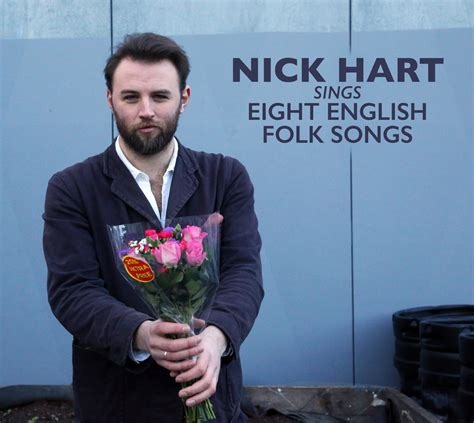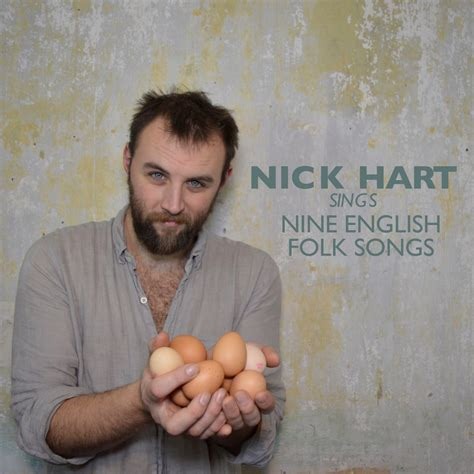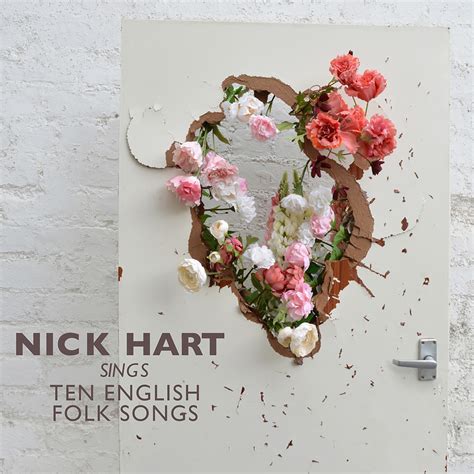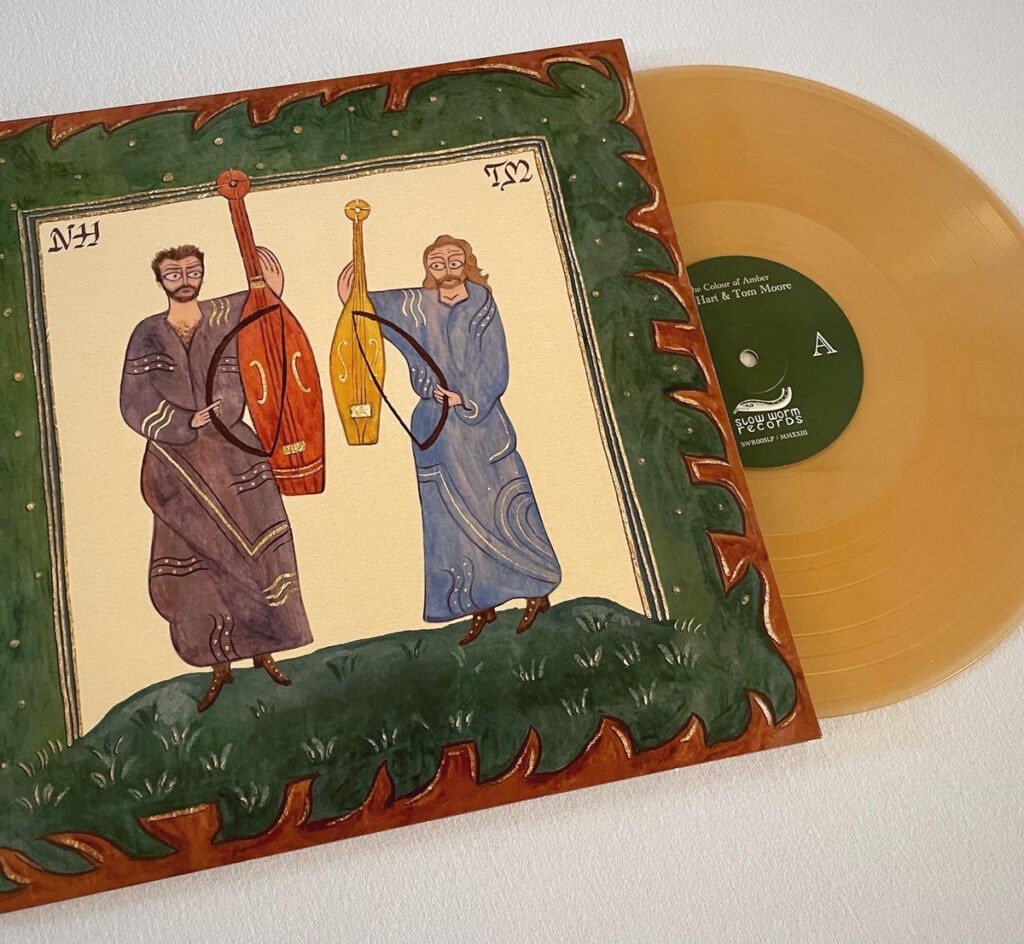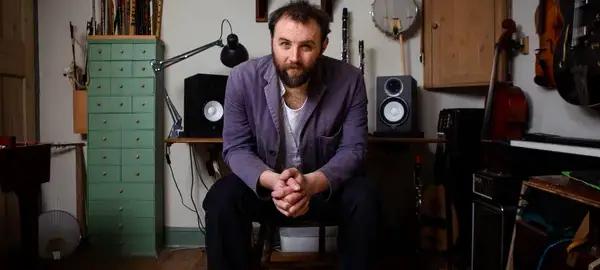
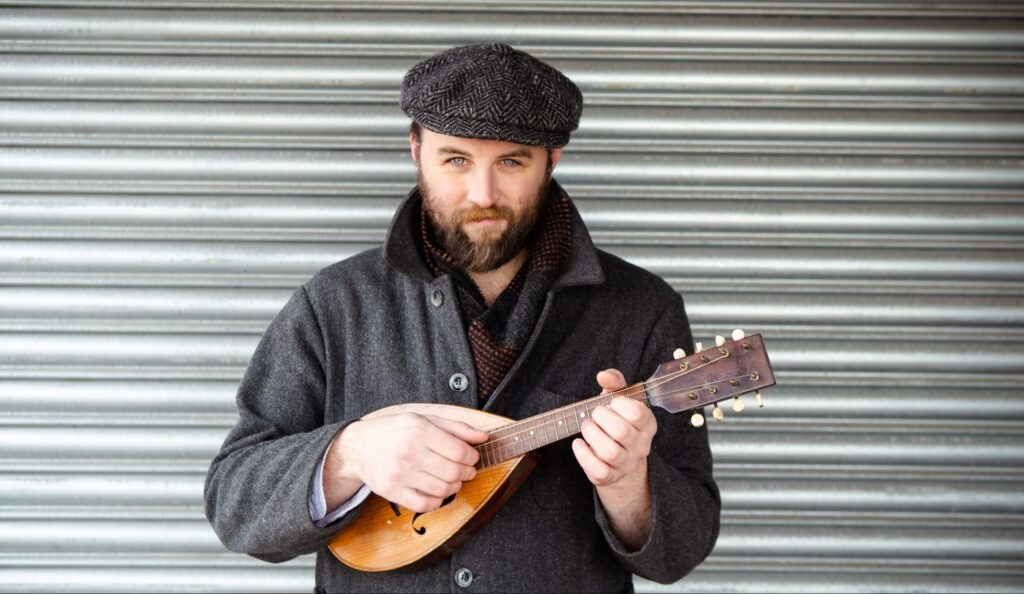
Nick Hart is a truly special musician. Endlessly fascinated by the traditional song of England, but particularly of the East Anglian region where he grew up, his performances combine deeply moving vocals with the kind of virtuosity that reassures us folkies that traditional music’s future is secure. His most recent album – The Colour of Amber (2024) – which he released with regular collaborator, Tom Moore, blends his unique vocals and the haunting sounds of the viola da gamba with Moore’s fiddle, and his most recent project – The Nursery Rhymes Project – is just about to come to fruition.
“Probably the finest interpreter of traditional English folk songs this generation has produced”
-tradfolk.co
He is one of our featured artists at the 2026 Traditional Music Day in Stowmarket and tickets for the evening show (featuring Nick, Jimmy Aldridge & Sid Goldsmith, and Bryony Griffith & Alice Jones) are available now.
We caught up with Nick recently for a freewheeling chat about traditional music in which we touched upon the endless appeal of songs without authors, Hereward the Wake, the importance of local curiosity and much more.
Let’s start with a big question, Nick. What is traditional music – and why does it matter?
I grew up playing folk music, and I grew up in a house where what people listened to, and what they performed and what they participated in, was generally referred to as folk music. And that’s the terminology that people used; it’s certainly the terminology that I used, but the definition – and the goal posts – have widened over time.
When I was at university, bands like Mumford and Sons were also being described as folk, so actually for a while, I was using ‘traditional music’ to refer to the kind of music I played. I used it to define things that are older and pinned to a particular place. There’s a distinction between music that’s held in common, which belongs to all of us – and stuff which is the personal intellectual property of a songwriter.
As for why it matters, well, I think we all have to find and define our own relationship to it. I think it’s important because we’re living in an age where, I think more than ever before, we are encouraged to lean into the individual and when music is discussed, often it’s from the perspective of a musician. I’m not sure that that’s good for us. I think participating in things that are bigger than ourselves, that existed before us and will exist after us, is a really good thing for people. There’s my answer!
How did it all start for you?
I grew up around it. My dad was a Morris dancer. He met my stepmother through Morris dancing, and then when his knees went, he started playing the melodeon for Morris sides, so I was very much there, growing up around the revival of the Morris tradition and listening to all the big names, you know, Kate Rusby and Eliza Carthy and Spiers and Boden. Lots of my childhood weekends were sort of spent sat on my dad’s melodeon case whilst they went about their business.
You studied Ethnomusicology at university – what did you learn from that?
By the time I went to university I kind of had the impression that English traditional music in England had been caught in the nick of time by the kind of Edwardian collectors before it died out. I studied traditional music from all over the world, but in so doing, I realised how much of that premise – that the traditional music of England needed to be ‘saved’ – wasn’t true. There was a much greater sense of continuity than I’d realised, and when I discovered that those recordings were there and they were available, I just guzzled them up.
Had you always gravitated towards the performing of songs from the traditional canon, rather than writing yourself?
When I was about 19 or so, I was living with a musician who was working more around popular music, so I did some projects with him, trying to write songs, which I was terrible at. I’m a dreadful songwriter, but I realised that there could be this great surrendering of ego if I just stopped writing these dreadful songs and just focused my time and effort on this huge body of stuff that belongs to all of us. So it thrust me back into the world of these old songs, and I started discovering a vast array of not only songs but largely East Anglian singers. Finding those recordings and hearing voices from the part of the country that I came from, realising how recently they’d been made was astonishing.
Sounds like a really pivotal moment!
Definitely. I sought out Simon Richie, the great melodeon player, and once I was hanging around with him and seeing how central traditional music was and is to his life, I could see how you can draw a line back through all those old boys. He had gone around with John and Katie Howson, and people like that and played and sung with that last generation of boys and girls from East Anglia.
That direct contact really helped to kind of square it all up for me, and it suddenly made it all make sense. So there’s something which I’m incredibly grateful to Simon and to all those people who saw all those charming rustics out and made sure that I was in a position to benefit from it all.
Having been in that fortunate position to learn from those folks, is there a sense of responsibility as well in keeping those traditions alive?
I think so, yeah. And I think maybe that comes back to the reason why this stuff is important. You know, it’s not for everyone, but these songs have been kept alive in people’s mouths for hundreds of years, and they’ve been kept alive because they’re the work of many hands. Once you understand that, you realise that it is a responsibility. I think the word ‘duty’ has become a bit of a dirty word and kind of strips the joy out of the task because it makes it sounds a bit onerous. There’s a risk we might miss the real meaning of it: if someone gives you something marvellous, and you have enough skill and understanding to do something with it, you can hand it over to other people in time.
Maybe we need a new word. Something a bit less… Gilbert and Sullivan?!
Maybe! The Jews have a lovely word for it: Mitzvah. If I understand the meaning correctly, it is the idea that a duty is joyful to perform. There’s a lovely secondary layer of meaning in that word. Perhaps ‘responsibility’ is slightly less loaded than ‘duty’, but maybe it amounts to the same thing.
Back to your studies: did you find that studying other kinds of folk music from around the world helped you understand England folk music and its culture better?
One hundred percent – and I think that’s the greatest thing I walked away from that degree with actually: realising that although the grass might always seem greener, in fact lots of music traditions have also been interfered with, had lulls, and have had to be brought back to life or revived somehow.
That was the thing that gave me the greatest sense of resolution to put all my energy into this music: realising that there is nothing anomalous about the English folk tradition. It’s pretty much the way things work throughout history and across borders.
I’ve spoken about this a lot over the years, but it’s both interesting and baffling to me that you quite often see people deal with a sense of unease at their own country’s history by leaning into other peoples’ culture. Isn’t that just a continuation of a colonial mindset? I was fortunate to meet some amazing musicians from around the world during my degree, and I became more and more conscious that I didn’t want to be meeting them with a pith helmet on my head and clipboard in my hand: I wanted to be able to meet these people from a place and assumption of cultural equity – that you are proud of your musical heritage, and I’m proud of mine. I think I felt quite strongly that I had a big point to prove about this, so my response was to go as local as possible.
Hence the return to this region’s music in particular?
I think so, yes. The majority of my repertoire is East Anglian, taken from East Anglian sources. If I’m looking to put together a version of a ballad, I’ll start here, as close to where I grew up as possible, and work out from there until I find something that’s good and interesting.
I get a huge amount out of playing English music and hopefully I’m able to give something back to it, and help it reach the next generation and so on.
We don’t need leaps forward in traditional music. We like incremental things. We like people finding new corners, or new, meaningful, insightful contributions to a musical culture. I think I do and, as far as I’m concerned, those things always happen from within the culture rather from outside it.
Which leads onto next question, which is: how do you think those regional identities, particularly with regards to East Anglian music manifest in the music?
Well, it’s a difficult thing. As I said earlier, there is greater continuity in traditional music of this country than I had been led to believe growing up. But, you know, we’re still compared to a country like Ireland. I remember reading something Chris Wood wrote on this subject for an Irish newspaper: we (English folk and traditional musicians) cannot split hairs in a way that you can in Ireland. I think it’s much harder to make assertions about English regionality than it is in other countries. And I think there are lots of reasons for that, even though – presumably – there must have been localised differences at one point or another.
I was reading recently about Hereward the Wake – and just so we’re on the same page, he was a kind of Saxon posh boy (Anglian posh boy, really), who was sent away on his travels because he was a bit of a handful. He was in Flanders and Ireland and other places, and when he came back to find that the Norman invasion had happened and lots of his family had been killed, he made a last stand in the Fens in Cambridgeshire. We don’t need to go into all that, but there’s a lovely bit in the Gesta Herewardi [the middle Latin text describing this period] where he’s reported to have been granted an audience with one of the kings of Ireland. Wherever he went people were delighted by his ability to sing and recite poetry and dance and all these things and they said something like “he and his companions sung in the distinctive style of the Fenland people.” I found that so delicious, the idea that there was a distinctive Fenland style of singing in the 11th century and frustrated that we have absolutely no way of knowing what that was. I just want to know!
If only we could! What’s your take on our region’s song, dance and music? Is there a way to identify song or music as being particularly ‘East Anglian’?
Yeah, so it sounds like there was a distinctive style in Hereward’s time, but more recently, can we say that there’s anything that really defines East Anglian music as being different to other parts of this country? If we’re being honest, no, not really.
John and Katie Howson did such a marvellous job of capturing, documenting the musical culture of Suffolk (and a bit of Essex and Norfolk as well) and bringing all those musicians together and getting a better sense of the region’s musical fingerprints. But while looking at that as a snapshot of a musical culture in a time and place is incredibly special, I think we have to be a bit careful about making too many assertions about much more than that.
I guess perhaps because of its isolation, East Anglia was pretty well represented for good singers, there were some really, really great singers collected in the second half of the 20th century – and in Norfolk in particular. That’s a pretty remarkable thing. But if you want to take the three big boys of Norfolk folk song, Sam Larner, Walter Pardon and Harry Cox, I mean, those are three very different singers with three different styles of singing – even though they had broadly similar repertoires. I mean, there’s not much you could say that they have in common as singers in terms of their style or anything.
So I guess the short answer is, it’s hard to really make any assertions about East Anglia music being materially different from the rest of the country at least not in the recent past.
So that was a very, very long answer to a very straightforward question.
That’s the typical balance though, isn’t it? Simple question, complex answer, or the other way around?! You just alluded to the fact that East Anglia was geographically out on a limb. Presumably, when people were collecting, they came across people who were still in the communities their kin had been in for many generations. Anything further to add to that one?
It’s an interesting question.
I guess a big part of the reason why East Anglian music can seem in good health is because of the work of people like John and Katie Howson who dedicated so much time recording, starting the Trust and so on. I suppose it kind of circles back to what I was saying about the Edwardian collectors before: you need an unbroken line between the past and present – a focal point and perhaps in this region you had a better chance of finding it?
One more question, Nick: which is the song or the piece of music that to you, is just the gift that keeps on giving?
Ooh. That’s a really good question. I mean, there are so many. It’s like choosing your favourite child.
We talked about the Cambridge in May song earlier in the year, and I think I’ll stick to my guns. I love that song so much because it contains so much. It’s sort of the apex and it touches on so many things that are important to me and encapsulates the reason why I do this.
I also love the fact that my version of it is a composite of two versions from two villages, one of which my dad was born in, and the other one being the village in which my dad lives now: Fowlmere in South Cambridgeshire, and then Debden. It’s basically the same song, but of course there are little differences.
The melody is from the Cambridgeshire version, and it is such a weird melody. You could say it’s in the Dorian mode: a minor third, but with a major sixth, which for me is probably the defining, most English sounding mode. I just love the lovely jumbly mess of this potentially very ancient tradition, with elements of Christianity shoved in it – and what a challenge that presents our ideas of what May Day should be. It’s as if people want it to be this pagan festival, and within that song there are things that you could pin to that. But it gets scuppered by all the Christian elements of the season too. I love how deliciously difficult it is. There are lots of people who wouldn’t be able to make that song do what they want it to. And I like that about it. I like it for its awkwardness.
But in terms of ballads, Lord Bateman is a is a song that is really important to me, and one that I keep having to work, and I keep having to find new things in because as someone whose work has really been leaning into ballads, that one has a lot of emotional heft to it. There you go. There’s your answer.
They’re lovely answers. Nick, you’re a treasure.
For more information about Traditional Music Day (and to get your ticket to see Nick perform on the Saturday evening), click here
Find out more about the Nursery Rhymes Project
Listen to Nick’s music on his bandcamp page
Explore Nick’s music by clicking on the albums below: