Category Archives: Articles

Harry Cox: The Catfield Wonder

An appraisal of the Norfolk singer in “Ethnic” magazine, 1959


“There’s people making money out of these hare old songs, but it’s not us.” – Harry Cox

In the late 1950s, as the post-war revival of interest in traditional music and song was
gaining momentum, there were considerably fewer opportunities or forums available for those wishing to read, write or find out about the subject, than there are today. One
short-lived magazine, which ran to just four issues, was Ethnic magazine, edited by
Peter Grant, Reg Hall and Mervyn Plunkett. Later, Reg Hall wrote: “Mervyn Plunkett
(1920-86) tape recorded many singers and musicians in Sussex, Norfolk, Dorset,
Cornwall, Oxfordshire and Hampshire. He and I jointly produced four issues of Ethnic: A
Quarterly Survey of English Folk Music, Dance and Drama in 1959 and an EP 4 Sussex
Singers (Collector Records JEB7) in 1961, featuring George Spicer, Pop Maynard, Jean
Hopkins and Jim Wilson.” (1) Both men were involved in the West Hoathly Band of
Music, playing with the older pub musicians of that part of Sussex and, amongst other
things, brought the music of Norfolk’s Walter and Daisy Bulwer and Billy Cooper to a
wider audience. (2)

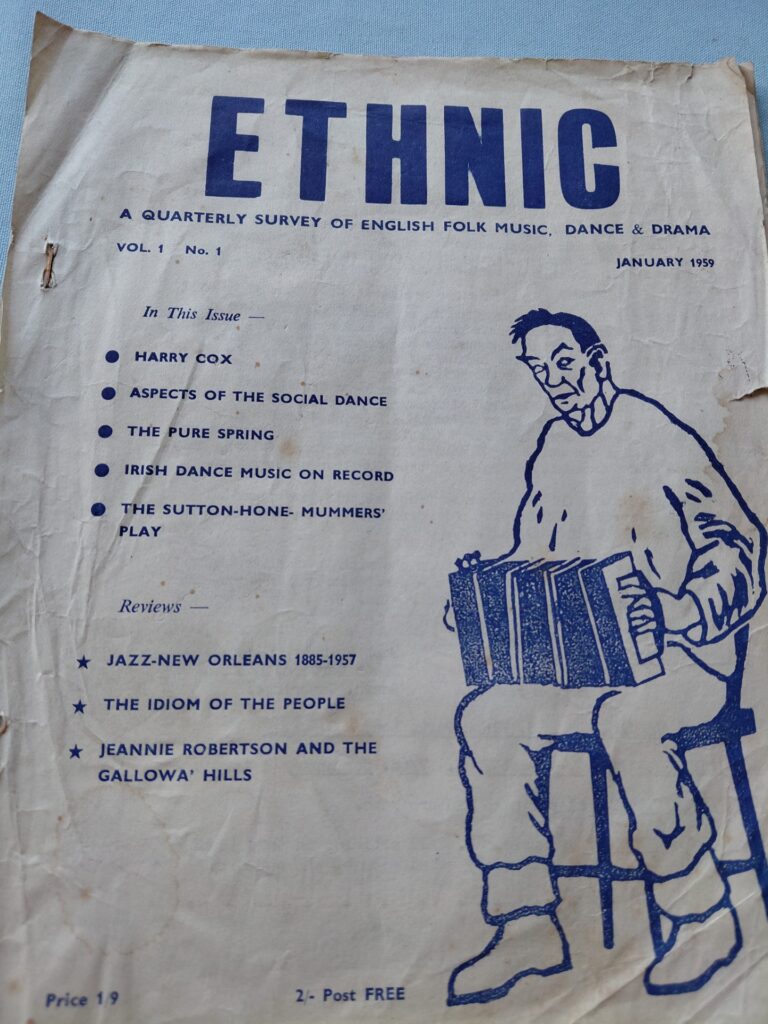
Ethnic magazine was a crude, basic affair by many standards. It contained no
photographs and comprised typed pages, with only the occasional drawing or diagram
amongst the text. The editorial policy statement read: “This Magazine is concerned with
traditional English song, instrumental music, dance, drama, and related activity and
custom. We hope to provide a common platform for singers, players, critics, collectors
and commentators who have the good of the tradition at heart.” In this respect, it
undoubtedly fulfilled a need in its short life. With this in mind, and given the rarity of
existing copies today, what follows is the article about Harry Cox, in the first issue, (3)
with the title given above, complete and without editing or abridging, including retaining
the occasional rendering of dialect speech, such as “hare” for “here”, as in the quote
above, also taken from the magazine, in a section entitled “Things They Say.” Unlike the
other articles in the rest of the magazine, no actual authorship is given.
———————————————————————————

Harry Cox – The Catfield Wonder


No English folksinger has been more publicised than Harry Cox of Catfield, Norfolk. At
73 Harry is an almost legendary figure who for twenty years has been presented to us
as a relic miraculously preserved from a bygone age. Casual readers of the literature
during the thirties and forties might well have imagined that – apart from Philip Tanner of the Gower – Harry was the last of the Mohicans, and that with him would die the last
flicker of a fire that had burned throughout English history. Of course, people know
better now, and recognise that there are in fact several ancient English singers still
alive, or rather, lingering on.


While most field collectors would agree that there are still thousands of good traditional
singers in the countryside, Harry is widely regarded as the doyen of them all and the
post-War revival has brought him renewed recognition in the shape of BBC recording
sessions, television with Alan Lomax, and more recently a visit to the heart of
Revisionist Revivalism – the Hootingnanny. “The rummest do I bin to lately.”
Harry was born at Barton Turf on Barton Broad, one of a family of thirteen, of whom four
died in infancy. His grandfather was well known locally as a step-dancer and as a singer
with a very large repertoire. Harry learned many of his songs from him and will cite this
as evidence that some of his songs are more than a century old. In Harry’s childhood
his family had a bitter struggle to make ends meet, yet he is able to say of his
grandfather “he was in the hard times.” Harry’s father was a noted singer and fiddle
player – his fiddle was always in demand at festive occasions and in the local pubs –
and when money was short he could often earn as much as a day’s pay for an
evening’s playing, with beer thrown in. He would bring in as much as a shilling a night
when Harry was “a little old tot.” Unlike his father, who was a fisherman and wherryman, Harry has spent most of his life on land “doing everything I should think round about the farming way.” He has often been referred to as a blacksmith, but doesn’t know how the idea got about, “except maybe that I’m black enough.”
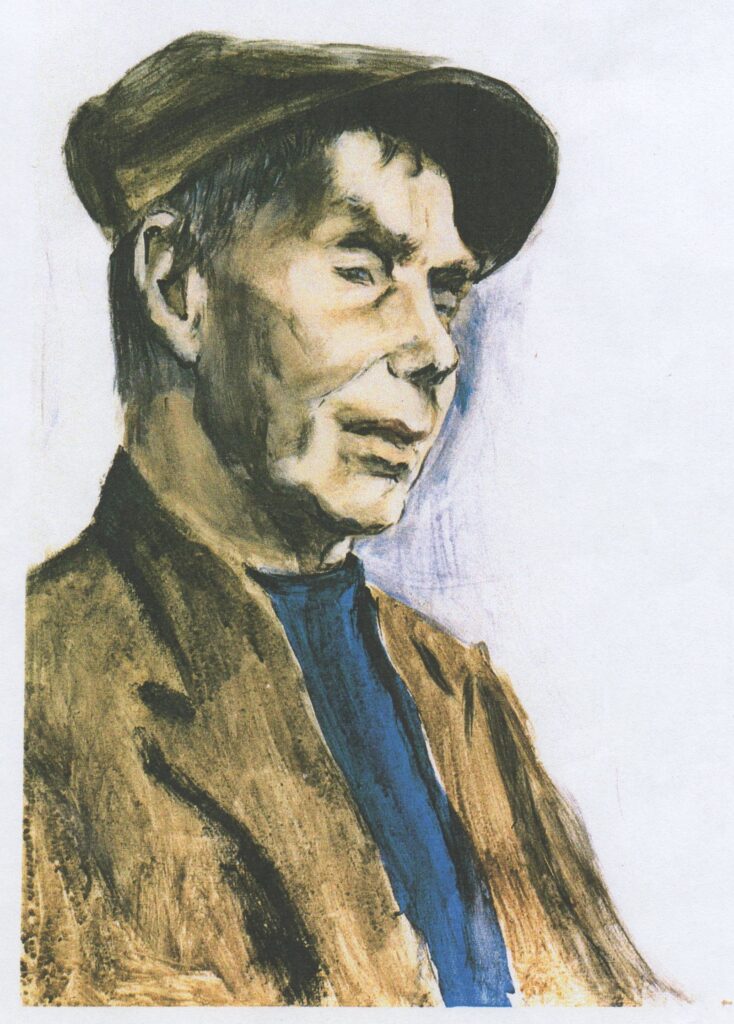
During the first World War Harry served on a minelayer in the North Sea, based on
Rosyth and Scapa Flow. Apart from this period and occasional trips to Norwich and
London, he has never been more than a few miles away from his home. He recalls one
visit to London on which he was pressed into playing the ‘house’ melodeon and came
home with full skin and pockets. In his experience strange musicians generally did
better than local men, and some of the travelling fiddle players at that time were
comparatively wealthy men. The dancing in the pubs was step and clog mixed in with
four-hand reels and other country dances.


“Polkas? I never was in that. These hare old women they used to like what they called a
jig – a jig-step they called it. These hare old girls they used to come in the pubs and
have a spree – used to kind of skip and mess about. The ‘Ship’ at Sutton was never a
real dancing house – not like some of the others – although we used to have our
meetings there and Moeran used to come. I never did know him before, myself. I think
his father was a clergyman over at Bacton. Then he was in the first World War – he
began collecting these songs before – then he had to pack up. After the War he began
again – he used to come to Sutton. Come that way I first met him. He put me in those
books. They never were all in there though. He did well, he did a lot of writing. You used
to sing for him – he used to get the music – take the tune down you see, a little in this
line, a little in that. He got the “Ploughboy.” I don’t know what happened to that – he sold that or something or other. He got ten pound for that. We went halves. Well, they can’t do what they like with these hare songs, really, can they? That was mine – or that was how he got it. We had five pound apiece. I don’t know what I done with it – where it went. Now I’m blessed. He was a good chap.

Harry is a modest and warm-hearted man of many skills. It is nearly fifty years now
since he made his “little old dancing doll.” This doll accompanied him on his recent trip
to London, but he didn’t unpack it. The doll is carved out of wood, blackened and
burnished by long years of handling. The body is supported by a horizontal peg which
projects from its back and is held rigidly in one hand. The arms and legs are freely
articulated in puppet fashion. The operator sits on one end of a thin three-foot board,
the other end projecting between the knees and free to vibrate vertically. The doll is held in position just above the free end of the board which is rapped with the knuckles of the free hand. The result is a spectacular quick-fire clog dance by the doll to a diddled accompaniment.

Harry plays the fiddle, but unlike his father he is very shy of playing it in public –
preferring to tune up in the afternoons when he is alone in the house. His main
instrument is the melodeon, which he plays with a fierce open four-in-a-bar left hand
and a jagged right – a rough and typically Southern style of great drive and punch. His
tune repertoire includes many old EFDS stalwarts and it is an eye-opener to hear these
tunes played in this earthy style. Although his playing gives the impression that he has
never been a player at formal dances, Harry does not regard his instrument as a vocal
prop – indeed he never accompanies himself when singing. This apparent dissociation
of instrumental music from song and organised dance is common amongst country
musicians.
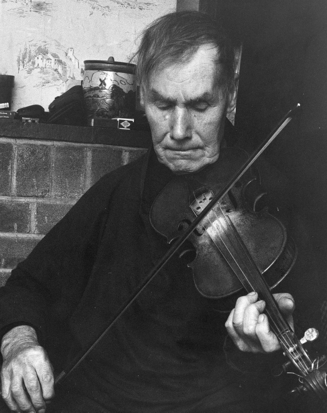
Harry’s repertoire has never been fully documented, and the list, published in the current EFDS Journal (53 songs) falls a long way short of the 200 accredited to him by rumour. Gifted as he is with an ear which is both accurate and remarkably retentive, his total may well be over the two hundred mark. He can, for example, sing verses of songs which he has heard Bob Roberts sing a couple of times on the wireless and is keen to
acquire an additional verse or two for those of his ballads which he feels are not quite complete, or of which he says “I never did get that bit right.”


Of the fifty-odd songs I have heard him sing, almost all are in the major mode. Even the
exotic-sounding “Georgie” which starts off in the Dorian owes much of its attraction to a
late switch to the major. Few of his tunes show any marked tendency towards
hexatonism and he is no more disposed to sing in the Mixolydian than are other
traditional singers. He pitches mainly in the middle to lower register and would perhaps
sing a tone or so higher if his voice permitted him nowadays. Like that of every other
great country singer his style sounds deceptively simple and has little decoration. He
makes little use of the shake and decorates sparingly. His pitching is subtle, decorative
figures often being sharpened and line-endings flattened slightly, the effect being to give greater lift to the performance. While he does not slur to any marked extent, a
noticeable feature of Harry’s style is the quite artificial quality of many of his vowels and
most of his consonants.


Harry’s unnatural singing pronunciation is quite deliberate and is by now means unique.
It tends to give his words a curiously exaggerated clarity and to give added emphasis to
the beat. As he says himself, he likes a tune to have a swing to it. Many of his tunes are
very fine, but the impression given by the BBC recordings is misleading as these are
highly selected. Harry singing in the flesh and swapping songs as they come into his
head is not the rare and exotic flower of the fens – a great many of his songs are
common amongst my Sussex friends – but rather a homely and familiar figure as we
argue the toss as to whether Maria Martin and William Corder belong in the same song
as Maria Back and Switzerland John of “The Folkestone Murder.”


Harry is no orchid; nor a daisy for that matter. Perhaps his badge should be one of his
own beautiful corn-dollies, draped with a twist of duck-weed.

Schottische

I had a little horse
He was such a kick-er
I stuck a plaster to his arse
And made him kick the quicker
It was all done with sheepskin
Beeswax
Tons of pitch and plaster
The more you tried to pull it off
By God it stuck the faster

I had a little cat
He was such a thief Sir
Stuck a plaster on his arse
And pulled out all his teeth Sir
It was all done…etc

I had a little wife
She was very civ-il
Stuck a plaster to her arse
And drew her to the dev-il
It was all done with beeswax
Sheepskin
Tons of pitch and plaster
The more you tried to pull it off
By God it stuck the faster
The tune is close to “The Ball of Kirriemuir”

There Was an Old Woman in Yorkshire

There was an old man in Yorkshire she did dwell
She lov’d ‘er old husband dearly and the lodger twice as well
Tiddle dee whack rye diddle um day
Toora looral day

She went to the doctor’s and asked him all so kind
Which was the nearest way to send ‘er old husband blind

He told ‘er to get some marra bone an’ scrape it fine and small
Rubber it into the old man’s eyes till he can’t see at all

The old man said I’ll go ‘n’ drown myself for I can’t see one mite
The old woman said I’ll go with you ‘fraid you shouldn’t go right

Arm and arm they went on until they came to the brim
The old man ‘is foot to one side and plump’d the old woman in

She swam about and swam about until she came to the brim
The old man got the linen prompt and pushed ‘er further in

How the old woman did scream how the old woman did bawl
The old man said I can’t help you for I can’t see at all

So now my song is ended and I can’t sing no more
My old woman is drownded and I am safe on shore
Toora looral day


This song is sometimes known as “Johnny Sands.” It seems to be well known in Ireland
and in the States, and has been referred to as well-known in England. It does not,
however, appear to have been printed in any of the collections or in the EFDS Journal,
although it has appeared on broadsides.

Bold Archer

It was all in the month of June
Just as the flowers were in full bloom
A cas’ ‘e was built on Kansa’ Green
For to put Bold Archer in

So now our brother in prison do lay
Condemn’d for to die is he
If I ‘ad eleven such brothers as me
So soon a prisoner I’d set free

Oh eleven said Richard that’s little enow
For forty there must be
The chains and the bars will have to be broke
Before Bold Archer we can set free

Now ten for to stand by our horses rein
Ten for to guard us round about
Ten for to stand by the cas’le wall
And ten for to bring Bold Archer out

So Dickey broke locks and Dickey broke bars
Dickey broke everything he could see
He took Bold Archer under his arm
And carried him out most manfully

They mounted their horses away they did ride
Bold Archer he mounted so ‘appy and free
They rode till they came to a far waterside
Where they dismounted s’ manfully

And then they order’d the music to play
It played so sweet and joyfully
And the ver’ best dancer amongst them all
Was Bold Archer who they set free

Oh look back look back Bold Archer he cried
Look back look back cried he
Here comes the High Sh’reeve o’ Honny Dundee
With a hundred men in his company

Oh come back come back now cried the High Sh’reeve
Come back come back cried he
If you down retorn my irons to me
Bold Archer a prisoner still must be

Oh no nay no nay that never can be
No that never can be
The iron will do our horses to shoe
And the smith he’ll a-ride in our company

So ‘e wrote a letter home to ‘is wife
And to his children three
Say’ng my ‘orse is lame and I cannot swim
So condemn’d this day shall be

Note. We make no apologies for the printing of Harry’s “Bold Archer.” Verses 1- 7 of this
ballad were published by Francis Collinson and Francis Dillon in their collection of
songs from “Country Magazine” – (Songs From The Countryside, book 1, W. Paxton &
Co.) without acknowledgement of the source. Our version of Harry’s text differs
substantially in Verse 6, and we print the whole in order to do justice to a very fine and
otherwise unknown ballad.

Note. In spite of the association of Harry’s name with that of the late E J Moeran, the
latter included hardly any of his songs in his two contributions to the Folk Song Journal
(Vol. VII No. 26, 1922, & Vol. VIII No. 35, 1931). In those collections it will be seen that
Moeran relied almost entirely on material from other Norfolk and Suffolk singers. Very
few of Harry’s songs are available in print, but about fifty are available on disc
recordings in the Sound Library at Cecil Sharp House (BBC recordings). One master of
his “Foggy Dew” has been released twice by HMV in two different settings – one on LP
and one on EP (“The Barley Mow”).
Songs not listed in the EFDS Journal Vol. VIII No. 3 include –
Wreck of the Ramilles Rigs of the Time
Barbara Allen Box upon her Head
Outlandish Knight Lord Bateman
Jolly Cobbler I wish they’d do it now
Folkestone Murder Cruel Ship’s Carpenter
Miss Doxy Johnny used to grind the coffee mill
Hungry Fox One man to mow me down my meadow
———————————————————————————-
As mentioned previously, the above text has been given verbatim and complete, with no amendments made, to preserve fully the article in its original form. Fuller details of Harry Cox’s life and music are available in a variety of articles, including on this site, where can also be found a full discography of his recordings. Highly recommended too is the
Bonny Labouring Boy CD set released by Topic Records (TSCD512D) with its
accompanying booklet, and on which Bold Archer can be heard. Harry’s version of
There Was an Old Woman in Yorkshire (Marrowbones) was released on the English
Love Songs LP.

Chris Holderness August 2025

Notes:

(1) Reg Hall: “I Never Played to Many Posh Dances”: Scan Tester, Sussex Musician
1887-1972 Musical Traditions supplement no. 2 1990 p.69

(2) The English Country Music album, originally released as Record No.1 in 1965.
This will be considered in detail in a future article.

(3) Vol.1 No.1 January 1959
Share:

I’ve been Jack the Ladding all my life…

Step-dancing in and around Essex in ancient times: a not-so-personal memoir

By Phil Heath-Coleman

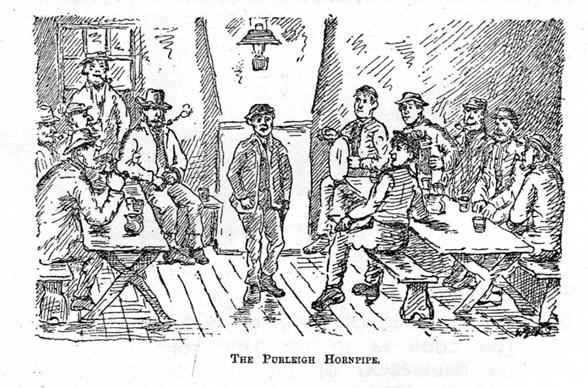
Illustration of ‘admirable specimens of the Essex labourer’ step dancing at Purleigh Bell (from ‘The Essex Labourer’, Benham: Essex Review [n.d.]) 

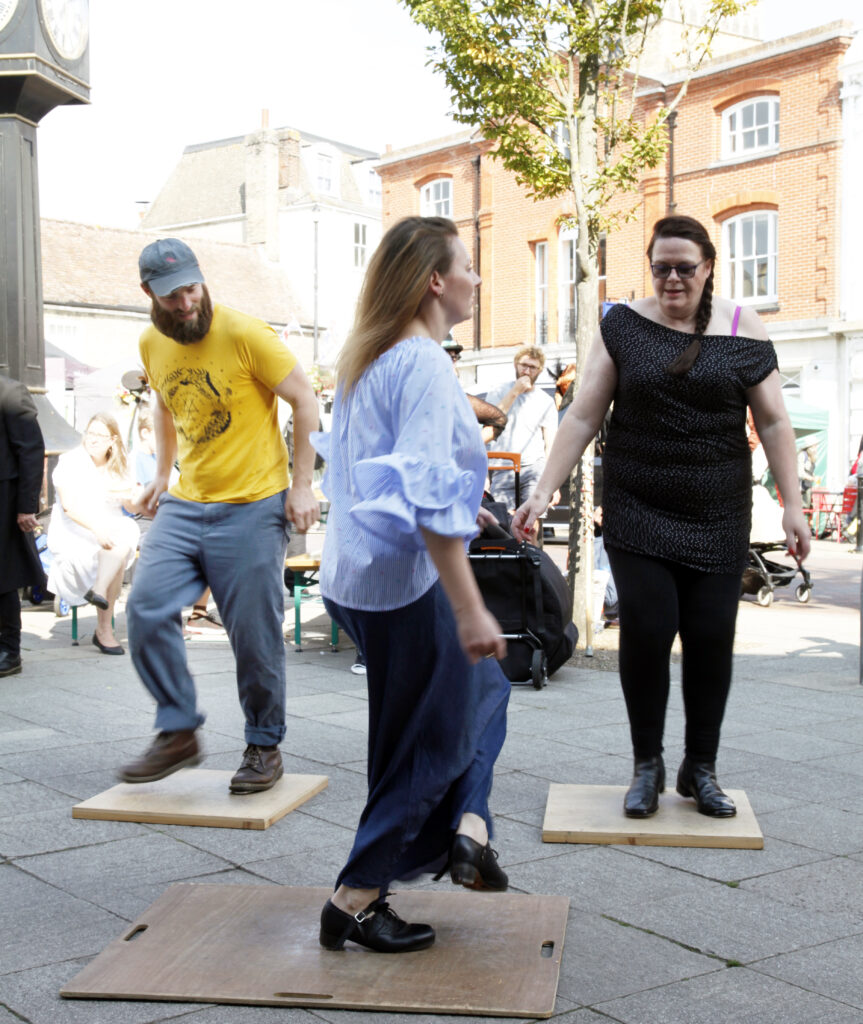
During the great storm of 1987 – which some folk will think of as being a long time ago, but will always be just another of my yesterdays to me – the Woolpack at Chipping Hill in Witham was without power for days on end, and we regulars (I lived opposite at the time) migrated to the White Horse at the top of Church Street or even further afield. It was at the George in the High Street on one of those days that I ran into Colin Smith, – another of those regulars of far longer standing than myself and something of a local character – , and found him, to my surprise, ‘tap-dancing’ in the bar. I told him I didn’t know he could dance, to which he replied in the broad Essex accent which could still be heard locally:  “I’ve been Jack the Ladding all my life …”.  

That wasn’t the first time I’d heard the expression used of what I thought of as step-dancing, but it was the first time I’d heard it used in the wild (rather than as in ‘They used to call it Jack the Ladding …’ or some such): I don’t recall any of the old steppers I met in those days referring to what they did in that way, whether ‘Herbie’ at the Tower Arms in South Weald, ‘Cubby’ at the Stag on Hatfield Heath (who’d learnt to step in the RAF), or – last but not least – Johnny ‘Scuffer’ Smith, who sometimes couldn’t resist the odd step at one of the many pubs where he was a familiar face, despite his ‘dicky ticker’.  

In those days they’d dance to anything, often covering much more ground than would be considered the rule nowadays. It was the Bluebell Polka which I recall being asked for, and which could long still be found on the ancient jukebox at Mashbury Fox – where it had once presumably served the same purpose.  

I have always taken it for granted that ‘Jack the Ladding’ took its name from the tune known popularly as Jack’s the Lad (otherwise the College/Sailor’s Hornpipe), which was also known in Essex as Jacky Robinson, Vaughan Williams having come across a version involving a ditty referring to someone of that name, which he described as a ‘dancing song’, in the Dog at East Horndon (oddly enough Beatrice Hill referred to her version of the ubiquitous stepping tune known elsewhere as the Yarmouth or Manchester Hornpipe as Jacko Robinson). The versions which the steppers knew were simpler than the Jack’s the Lad of the Last Night at the Proms, which was once universally familiar as the Sailor’s Hornpipe, of course. This is how Billy French had sung it for Neil Lanham by the roadside somewhere near Sudbury in the 1950s: 

Billy French: Jack’s the Lad 

As well as a highly step-worthy version of Old Joe the Boat is going over, Billy French also diddled a stepping tune which married a simplified first strain of the Harvest Home with a second strain of Fisher’s Hornpipe which resembled William Kimber’s. Neil told me that many of the steppers in the area preferred to step to ‘tuning’ (mouth music) rather than to a musician: 

Billy French: Medley [Harvest Home /Fisher’s Hornpipe] 

Over at Thaxted, in 1911, the opera singer Clive Carey, who lived nearby in Hedingham, noted a number of familiar country dance tunes, including the King of the Cannibal Islands, Haste to the Wedding, Trip to the Cottage, and The Triumph from the fiddler Alf Bishop, a travelling showman (and latterly photographer) who had settled in Thaxted, from whom he also noted a couple of hornpipes, which were conceivably used for step dancing: the Fisherman’s Hornpipe (which I, at least, suspect might ultimately be a version of Fisher’s Hornpipe), and the Gypsy’s Hornpipe – possibly a reference to his source – which combines the first strain of the Flowers of Edinburgh and the second strain of the now less familiar but once popular Miss Baker’s Hornpipe (and it’s easy to see how the first few notes of the second strain of Miss Baker’s Hornpipe might be confused with those of the Flowers of Edinburgh) [for those who can’t read (music) I offer my own – partly transposed – take]:  

Alf Bishop’s ‘Gypsy’s Hornpipe’ [Flowers of Edinburgh/Miss Baker’s Hornpipe] 

Alf Bishop in 1905

The gipsy fiddler Moses Shaw was once also well known in and about Thaxted, and it’s possible to see resemblances between Alf Bishop’s repertoire and that of the musical Shaw family as a whole, who played a significant part in musical life in the adjacent parts of Herts, Cambs and Essex, being particularly associated with Molly Dancing, but that’s another story [though if you’re interested see Romany Routes, vol. 11, no.6, March 2014/vol.13, no. 3, June 2017]

 Also at Thaxted, on the same occasion, Carey noted a few tunes from Harry Smith, including a ‘Hornpipe’, which resembles the ‘vernacular’ version of the Wonder Hornpipe (as recorded, for example, from such notables as ‘Scan’ Tester in Sussex and Dolly Curtis – and others – in Suffolk: again, and for the same reason, I offer my own take – with some re-imagination of the second strain on the lines of other field recordings.

(Harry Smith’s) ‘Hornpipe’  [Wonder Hornpipe]

To round of the recordings, we must obviously go back to the real thing in the shape of Neil Lanham’s recording of Charlie Cutmore – formerly the landlord of the Plough at Belchamp St. Paul, where a board with a cross on it had been kept for stepping – playing his father Joby’s version of the familiar Yarmouth/Manchester Hornpipe:.

Charlie Cutmore: Joby Cutmore’s stepdance [aka the Yarmouth/Manchester Hornpipe, Pigeon on the Gate]

Share:

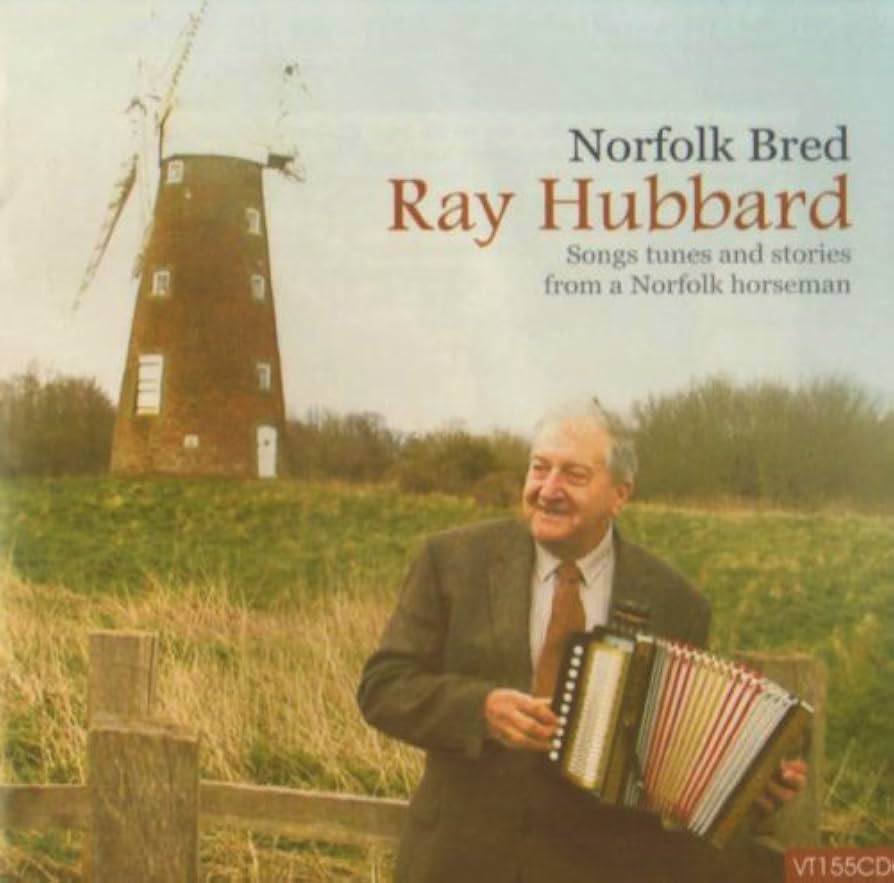
CD Review – Ray Hubbard Norfolk Bred Veteran VT155CD

Following on from the recent death of retired horseman and consummate entertainer Ray Hubbard, it seems apposite to review the CD which was made of his music by John Howson and released by Veteran (1) in 2007, a wonderful selection of the songs, tunes, tales and jokes which made him such a beloved performer for so many years.


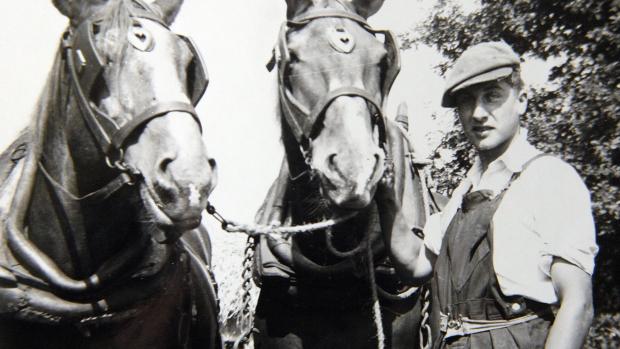
Ray was born in 1933 in Langmere, a hamlet of Dickleburgh in south Norfolk. Aside from music, his main love was working with horses, and he spent most of his life doing so, following a family tradition, as he commented: “You can trace my family working with horses back to the 1700s.” (2) He started working with horses alongside farmer Albert Saunders at Langmere Hall Farm when he was eight and a half, on being taken on for a Saturday job. “I used to lead in the harvest field and take the wagons home when I was just nine or ten; we’d work late into the night if there was light. I’d lead the middle wagon when it was dusk, the farmer would be in front with one wagon, the horseman would be behind me with the last one. We always used three.” Once he had finished school, Ray was taken on full-time at the farm, becoming head horseman at 17 and then took over the running of the farm at 21. He continued in this capacity until 1966, and the advent of mechanisation, when he retired from the farm and spent the rest of his working life in the building trade.


At home, Ray was born into a house with music. Both parents played the mouth organ, his father playing accordion and mandolin too. Other family members were musical and the youthful Ray seems to have soaked it all up. After his marriage to Pamela in 1954, the couple started a concert party called “Norfolk Bred”. This was a variety show with a changing cast and a wide variety of acts, and was busy for a great many years. In addition, Ray was organist for Rushall church and would also play regularly in pubs in the area around Dickleburgh. More recently, Ray was a regular attender – the life and soul to a great extent perhaps – at many local events dedicated to local traditional music, where his contribution will certainly not be forgotten.


In 2006 and 2007, John Howson recorded Ray for his Veteran label. Some tracks were recorded live at Stradbroke Queen’s Head on 26th October 2006, and the rest was recorded at Ray’s home in Diss in 2007. Taken all together, they present a wonderful selection of his music making that was the staple repertoire at the time of recording. There is a wide variety of songs, the majority of them comic, such as The Muck Spreader, Over the Garden Wall and Sarah. Almost all are of relatively recent vintage and with known composers, rather than traditional fare, a good example being Has Ya
Fa’r Got a Dickey, Bor? by Allan Smethurst. (3) Ray seems to have picked his material up from a wide variety of sources: fellow concert party members (Over the Garden Wall), and the East Anglian magazine (You Can’t Tell Them Nothing,They Know) for example. An unusual item is Good King George the Farmer, published in 1929 in Five Songs from Essex, although that may not have been Ray’s source. In all, it’s a selection for entertainment, mostly light and comic in a very memorable way. Whatever the provenance, Ray sings them with a surety born of the experience of having performed them in front of audiences for years before the recording. Equally comfortable are the tunes played on melodeon, a medley of waltzes and the East Anglian perennial favourites Oh, Joe, the Boat is Going Over, Heel and Toe Polka and Waltz for the Veleta. Sprinkled amongst all of this are a couple of recitations, comments and the hilarious set of jokes presented as “My Life Story”. This last still makes me laugh out loud, even though I’ve heard the material countless times. All delivered in Ray’s rich Norfolk brogue, it’s a great evocation of times gone by but also, by virtue of its sturdy existence, equally relevant to the present day. After all, who could fail to be moved to grin, if not actually laugh, at Ray’s sly, witty and sometimes self-deprecating humour, as presented here, no matter how far removed from the social circumstances which nurtured it?


In all, this is a wonderful recording in its entirety. A historical document in that it preserves a portion of home-spun entertainment, by an exemplary practitioner, from a time when such music-making was commonplace, but it’s much more than that – I highly entertaining record and a valuable addition to the considerable accumulation of recordings of traditional East Anglian traditional music making. It stands as a fitting testament to a much-loved and greatly-missed entertainer. Furthermore, it has to be mentioned that the sound quality is excellent and the CD is housed in handsome packaging, including a 14 page booklet with much information about Ray’s life and the tracks, as well as many photographs. It is highly recommended.


Chris Holderness April 2025

Notes

  1. Veteran VT155CD, released in 2007. Now available only as a download. veteran.co.uk
  2. Eastern Daily Press, 17 September, 2022.
  3. “The Singing Postman”.

Share:

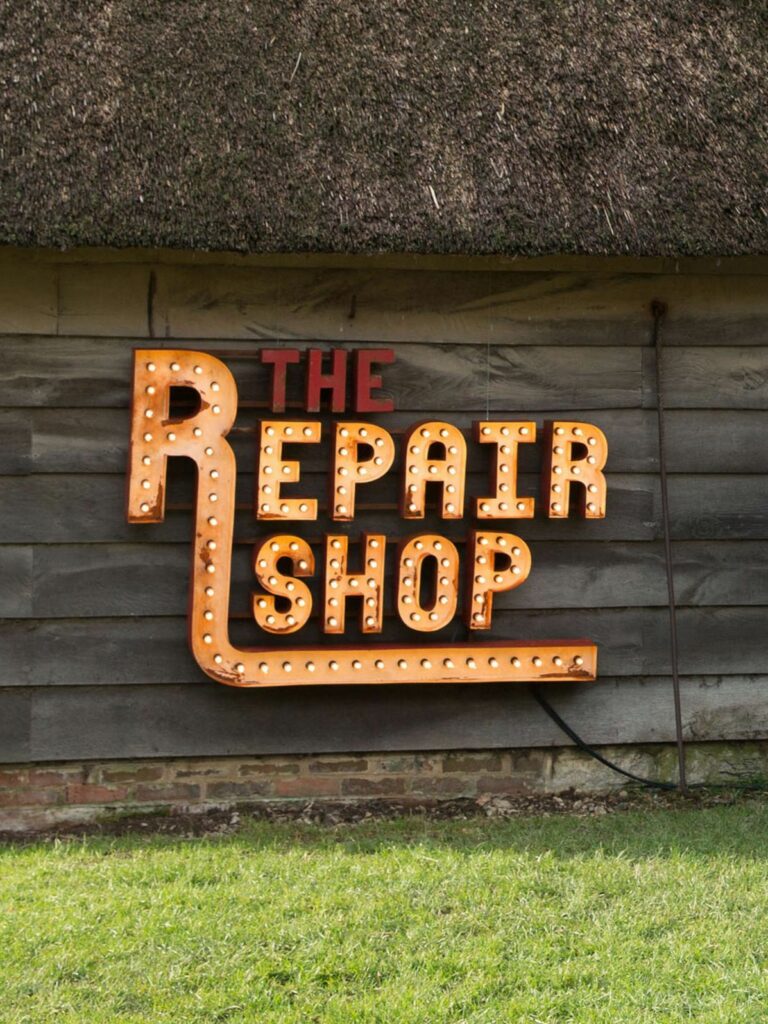
Dancing Davies’ Boots and The Repair Shop

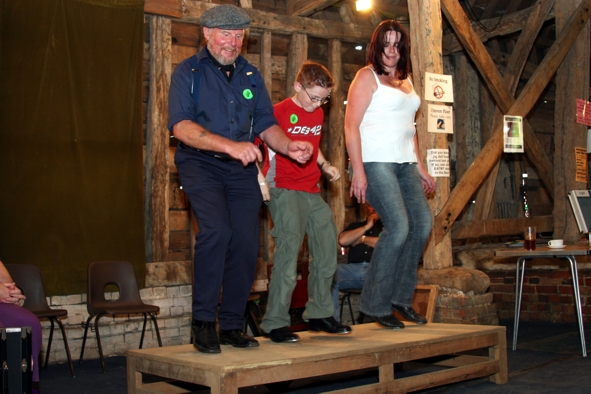
3 Generations of the Stepdancing Davies Family – Richard, with daughter Fiona and grandson Ben, TMD 2005
Credit C Gill

By Fiona Davies, October 2024

Having watched the BBC Repair Shop many a time, I had always thought of applying to have my father’s, Richard Davies, step dancing boots repaired.

Some of you know I dance in them on special occasions. Yes, we had the same size feet! When he was alive he would dance in them, when he finished he’d take them off and hand them to me to put on and I’d dance in them.

c1976, Richard at The Bath House, Cromer

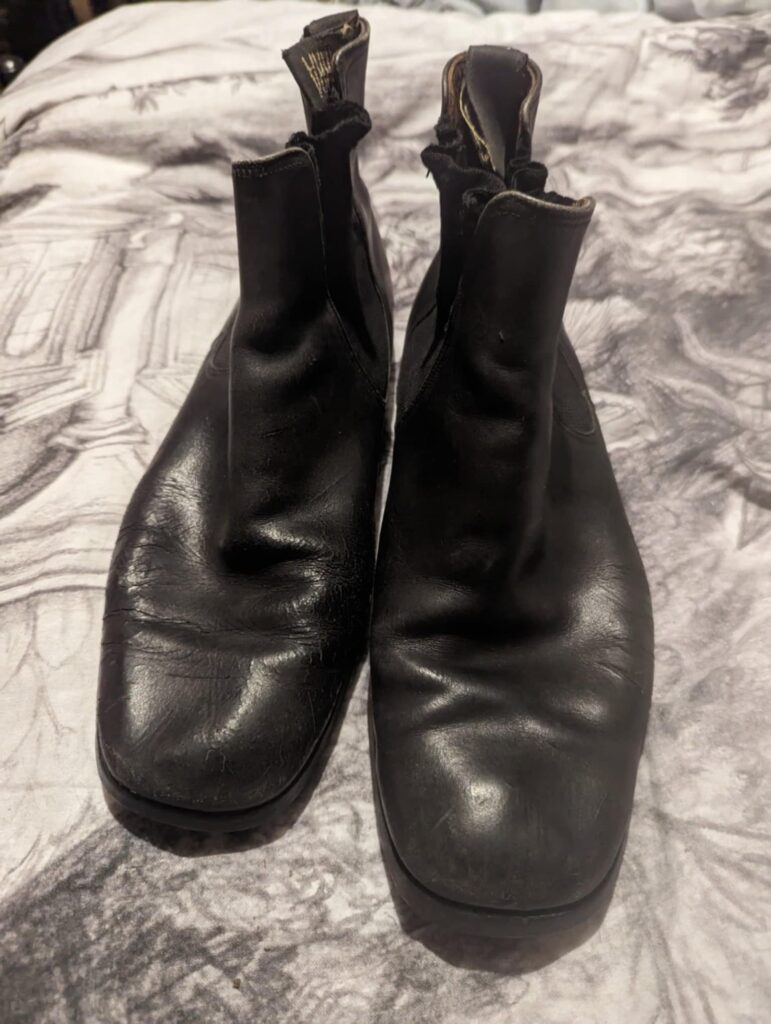
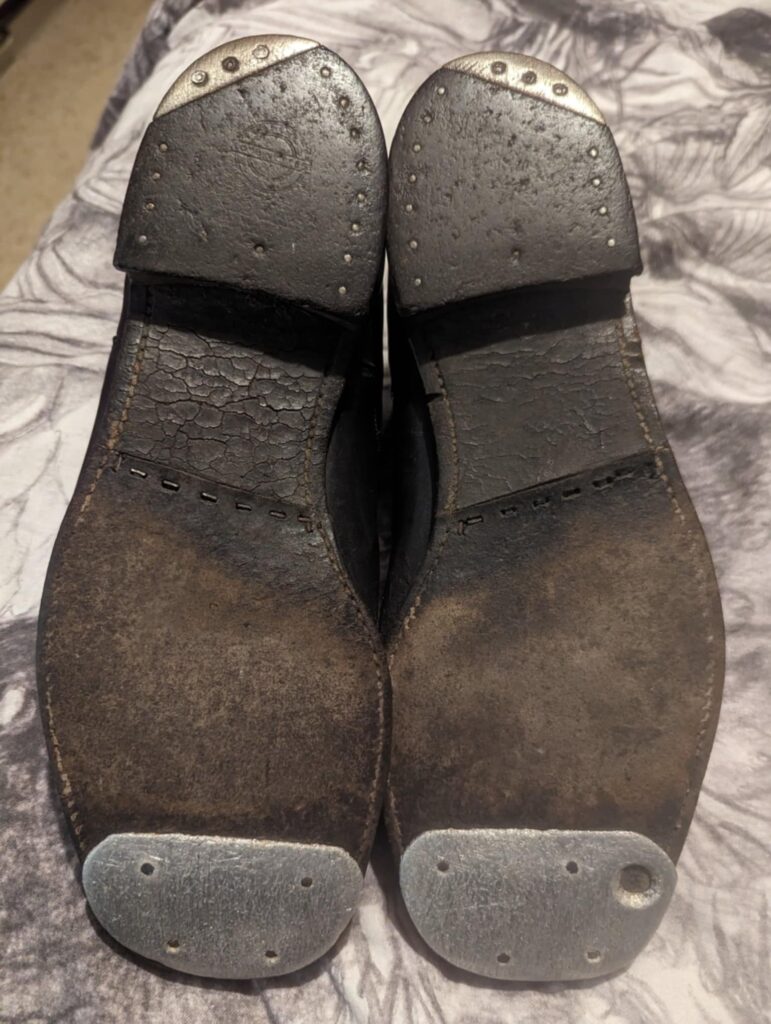
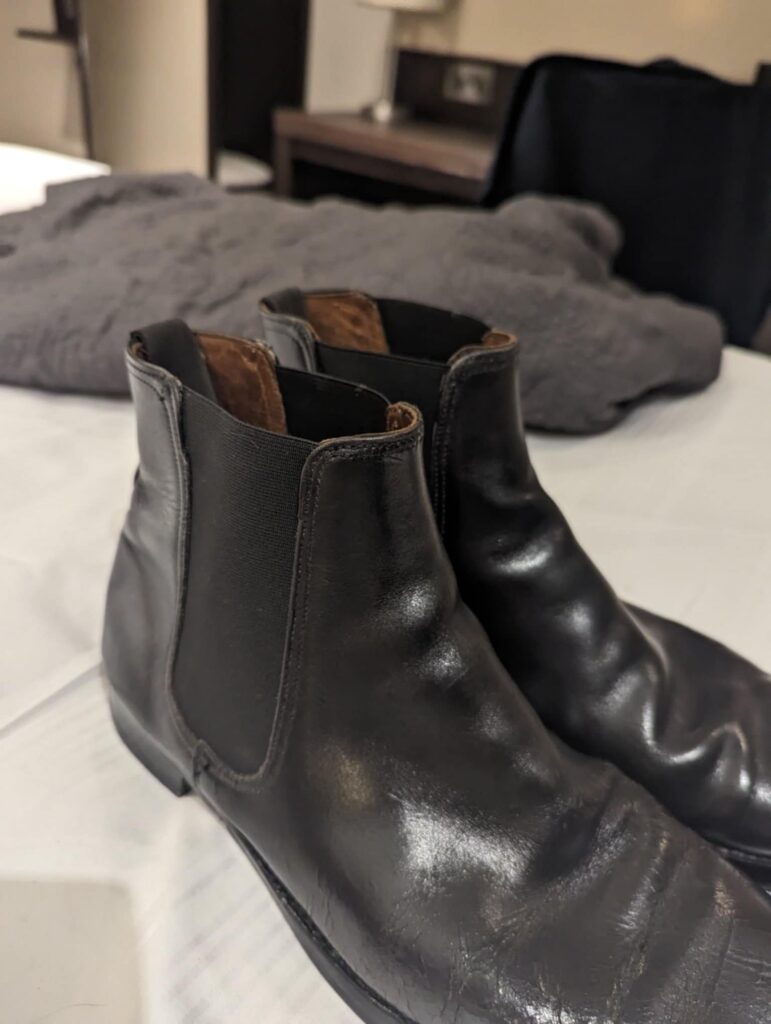
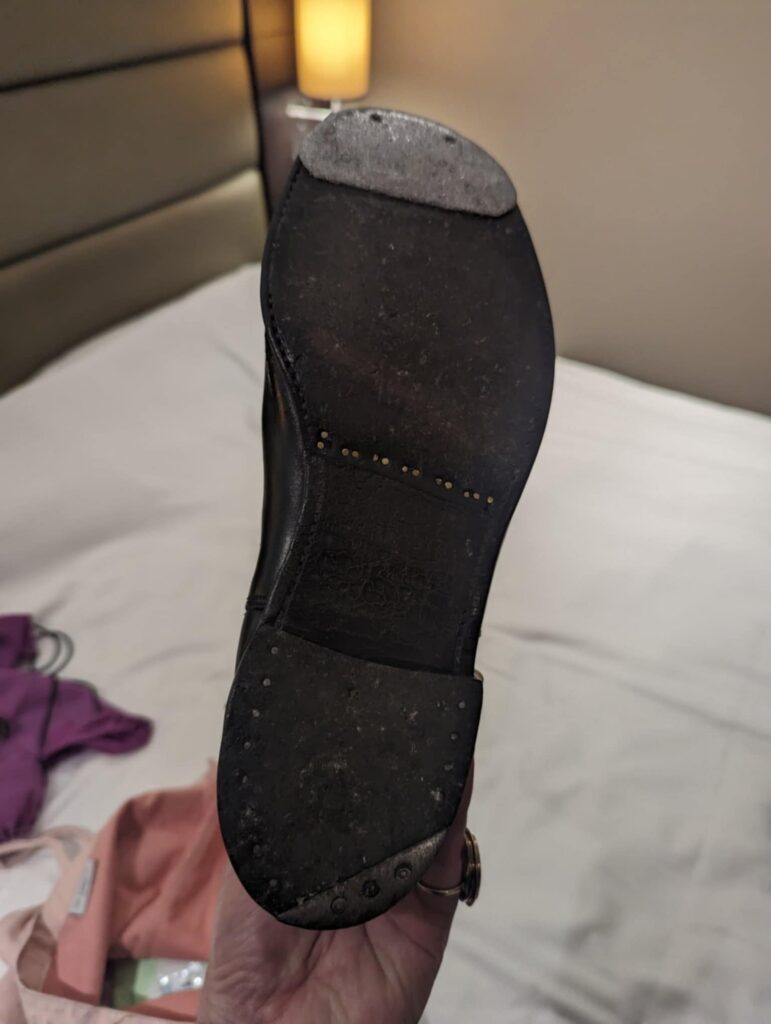
The boots are flat soled leather Chelsea boots, acquired from a boot maker from Northampton at the Norfolk Show in the 1960’s. He was obviously dad’s favourite boot maker as he had a few pairs of these boots. Chelsea boots were commonly worn by Cromer fishermen for best. They all came with heel plates to protect the heels from wear. As a child I would always hear the fishermen approaching before I saw them. They always had a comforting clicking sound as the heel plates hit the concrete of the pavement. It was the same with the step dancing as the heel plates hit the pamment tiles or wooden floor boards, each making their own individual sound.

My Father being the individual that he was, he always liked to be different, added extra flat pieces of metal to the toe end of the soles of his boots. These boots were solely used for his step dancing. By the time I acquired them they had definitely seen life and were used to perform in many places in East Anglia.

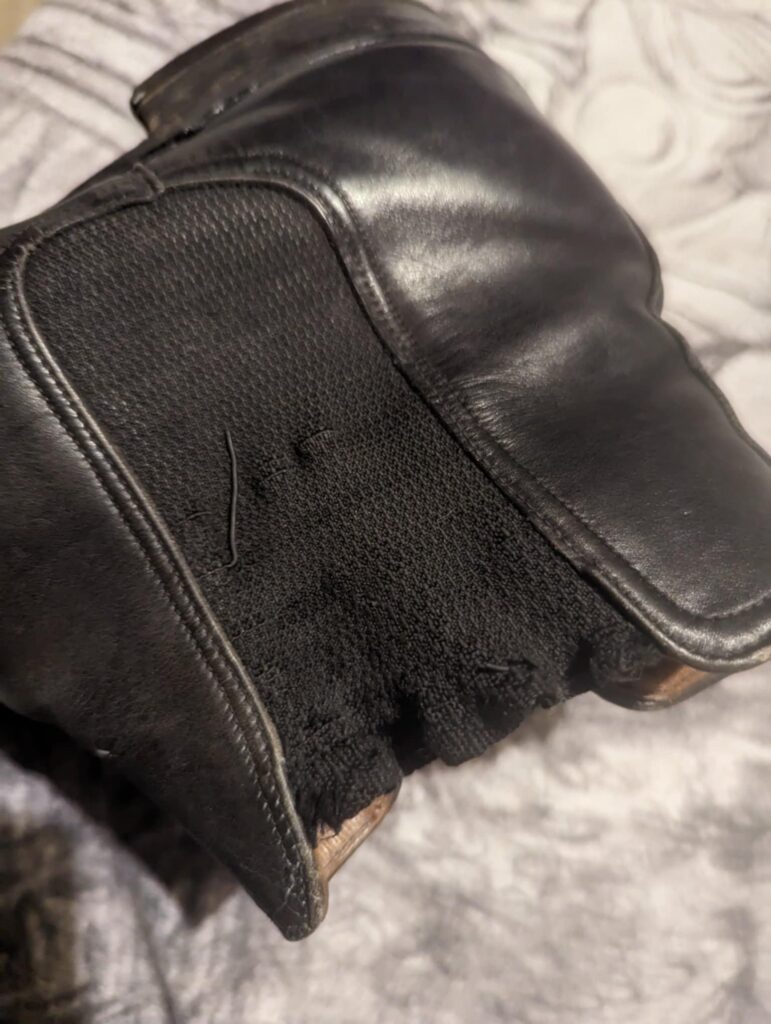
The elasticated side panels were frayed and loose, the leather was worn, cracked in places, the insoles had gone and the stitching on the soles was broken and missing in places. I still wanted to dance in them. I have tap shoes that I use but I always feel my dad’s spirit when dancing in his boots. 

After years of saying I was going to apply for The Repair Shop, I finally did it in January 2024. After filling in an online form on their website and submitting some photos of the boots, they were in touch within two weeks. One of the programme researchers contacted me to ask me more questions about the boots and their history. I then had a recorded online interview with the researcher to see if the producers thought the boots, their story and step dancing would make for good T.V. Of course it does. Over the next week I shared more photos & videos of my family dancing, which included the late 70’s/early 80’s video that is on YouTube. I think that video has been taken down at the moment as the BBC will be using it for the programme. After the recorded interview I was invited down to The Weald and Downland Living Museum in West Sussex to film the programme.

It all happened within a month of applying  and filming was all done within a week. The first time, dropping the boots off, I was on my own. I had to be there 9:30 am – thankfully they put me up in a hotel, as the journey took me 6hrs. I was met at the gates by one of the crew and taken to a Portakabin dressing room. I was made to feel very welcome and was given a run down in what was going to happen from the director. The weather wasn’t the best that week with it raining all week & the walk in filming took a few takes, thankfully they had an umbrella on hand. I hadn’t been told who was going to be the other side of the door, I was expecting Jay Blades, it was Dominic Chinea and the shoe specialist Dean Westmoreland.

The director hadn’t told them anything about the boots, so they had no idea what to expect. I’m always nervous when it comes to being on T.V, But the cast were so nice and welcoming, it made for a pleasant experience.

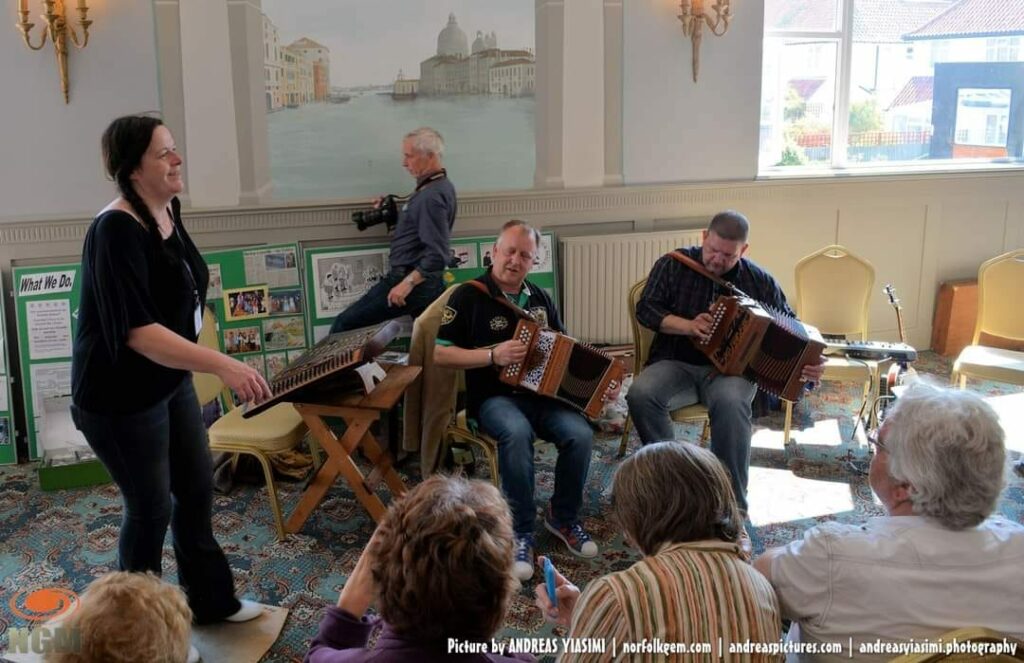
Then another 6 hours home and back 2 days later to pick them up. This time I wasn’t alone. The programme wanted me to use recorded music, however I told them that’s not traditional. I asked one of my best friends, Simon Care who is a fantastic melodeon player, if he was free that day and he was. I’ve known Simon for over 20 years, I’ve often danced with him & he has played for a number of my workshops. He has said to me before “Fiona, I love playing for you, as I don’t have to listen to you” -I take that as a compliment.

Fiona with Simon and Gareth, 2016, Cromer
Credit: Andreas Yasimi

He used to like playing for my dad too, along with our mutual good friend Gareth Turner, who sadly passed away last year. Simon brought with him one of Gareth’s melodeons to play for me that day, which made the day even more emotional.

After filming the walk in for the pick up, another very wet day, it was the reveal and a demonstration of East Anglian/Norfolk step dancing. Dean has done an amazing job on the restoration of the boots.

They are now no longer falling apart and I can dance in them for as many years as my arthritis will allow. The leather has been replenished, the soles tacked with small nails, insoles added and the elastic side panels replaced. They filmed me putting the boots on but I don’t think that will be added as I got cramp as they are now tight to get on. I still haven’t been given a date for when it will be aired, but as soon as I know, it will be put up on the EATMT website & social media.

Fiona dancing at Traditional Music Day in September 2024 in a Stepdancing Showcase here dancing with Josh Dart and Tatum Pridemore

In other news, I have moved. I am now living in Scotland, near Edinburgh. There’s more opportunities for my work up here. However, I will still be involved with the EATMT and FolkEast. I shall be planning family visits around events especially in the Summer months.

Share:

It’s a Small World…

During the summer weeks, in our build up to Traditional Music Day 2024, we took the Jig Dolls on tour around the town of Stowmarket featuring venues and mostly, a selection of independent retailers.

In this ever increasing digital world, it made a lovely change to be out and about meeting new people and visiting a wide array shops – some that had fallen off our radar as a result of our busy, ordering online way of life. As well as the usual retailers found in High Streets up and down the country, Stowmarket has a rather wonderful collection of Independent shops – we didn’t manage to get to all of them but we’ll add more to our list next year.

For a look at that 8 week tour, do visit the TMD 24 News Page which we introduced this year as part of our build up to the event.

When we moved the Mr Jollyboy characters (made by Stowmarket Meadlands Mens’ Shed) to Station Road West in August, Stow Framing was one of the local businesses that very kindly allowed us to use their shop window to promote Traditional Music Day. In return we promised a feature on our weekly social media promotion – expertly created by local young businesswoman Bethany Last as part of our Stowmarket on Show project which we ran alongside Traditional Music Day 2024.

Lou Hayden – overseas volunteer outside Stow Framing!

Greeting us on “drop off” day was proprietor Carol Kirkup. Her face lit up as soon as she saw Mr Jollyboy and she announced “I haven’t seen a jig doll in a long time! That brings back some memories”.

With a second home in Wingfield (the first being in London where both of Carol’s parents worked), this mid Suffolk, rural village was a regular holiday haunt growing up for Carol. They lived next door to the King’s Head (now the De La Pole Arms).

Stepdancing and Pony & Traps, at Wingfield

Here are Carol’s memories – a lovely contribution to this article:

My parents, June & Gordon Machen, purchased the then King’s Head at Wingfield, from the brewery, after it had been closed for sometime – I think in 1973/4. [This in itself is an interesting turn in their life as Mum was a teetotaller!] They renovated and expanded the building, and reopened it in 1975 under the name De La Pole Arms.  The pub soon became the centre of village life in Wingfield, hosting Parish council meetings, WI meetings, darts matches, and became a hub for socialising, eating, drinking and generally having fun!

There were two traditional bars.  The Public Bar where there was a piano, dart board, pool table, dominoes and a warm welcome.  We hosted folk/local music evenings there with fiddlers, drummers, accordions etc.  And then there was the Lounge Bar…the ‘posher’ one, with thick carpet, comfy sofas and chairs, a big open fire and tables to eat a leisurely meal, plus a unlicensed family room.  With two different feels to the bars, many would pop in for an ‘after work’ drink in their overalls or work clothes, and then return later in the evening spruced up and with their wives for a meal in the comfy lounge bar.  My Mum was a legendary cook and soon became well known for offering really tasty home made food.  It was the beginning of pubs becoming places to eat as well as drink.  It all seems such different times now!  My Dad took a back seat as he had his own career, but he became well known as ‘the car park attendant’ and was nicknamed ‘Gordon the goffer’!!!  He was very happy playing this role and many of our regulars would have a good laugh and a joke with him when he shared the occasional drink with them.

We [Alex and Carol] talked about Dusty Smith, his wife Val and her sister Gloria.  Gloria & Val’s Dad, Joe Keeley – known to many as Long Joe (I think that’s right) – were frequent visitors and I got to know them well.  Gloria’s husband, Brian Elsden too – a lovely gentle softly spoken man, sadly taken far too early ☹️.  

For several years we had a darts team and would have matches against other pubs, both at home and away.  I do recall one time ending up being paired with Dusty – I think they were short of a team member so I stepped in – I was about 16/17 years old.  The funny thing was Dusty being 6ft 6in and me being 5ft 2in were an odd looking pair.  I’m pretty sure Dusty offered to pick me up to help me get a treble 20 at the top of the board…I might have made that bit up, but we definitely all laughed a lot together about our differing heights.  

Stepdancing – Dusty Smith (right)

Every year the ‘travellers’ would meet in the field at the back of the pub with their ponies, traps etc on a summer’s Sunday afternoon.  And I think it was these events when the step dancing would take place.  I have a vivid memory of everyone crowding around in the lounge bar cheering and clapping as a series of ‘contenders’ took their turn.  It was an incredible atmosphere of shared enjoyment, friendship, community and sheer fun and joy. How I miss those days.

All this took place between 1975-1985 at which time for various reasons my Mum decided to retire and they sold the pub.  Those ten years were incredible and whenever I bump into anyone who remembers them and participated in the community spirit and friendship, we all agree how much it is missed, and how lucky we were to have experienced it.  So much has changed since then, and pubs in the middle of nowhere struggle today – the De la Pole is up for sale yet again.

My parents continued to live at The Old Forge next door until 2004, before moving to Diss to live with me, and they passed away in 2007 & 2008.  They are now in the church yard opposite their home and the De La Pole, and are surrounded by many of those they knew from those happy days.  

Not long after my Mum passed in 2008 I was able to buy Stow Framing.  I had been a photographer and had a small studio behind Babytime on Station Road West.  I got to know Andrew Mills who owned the picture framing shop a few doors down, and I worked with him for a while.  When he decided to retire I bought the business from him in 2009, at that time operating from the small premises behind the current wool shop Wool St on the car park.  I then moved the business to 25 Station Road in 2013.  I am the third owner of the business which I believe was started in around 1986 by Brian & Sylvia who originally had a DIY shop in the current empty premises between the Queen’s Head and the Chinese Takeaway.

Back to Wingfield days…here are a few names I remember from the ‘pony & trap’ community.  No doubt very many more escape me!

Dusty & Val Smith
Gloria & Brian Elsden
Joe Keeley
Harry & Josie Rumsby
Brian & Cathy (Smith?)
Roy & Margaret Barber*

And you [Alex] and I mentioned Tony Harvey of Tannington Hall, and Lenny.  There was the Jolly family too – Chabby & Di in Wingfield, and other members of the Jolly family in Hoxne. Guy Jolly was a thatcher and rethatched The Old Forge for my parents.                                              

Carol Kirkup, Proprietor – Stow Framing
www.stowframing.com
01449 257302
 

*The Barber Family (Cyril, Royal, Rip, Sonny etc) also hailed from Wingfield and were regulars in the King’s Head. Here is John Howson’s article on the family from Wingfield for Mustrad: https://www.mustrad.org.uk/articles/barber.htm

Morris connections

Later in the week, our travels took us opposite Stow Framing to the main Parish Church of St Peter’s and St Mary’s in Stowmarket to organise key collection for the day’s events on Saturday 21st September. Pat is one of the Parish administrators at the church and is often in the office when we pop in to amend or add to the details of our bookings at the Church and the Church Hall for the day. She’s a quiet but a very kind and helpful lady and on that particular day leading up to the event, she let slip she was likely to be drawn to the town on the day to see the Morris Dancing.

Jinky Wells
Credit Bampton Morris

Pat went on to explain she was the grand daughter of William Nathan Wells, better known as Jinky Wells, acclaimed fiddler for Bampton Morris – the only Morris side in the country with an unbroken tradition stretching back over 400 years. It was with Jinky joining Bampton Morris in 1887 as the Fool that Bampton’s contemporary history is thought to have begun. Jinky was from a family line of Bampton Morris Dancers. He became their fiddler in 1899 and continued to play with them steering the side through the First World War. He was considered a key figure in Traditional Fiddle playing and an influential musician at the start of the English Folk Dance Revival. He was visited and recorded by several collectors including Ralph Vaughan Williams and Cecil Sharp.

Two lovely connections – one local and one national – to traditional music and dance, which had we not left the office, would never have learned about from our neighbours.

Alex Bartholomew, October 2024

Share: