In 1952, as part of his extensive collecting of traditional music and song in Britain and Ireland for the BBC, Peter Kennedy found himself in the north Norfolk area of Blakeney and Morston. Here he collected country dance tunes, primarily from Blakeney blacksmith Herbert Smith, information about the dances and a few songs. These, along with more material collected locally by Kennedy on another trip in 1955 and by Seamus Ennis in 1956, were eventually released, firstly on cassette, then later as a CD, as Norfolk Village Songs and Dances. (1) Prior to that, some of the material had been used in at least one of the As I Roved Out series of radio programmes, broadcast on Sunday mornings. (2)
Before we delve into the contents, it’s as well perhaps to consider the provenance of the release of this material. The story seems to be that, on leaving his employment with the BBC, Kennedy took all of the recordings he and others had made with him, claiming them as his own. He then released them in a large series of cassettes on his Folktracks – later Folktrax – label. They were subsequently reissued as CDs, with sparse information, aside from track listings, and a distinctly low-rent feel about them. Considerable controversy has raged about this situation and the products themselves and I don’t wish to go into that here. Suffice to say that these releases were at least a way of obtaining these wonderful – essential – recordings, until Peter Kennedy’s death, after which they became unavailable. Topic Records obtained the rights to the material and started a reissue programme (3), but only a fraction has been made available and that includes nothing from the disc in question. It unfortunately means that the material is very difficult to find. More about the presentation later, but at least the music was released for a while, even if in far from optimum form, from what was by any standards an incredibly productive initiative, producing a large body of priceless recordings of the musical heritage of the British Isles.
Anyway, to return to the content of the disc under review: this north Norfolk coastal area proved to be a fruitful one. In the neighbouring villages of Morston and Blakeney Kennedy found reference to the Long Dance and a tune to accompany it. Ann Mary Bullimore, then landlady of Morston Anchor, gives a delightful description of the dance, which took place in “our barn”, as she describes the annex or lean-to room on the side of the pub (easily visible in old photographs of the place) and also plays the tune for the dance on the pub piano, increasing speed as she does so (although this doesn’t seem to have happened when accompanying the dance). Peter Kennedy, by his own admission, decided that ‘long dance tune’, or something similar, wasn’t name enough for the tune, and decided to call it Rig-a-Jig-Jig, the title of a play-party song of the nineteenth century. (4) The song has no connection whatsoever with the tune – it was merely Kennedy’s whim – but it is as Rig-a-Jig-Jig that this Long Dance tune has gone into wider currency.
In neighbouring Blakeney, Kennedy also recorded the tune from fiddler Herbert Smith. (5) He plays it with the clear intonation and solid rhythm of a seasoned player for dances, being about 60 at the time the recording was made. Here we have a local tune for a local version of the ubiquitous Long Dance, from neighbouring villages, played by people for whom the dance, and others, was an integral part of their social events. The late Barry Callaghan was quoted as saying in 2007 that the tune is “a favourite jig widespread throughout East Anglia.” (6) This isn’t really the case. The recordings from Smith and Bullimore seem to be the only ones made; it doesn’t appear anywhere else in Norfolk, or elsewhere in East Anglia. In fact it seems to be a very rare example of a tune with very limited location, as far as a narrow ‘traditional’ rationale is concerned. It has of course become very widespread throughout the Folk Revival. What Barry Callaghan was probably referring to was that John and Katie Howson’s Old Hat Band played the tune, (7) which doubtless was responsible for it being picked up locally. More nationally, its eventual popularity was probably due in the main due to seminal revival band Oak recording it. (8)
Be that as it may, both Ann Mary Bullimore and Herbert Smith give very spirited performances of the tune. There is also quite a bit more from Herbert Smith, and to these ears this material is worth the price of admission alone. Aside from Rig-a-Jig-Jig (to stay with its new name), he gives us more jigs with Tommy Make Room For Your Uncle and Starry Night For a Ramble, the latter rather different from the EFDSS-published version, which seems to have gained wider currency. (9) Snippets of talk, not all included on the CD, have him mentioning such tunes being used for dancing locally. We also get the hornpipes The Four Hand Reel and Blakeney Hornpipe, the latter a version of The Lass on the Strand and the former quite remarkably different from more common versions of the tune. (10) We also have a version of the Heel and Toe Polka and another untitled one. Herbert Smith says, “Take your partners for a polka” before launching into an un-named three-part tune which then merges into the ubiquitous Oh Joe, the Boat is Going Over. This tune, divorced from the Oh Joe part, now has fairly wide currency locally and has been recorded by several prominent revival musicians. (11) We also have a Highland Schottische tune, which seems to be totally unrelated to any other tune of that, or similar, name, and a version of the Varsovienna, with his comments as to how the tune fits the dance. Clearly, Herbert Smith has had a considerable influence on local musicians and the wider ‘English Country Music’ revival, despite the limited nature of the availability of the recordings. His highly rhythmic, relatively unadorned style and clear tone would be ideally suited for the dances he played for locally. (12) What is also remarkable is the fact that his tunes – or versions of tunes – are unusual, both for the area and more generally. Herbert Smith was a sterling example of an English country fiddler. For that reason alone, and given that there aren’t really that many examples of such players, this recording is of paramount interest and importance.
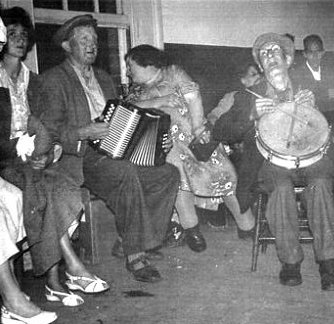
There is more to the disc than Herbert Smith though. Thirty tracks in total, although one is a snippet of Smith demonstrating his tuning – and the fact that he tuned his fiddle a tone low, which does not seem to have been an unusual practice. (13) Of further dance tunes we have a very sprightly Yarmouth Hornpipe on mouth organ, played by Leslie Lawson, the same tune also given here by Percy Brown, with ‘Shrimp’ Davies step dancing. Percy Brown, a melodeon player who lived near Aylsham, (14) was of course another musician who has exerted great influence on the Revival, although probably not through these recordings. (15) His muscular and rhythmic playing was much in demand to accompany dancing, and particularly step dancing.(16) He also sings the light Kitty Gray and, to finish off the CD, gives us Sheringham Breakdown, in conjunction with fellow melodeon player Bob Thompson, to accompany an un-named step dancer. Bob Thompson does not seem to have any tracks released elsewhere and remains a less well-known figure, although the late step dancer Richard Davies of Cromer remembered him playing. Here he also gives us an alternative (and perhaps more usual) Heel and Toe Polka. A third melodeon player – showcasing what was undoubtedly the region’s most common instrument for pub music and to accompany step dancing – is Albert Hewitt, father of renowned step dancer Dick Hewitt, and certainly no slouch himself as dancer and musician. Here we have the Southrepps Hornpipe (17) and The Breakdown, as given – actually Sheringham Breakdown again. All three show their prowess as dance musicians, Thompson and Brown with similar styles on two-row instruments and Hewitt more austere with his one-row playing. Step dancing really needs to be seen, of course, to be experienced properly, but the two step dance tracks work very well, the CD ending on a spirited note as a step dancer comes in about half way through the track. It’s a shame we aren’t told who they are.
As well as the instrumental music, there are also ten songs, as well as a short track of Herbert Smith talking about singing contests locally. Phil Hamond of Morston, a blind ex-army major, gives us Still I Love Him, accompanied by his own melodeon, and the unaccompanied The Foggy Dew. His rich dialect-inflected singing somewhat belies his background and social status. (18) The Foggy Dew is common enough in East Anglia; Hammond’s tune is quite unusual for this well-known song. Neville Grout of Cromer sings the emigration song Castle Gardens, to melodeon accompaniment, although the notes don’t state whether it’s his own. (On aural evidence it doesn’t appear to be.) This proceeds at a leisurely lilt, a track slightly marred by a bit of pitch fluctuation. Blakeney’s Billy Dickerson gives us the locally-composed The Young Girls of Blakeney, a fanciful paean to the girls of the village. The remainder of the tracks seem to have been recorded in Southrepps and some were undoubtedly taken down by Seamus Ennis on his visit there in 1956. (19) Sid Load gives us the sly and once-popular Rap-a-Tap-Tap (Farmer’s Servant), one song broadcast in As I Roved Out in January 1955. (20) He certainly relishes the story in the song. Leslie Bane gives us a steady and clear The Dark-Eyed Sailor and Faithful Sailor Boy, both perennial East Anglian favourites; an excerpt of the former was also broadcast in January 1955, in the same programme. Another track given here which was broadcast as above was Leslie Lawson’s magnificently paced The Dolphin. Finally we have a couple of tracks certainly recorded by Seamus Ennis – he took many songs, although often just fragments, from brothers Harry and Ben Baxter in Southrepps Vernon Arms – the latter was the landlord. Here Harry Baxter gives us a soft-voiced Blow the Candle Out and then both brothers perform a rousing In Scarborough, a rare example of unison singing from the area.
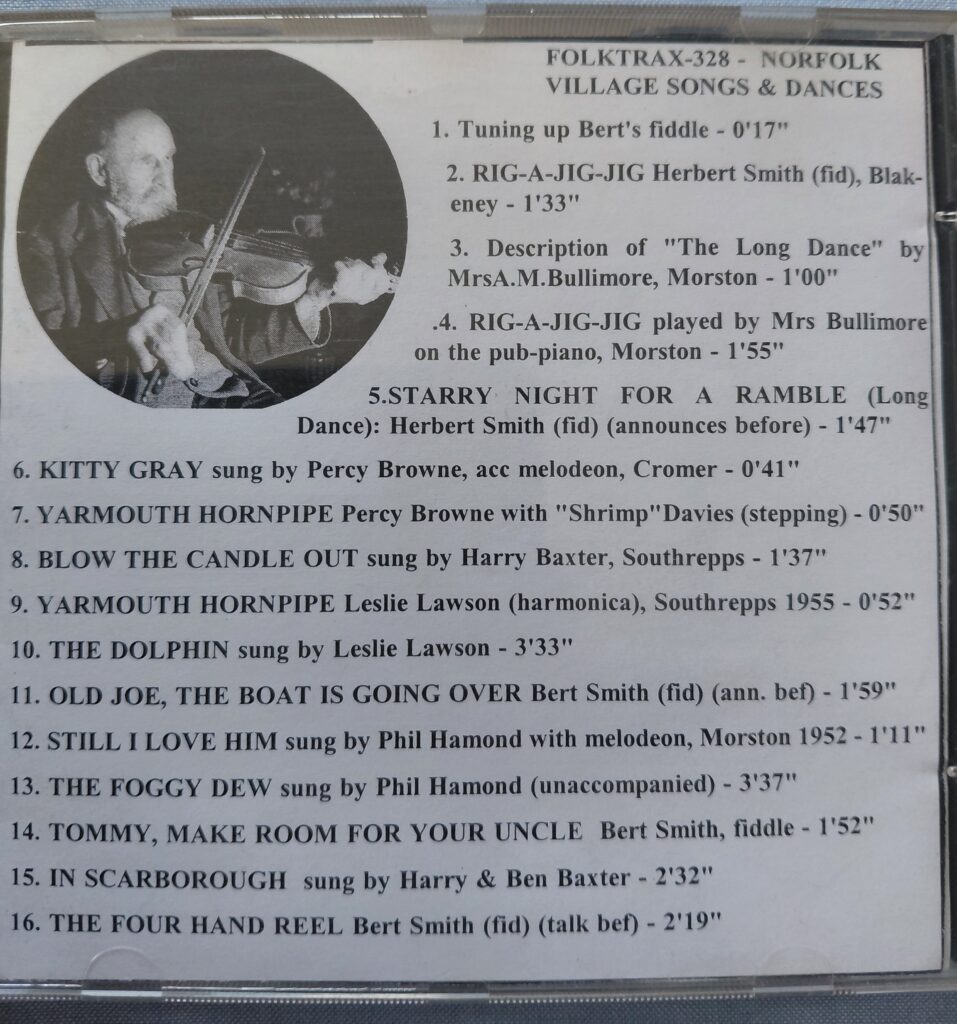
So, Norfolk Village Songs and Dances gives us a wonderful selection of music recorded in the 1950s, a time when there were still a great many practitioners in evidence, even if elderly. It is of course just a tiny fraction of the material collected in the British Isles at the time. There are three volumes devoted to Harry Cox, for instance, to give a local example. This disc, running at a little under an hour, gives us a supreme collection of music from this tradition in north Norfolk. It is a crying shame that it has never had a ‘proper’ release with presentation and notes of which it is worthy. An example of the shoddy packaging is that the monochrome inlay contains a picture of a fiddler, but it isn’t even Herbert Smith. When asked about it, Peter Kennedy admitted that he was just looking for a suitable photo, didn’t have one of Smith or any of the other performers, and so used one of Lincolnshire fiddler James Fussey. (21) That requires no further comment as to the respect accorded the material. More importantly, the disc has been long unavailable and Topic Records seem to have stopped their reissue programme years ago. One can only surmise that there just isn’t sufficient interest in the material in this country to warrant the expense of packaging it properly and reissuing it in a form worthy of the material. In some places, box sets of discs of such material might be issued, with weighty booklets of information to accompany them – Yazoo Records’ 7 CD set of Kentucky Mountain Music springs to mind as an example of such specialist-interest material (22), but there are many others – but sadly there does not seem to be much interest in England’s traditional musical heritage, apart from the relatively small amount of aficionados, and so I strongly suspect that the material will remain unissued.
Be that as it may, this is a superlative recording. The Herbert Smith tracks are essential and all of it is wonderful stuff. In lieu of any alternative at present, find someone who has a copy of this gem and ask them to make you a copy!
Chris Holderness August 2026
Notes:
1. The album was first released as a cassette and then, in expanded form, as Ftx 328. No date given.
2. Broadcast on 02.01.55. A copy of most of it is in the Russell Wortley Collection in the British Library. See: Chris Holderness: MT221: Southrepps: Singing and step dancing in a north Norfolk village (27.01.09) mustard.mainlynorfolk.info for more details.
3. Six releases of Peter Kennedy material were released, some multiple CDs, under the editorship of Reg Hall, as an extension of Topic’s Voice of the People series. 4. Words are given at tunearch.org/wiki/Annotation:Rig-a-jig.
5. See: Chris Holderness: MT179: Herbert Smith: Fiddling Blacksmith of Blakeney (08.08.06) – as 2 above – for details of Herbert Smith’s life.
6. Mentioned in The Traditional Tune Archive, as 4 above.
7. A recording is on The Old Hat Concert Party OH1CD (1999 – CD reissue) 8. Oak: Welcome to Our Fair Topic 12TS212 (1971)
9. The Old Swan Band recorded Starry Night… as Starry Night For a Randy on No Reels Free Reed FRR 011 (1976), mishearing, according to Rod Stradling, Herbert Smith’s title.
10. The Old Swan Band also recorded Blakeney Hornpipe as Blakeney Breakdown on No Reels, as 9 above. Rod Stradling told me that the only way he could get the recordings
originally was by sneaking a tape recorder into Cecil Sharp House; Jim Eldon recorded The Four Hand Reel on The Brid Fiddler Stick SDCD003 (2004 – CD reissue). 11. Herbert Smith’s Polka was recorded by Webb’s Wonders on Bob Davenport: Down the Long Road Topic 12TS274 (1975); Tufty Swift: How to Make a Bakewell Tart Free Reed FRR 017 (1977).
12. For more details about Herbert Smith’s playing and that of other East Anglian fiddlers see: Chris Holderness: The Devil’s Box in the East – Traditional Fiddle Playing in Norfolk and Suffolk (08/24) www.eatmt.org.uk.
13. Another example is Herefordshire fiddler Stephen Baldwin: English Village Fiddler Leader LED 2068 (1976) and Here’s One You’ll Like, I Think MTCD334 (2005). 14. See: Chris Holderness: MT211: Percy Brown: Aylsham melodeon player (30.11.07) – as 2 above – for details of his life and music.
15. Some tracks of Percy Brown’s playing were included on English Country Music from East Anglia Topic 12TS229 (1973). This was very influential – reviewed in a previous newsletter.
16. See: MT211, as 14 above, and Chris Holderness: MT291: The dancing Davies: Step dancing fishermen of Cromer (11.02.14) – as 2 above – for more information about step dancing in the area.
17. The names of Yarmouth Hornpipe and Sheringham Breakdown seem very long-standing and widely-used in the area. It’s unclear whether Blakeney Hornpipe and Southrepps Hornpipe were equally so, or added by the collectors. Katie Howson plays a version of the latter on The Old Hat Concert Party – as 7 above – where she calls it Albert Hewitt’s Hornpipe.
18. See: Chris Holderness: MT198: Billy Lown and Philip Hamond: two north Norfolk singers (01.02.07) – as 2, above – for information about Phil Hamond.
19. Full details given in Chris Holderness: MT221, as 2 above. The article contains photographs of Seamus Ennis collecting in the pub; Ben and Harry Baxter can be heard more fully on As I Roved Out: Songs from Norfolk: Ben and Harry Baxter (Folktrax Ftx 234).
20. More details of the broadcast of 02.03.55 are given in Chris Holderness: MT221, as 2 and 19, above.
21. James Fussey’s playing can be heard on Folklife Feasts and Customs of Cambridge and the Fens (Folktrax Ftx 423).
22. Various: Kentucky Mountain Music (Classic Recordings of the 1920s and 1930s) Yazoo 2200 (2003).